Introduction
This article uses 10 Pretty Villages in England as reading practice. It focuses on language, not travel planning. Each village is studied carefully.
For English learners, the goal is clear: better reading and vocabulary. The text uses UK place descriptions. It pays attention to details for descriptive writing.
Each village section is for close reading. It has concrete nouns, measured adjectives, and clear links. After the passages, there are language notes, a word list, and tasks to check meaning.
There’s also guidance on reading skills and grammar patterns. A set of Reading Comprehension Questions and a Speaking Prompt are included. These are great for ESL/EFL reading in classes or on your own.
Key takeaways
- The text frames 10 Pretty Villages in England as reading practice rather than a travel guide.
- It supports English reading comprehension through short, structured village passages.
- Vocabulary building is reinforced with a focused list drawn from the same descriptions.
- UK place descriptions are used to model descriptive writing with precise, concrete language.
- Reading skills and grammar noticing appear alongside the main passages for clearer analysis.
- ESL/EFL reading tasks include Reading Comprehension Questions and a Speaking Prompt for follow-up.
How to Use This Reading Practice
This reading practice uses short village passages to build accuracy and fluency. It offers a clear way to improve reading comprehension without rushing. The focus is on meaning first, then detail, then language.
The village details come from a travel overview of rural England. Places like Bibury and Robin Hood’s Bay are featured, based on prettiest villages in England. These passages are treated as study texts, showing how description, history, and place names work together.
Recommended reading approach for learners
A steady sequence supports an English learner reading routine and keeps the task manageable. On the first read, focus on the general sense: location, key features, and tone. On the second read, look for facts such as dates, landmarks, and relationships between ideas.
On the third read, the text becomes material for active reading strategies. Notice language patterns, precise nouns, and descriptive modifiers. This split helps separate understanding the passage from analysing how it is written.
How to annotate for meaning and inference
Annotation for inference works best when notes are simple and consistent. Mark explicit details as what the text states, and implied meaning as what it suggests. This makes it easier to justify an interpretation later, using evidence on the page.
Cohesive devices are also worth marking because they signal how ideas connect. Contrast markers (such as however), time markers (such as later), and cause markers (such as therefore) often change the direction of a paragraph. These signals guide readers towards stronger inferences.
Tracking new lexis with a vocabulary log
Lexis means vocabulary in use: single words, set phrases, and common pairings. A vocabulary log supports lexis tracking by keeping new items tied to context, rather than stored as isolated definitions. It also makes review quicker before speaking or writing tasks.
The entries below illustrate what to record from each passage, with a plain definition and a short example. This prepares readers for later work with key vocabulary, grammar noticing, and comprehension tasks.
| What to record | Why it helps comprehension | Example entry from a village passage |
|---|---|---|
| Word or phrase (as written) | Preserves the exact form seen in the text, aiding recall during rereading. | cobbled streets |
| Plain-English meaning | Reduces confusion and supports quick checking during close reading. | streets made from small rounded stones |
| Example sentence (copied or lightly shortened) | Keeps meaning linked to context, which strengthens retention. | The village is known for cobbled streets and old cottages. |
| Collocations (common word partners) | Improves natural phrasing and speeds up reading by chunking. | cobbled lane, cobbled path, narrow street |
| Word family (related forms) | Expands range without extra memorisation, useful for writing tasks. | cobble (verb), cobblestone (noun) |
- Which details in a passage are stated directly, and which require annotation for inference?
- Which cohesive devices change the meaning of a paragraph most, and why?
- How do active reading strategies differ between the first read and the third read?
- Which vocabulary log entries lead to faster lexis tracking during rereading?
- How does an English learner reading routine change when attention shifts from facts to language?
What Makes a Village ‘Pretty’ in English Contexts
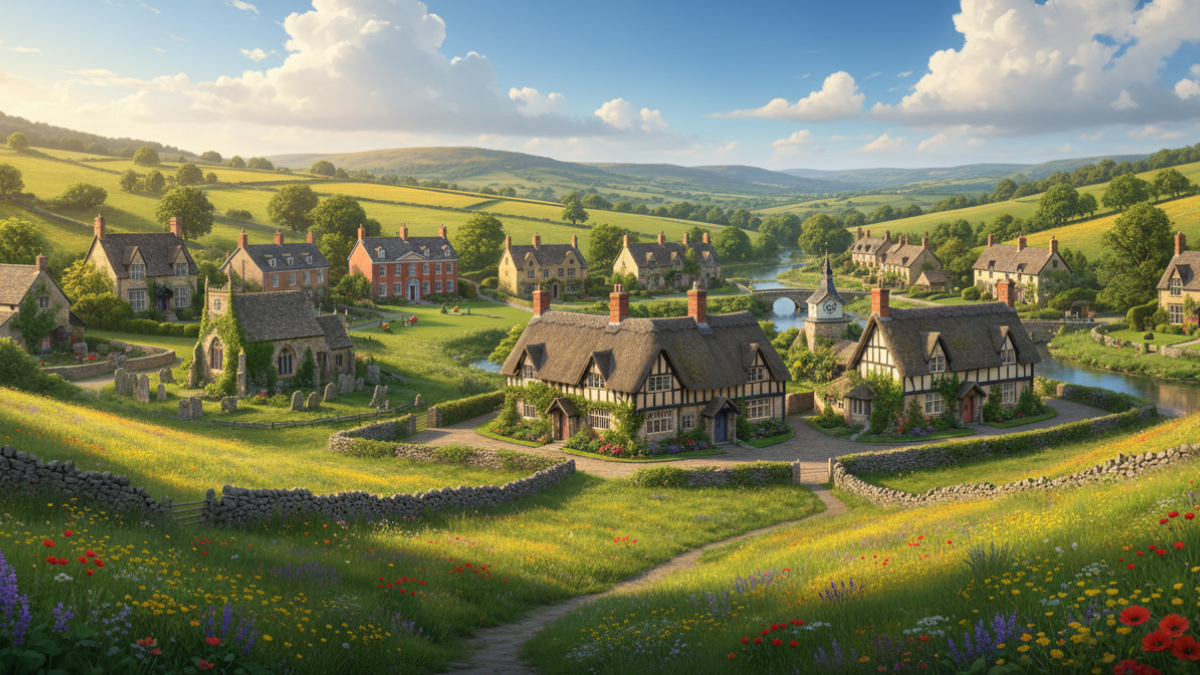
In English writing, “pretty” is a simple term, not a grand statement. It’s about small, noticeable choices like balanced designs and calm colours. A village’s beauty also depends on its setting, like where it meets fields or a river.
Writers use specific words to describe villages. They talk about flint walls, red brick, and timber frames. They also mention rooflines and windows. These details help readers imagine the village easily.
UK rural settlements often have certain features. These include a central area, a short high street, and a village green. Footpaths and hedgerows make it easy to explore. A church tower or a small bridge can be a landmark.
| Detail type | Typical words used | What the words help the reader notice |
|---|---|---|
| Building materials | flint, limestone, red brick, slate, thatch | Surface, colour, and local character without overstatement |
| Street shape | lane, bend, junction, cul-de-sac, verge | How movement works on foot and where views open or close |
| Shared spaces | green, common, churchyard, square, noticeboard | Where community life appears and how the centre feels defined |
| Edges and boundaries | hedgerow, stone wall, stream, meadow, footpath | How the village meets farmland, water, and open ground |
“Pretty” is shaped by culture, as it’s chosen carefully. Writers pick a few key words and leave the rest out. This makes the description vivid and avoids exaggeration.
- Which nouns in the table feel most specific, and why?
- How do landscape and architecture terms change the clarity of a description?
- Which UK rural settlement features suggest a clear centre, and which suggest an edge?
- In one paragraph of a village text, which adjectives seem factual and which seem evaluative?
10 Pretty Villages in England
In this text, we explore 10 pretty villages in England. Each village is described briefly and consistently. This helps us compare them and learn about English places.
Village profile format used in this text
Every village profile is structured the same way. This makes it easy for readers to know what to look for. We start with where the village is, then describe its setting and built environment.
Next, we talk about the community spaces. A small detail about the season or senses is added. This makes the text more engaging and encourages readers to think critically.
| Profile element | What it covers | Typical language signals | Reading skill it supports |
|---|---|---|---|
| Location context | County, nearby city, or wider region | in, near, on the edge of | Orientation and gist |
| Setting | Hills, river valley, coastline, woodland | above, along, at the foot of | Visualisation from text |
| Built environment | Materials, rooflines, lanes, boundaries | flint, brick, stone, timber | Detail spotting and accuracy |
| Community spaces | Green, high street, churchyard, footpaths | by the green, through the churchyard | Mapping and cohesion |
| Reflective line | A hint that invites inference | seems, suggests, as if | Inference and tone |
Shared features to notice while reading
Many villages are surrounded by a green or a short high street. Others are shaped by rivers, ridges, or coastlines. This changes the scenery and pace.
Look for footpaths, commons, and small bridges. These connect lanes to fields. Signs of age, like boundary walls and church towers, are common.
Repeating certain features makes it easier to track and compare. It helps us see how villages use space and scale differently.
Language focus: descriptive details and precise nouns
The text uses descriptive language that is clear. It focuses on specific nouns like flint wall and cobbled lane. This makes the descriptions vivid.
Adjectives add depth without making the text too long. Words like narrow and weathered enhance the image.
Reading this text closely helps us learn English place vocabulary. Small differences between profiles become clear.
- Practice point: underline precise nouns that name materials, boundaries, and routes.
- Practice point: note how descriptive language changes when the setting moves from river valley to coast.
- Practice point: compare two close reading passages and list the shared place terms.
- Which profile element makes the setting easiest to picture, and why?
- What repeated place terms appear across several villages, and what do they signal about layout?
- How do precise nouns reduce the need for long descriptions?
- Where does the text invite inference, rather than giving a direct statement?
- Which items of English place vocabulary seem most useful for describing a town or neighbourhood in the United States?
Village Reading Passages for Close Reading
These close reading passages are set up as core texts for careful rereading. A first read supports gist, while later reads support detail and language noticing. The same lines can be marked for place, form, and time, without rushing to interpret.

Landscape and setting: language for place
Each passage builds orientation through landscape vocabulary that fixes the reader in space. Words like valley, ridge, stream, lane, and boundary act as steady reference points. Prepositions and short location phrases help track movement, distance, and edge.
Attention also falls on how viewpoints shift. A lane can “dip”, a stream can “run beside”, and a ridge can “rise beyond”. These small choices shape how a setting is mapped in the mind.
Architecture and materials: stone, brick, timber, flint
Descriptions of buildings give repeated practice with architecture materials vocabulary. Stone, brick, timber, and flint appear as plain nouns, then gain meaning through texture, colour, and pattern. A wall may read as “rough”, “pale”, or “banded”, depending on material and light.
This lexis matters because built-environment terms recur across British writing. Materials are often linked to local character and visual effect, rather than claims about travel or lifestyle.
Community spaces: greens, high streets, footpaths, commons
Shared places add concrete anchors for reading. The village green high street can frame services, meeting points, and everyday movement. In the same way, a footpath and common can signal access, boundaries, and social use of open land.
These features also recycle settlement vocabulary at a steady pace. Learners see how civic terms sit next to simple directions, creating clear, testable meaning in context.
Seasonal change: how writers signal time and atmosphere
Time is often suggested, not stated, through seasonal descriptive writing. Markers such as morning light, winter frost, and late-afternoon shade help readers infer season and mood from evidence. Brief sensory cues, kept restrained, support attention to tone without overloading the sentence.
| Focus in the passage | Typical signals on the page | What the reader can track |
|---|---|---|
| Place and orientation | landscape vocabulary; boundary, ridge, lane; prepositions like across and beyond | Direction, viewpoint, and spatial relationships |
| Built environment detail | architecture materials vocabulary; stone, brick, timber, flint; texture and colour adjectives | Surface, age cues, and regional feel in description |
| Public space and settlement terms | village green high street; footpath and common; nouns for routes and meeting places | How communities are organised and described |
| Time and atmosphere | seasonal descriptive writing; light, frost, shade; mild sensory detail | Season inference and shifts in tone across lines |
- Which single noun does most work in setting the scene, and why?
- How do prepositions change the reader’s sense of distance and direction?
- What does one material word suggest about a building’s look or age, based on nearby adjectives?
- How does a village green high street differ from a footpath and common in function within the description?
- Which time marker is strongest, and what evidence supports that reading?
Key Vocabulary from the Text
This key vocabulary from the text is grouped for easy spotting and reuse. It includes place and geography words, settlement vocabulary, countryside vocabulary, and adjective nuance. Plus, common collocations and word families are included.
US readers might notice some label differences. In British English, a village green and a parish church have special meanings. A high street is the main shopping street, unlike “Main Street”.
Place and geography vocabulary
Place and geography words map the village setting in simple layers. Landforms like valley, slope, ridge, bank, and verge help find a lane or footpath easily.
- Directional and position: at the edge of, beyond, opposite, uphill, downhill, along, across, towards
- Spatial nouns: bend, crossing, lane, track, boundary, corner, approach
Buildings and settlement vocabulary
Settlement vocabulary names what is built and how it’s arranged. A cottage, terrace, boundary wall, parish church, village green, and high street often appear together. They show a compact centre and a quieter edge.
These terms also show density and layout. A cluster of cottages suggests a small nucleus. A row of terraces hints at a longer street line and closer spacing.
Nature and countryside vocabulary
Countryside vocabulary combines with movement and sound. Hedgerow, meadow, stream, and woodland are frequent. They link well with verbs like runs, winds, crosses, and borders.
Nature description often uses calm detail. A narrow stream, a winding footpath, or a weathered gate can anchor the scene with clear, factual texture.
Adjectives for tone and nuance
Adjective nuance separates neutral description from opinion. Words like narrow, winding, modest, and weathered add precision. They avoid overstatement.
In village writing, tone often depends on restraint. A quiet lane, a sheltered valley, or a neat boundary wall can feel vivid. This is because the adjectives stay specific.
Word families, collocations, and useful chunks
Collocations and useful chunks support fluent reading by repeating across passages. Word families also help: settle, settlement, settled; wood, woodland, wooded; nation, national; vary, varied, variation.
| Focus | Useful chunk | Typical pairing | What it helps describe |
|---|---|---|---|
| Layout | lined with | lined with cottages / lined with trees | Street character and building rhythm |
| Contrast | set against | set against a ridge / set against woodland | Background and wider landscape shape |
| Density | a cluster of | a cluster of cottages / a cluster of shops | How buildings gather in the centre |
| Position | at the edge of | at the edge of a meadow / at the edge of the village | Transitions between settlement and countryside |
| Route | leads to | a footpath leads to the stream | Movement through place and geography words |
- High-frequency pairing: winding lane, narrow path, weathered stone, modest cottage, quiet green
- Settlement pattern: the village centre, the edge of the village, a row of terraces, a boundary wall
Reading Skills Focus: Skimming, Scanning, and Close Reading
Improving comprehension skills means changing pace with purpose. Skimming, scanning, and close reading work together. They help learners manage gist vs detail effectively.
Skimming helps catch the main topic and first impression. It focuses on headings, opening sentences, and repeated nouns. This quick scan gives a clear idea of the passage’s main points.
Scanning is more focused. It looks for specific details like building materials and landscape features. This method is quick and helps find facts without reading every word.
Close reading is slower and deeper. It looks for implied meanings and uses reference words like “this” and “those”. This method uses short phrases to support inferences about the atmosphere or season.
| Mode | Main aim in the village passages | What to look at first | Typical details found | How it supports later tasks |
|---|---|---|---|---|
| Skimming | Build an overview of setting and overall impression | Headings, opening lines, repeated nouns, place references | Key locations, dominant features, broad tone | Helps frame gist responses and prevents off-topic answers |
| Scanning | Locate precise information quickly | Named materials, numbers, time markers, proper nouns, punctuation cues | Stone or timber, river or ridge, green or high street, seasonal signals | Supports factual recall and efficient checking during timed reading |
| Close reading | Explain how language creates meaning and effect | Linking words, reference chains, descriptive clusters, sentence patterns | Contrast, cause, viewpoint, implied mood, careful description | Builds text evidence for inference and strengthens comprehension skills |
These strategies are key for later Reading Comprehension Questions. They help learners handle gist vs detail well. Skimming, scanning, and close reading make it easier to justify answers by linking observations to text evidence.
- Which repeated nouns signal the setting most clearly during skimming?
- When scanning, which details are easiest to miss: materials, landscape features, community spaces, or time markers?
- In close reading, which reference words create the most confusion, and why?
- What is one phrase that can serve as text evidence for a change in season or atmosphere?
- How do gist vs detail questions test different comprehension skills in the same passage?
Grammar and Sentence Patterns to Notice
In these village passages, grammar is seen as careful noticing, not just rules. This way, reading and writing become clearer and steadier. Grammar for description often hides in everyday sentence choices. Small changes in word order, punctuation, and detail can greatly alter how a scene is pictured.
Prepositions of place and movement
Prepositions of place help a reader build a mental map. Look for patterns like along a lane, across a bridge, beyond the green, between cottages, through a gate, and towards the river. These choices show distance, direction, and boundaries without adding extra sentences.
When movement is implied, the same forms often do double work. A footpath can run through a field and then bend towards higher ground. This gives a sense of route as well as location. This is why prepositions of place are crucial in place writing.
Relative clauses for added detail
Relative clauses add detail in a compact way, especially when the writer wants to stay focused on the main view. A phrase like “a lane that runs behind the church” keeps the sentence moving while adding a clear extra fact. Commas also matter: a non-defining clause, set off by commas, reads like an aside, while a defining clause narrows meaning.
In close reading, notice what each relative clause selects or limits. It may point to a feature a visitor would need to identify, such as “the footbridge that crosses the stream”, rather than any bridge in the area. Used well, relative clauses reduce repetition and keep description tidy.
Participles and expanded noun phrases
Participles often compress information that might otherwise need a second sentence. Phrases like “cottages lined with stone planters” or “a terrace overlooking the valley” pack action and viewpoint into a single unit. This keeps pace steady and helps the reader hold the scene together.
Expanded noun phrases build precision by stacking details in a controlled order. Consider how “a low flint wall topped with weathered coping stones” names the object, then adds texture and finish. In grammar for description, these expansions are useful because they specify what is seen, where it is, and what it is like.
Comparatives and hedging for careful description
Comparatives shape judgement without sounding absolute. A high street may be “quieter than the main road” or a lane “narrower than it appears on a map”, which creates contrast and helps the reader weigh options. These comparatives often sit near place details, so the comparison feels grounded.
Hedging language keeps the tone measured and realistic. Words such as rather, somewhat, and “tends to” can soften claims about atmosphere, size, or pace, especially when a writer cannot guarantee the same experience for every visitor. In combination, comparatives and hedging language support careful description that still feels specific.
| Pattern | Typical form in description | What the reader gains |
|---|---|---|
| Prepositions of place | “across the stream”, “between the cottages”, “towards the hill” | Clear spatial relations and a stronger sense of route |
| Relative clauses | “a path that leads to the common”, “the square, which is edged by shops” | Extra detail without breaking the main sentence |
| Participles | “lined with beech”, “overlooking the harbour”, “painted in pale tones” | Compressed information and smoother flow |
| Expanded noun phrases | “a narrow cobbled lane with uneven stones”, “a small green framed by oaks” | Greater specificity and sharper imagery |
| Comparatives with hedging language | “somewhat quieter than”, “rather more open than”, “tends to feel brighter than” | Balanced evaluation that avoids overstatement |
- Which prepositions of place appear most often near water, bridges, or field edges, and why might that be?
- How do relative clauses change the pace of a sentence compared with a full second sentence?
- Where do participles add viewpoint (such as “overlooking”), and what do they imply about the observer’s position?
- Which expanded noun phrases add texture, and which add location, and how can they be told apart?
- How do comparatives and hedging language work together to keep a description precise without sounding fixed?
Reading Comprehension Questions
These reading comprehension questions test how well you follow village profiles at different levels. They start with broad meaning, then move to precise details, and finally to making inferences with evidence. The goal is to focus on what the passages say and how the words shape our understanding.

Gist questions for overall understanding
- Which village profile shows a busy centre, and which is quiet?
- What is the main setting in the passage: coast, valley, upland, or riverside? State the choice and one phrase that supports it.
- Across the ten profiles, what mood appears most often: calm, brisk, or formal? Use a short quote to justify the choice.
Detail questions for factual recall
- List two building materials mentioned in the profile and match each one to the building it describes.
- Identify one community space named in the passage (for example, a green, a high street, a footpath, or a common) and note what happens there.
- What landscape feature is named nearest to the village (such as a ridge, stream, meadow, or lane)? Copy the exact wording.
Inference questions using textual evidence
- What season is implied, even if it is not stated? Give inference with evidence by quoting one sensory detail (light, weather, colour, or sound).
- What can be inferred about how the village layout fits the land (for example, clustered, stretched along a road, or stepping down a slope)? Support the claim with one phrase.
- What does the passage suggest about visitors: encouraged, managed, or discouraged? Answer using one line that signals rules, routes, or pace.
Vocabulary-in-context questions
- Choose one descriptive adjective from the passage and explain its meaning using nearby nouns; keep the answer tied to vocabulary in context.
- Find a near-synonym pair (for example, narrow and tight, or quiet and still). Explain the difference the writer creates.
- Pick one phrase that describes colour or texture and paraphrase it without changing the sense.
Short writing responses based on the passages
- Write 2–3 sentences that summarise one profile using gist and detail questions as a plan. Include one place noun and one relative clause.
- Write 3 sentences that compare two villages, using one quoted detail from each passage as support.
- Write a short writing responses paragraph (40–60 words) that recreates the atmosphere of one setting, reusing two key adjectives from the text.
| Question type | What it checks | Evidence to use from the passage | Typical answer length |
|---|---|---|---|
| Gist and detail questions | Main idea, overall setting, and the strongest organising impression | One short phrase naming place, movement, or mood | 1–2 sentences |
| Detail recall | Accurate retrieval of stated facts (materials, features, named spaces) | Exact nouns and noun phrases, copied with care | Bullet list or 1–2 sentences |
| Inference with evidence | Reasoned reading beyond what is stated, without guessing | Quoted sensory details and layout clues that support the inference | 2–3 sentences |
| Vocabulary in context | Meaning shaped by nearby words, tone, and collocation | Adjectives linked to the nouns they modify, plus a brief paraphrase | 1–2 sentences |
| Short writing responses | Controlled writing that stays close to the text and mirrors its patterns | Two reused terms from the passage and one accurate quoted detail | 40–60 words |
Speaking Prompt
This speaking prompt helps turn reading into clear, organised talk. It works well in pairs, small groups, or alone. It keeps the focus on what the text actually says.
For speaking practice, pick one village passage and highlight two or three precise details. Look for a mix of material, setting, and community space. Use these details to explain how the writer builds the scene.
Keep the talk neutral by using evidence-based speaking. Use phrases like the passage notes and the description suggests to signal sources. For extra support, check Cotswolds itinerary details for place references.
When comparing, stay careful and specific. Use comparatives and hedging like slightly quieter and more enclosed. This helps the listener follow your reasoning and avoids overstatement.
| Move in the talk | Language frame | Evidence to point to |
|---|---|---|
| Identify the focus | This passage foregrounds the setting and street layout. | Two nouns for place (lane, river, green) and one modifier (gentle, winding). |
| Add a concrete detail | The text describes materials used in buildings. | One material (stone, brick, timber, flint) plus a colour or texture term. |
| Compare with another village | Compared with the other passage, this one is more / less specific. | One shared feature (church, pub, bridge) and one contrast in setting. |
| Qualify the claim | It appears / it may be / it seems the writer is signalling season. | A time marker (July, spring light) or atmosphere term (quiet, busy). |
- Which two details from the passage best support evidence-based speaking about place?
- What descriptive language speaking choices make the village feel calm, busy, or remote?
- Which comparison is more accurate, and why: prettier or more carefully described?
- What did the writer include about community spaces, and what did they leave out?
Extension Activities for Classroom or Self-Study
These activities help learners control meaning, detail, and tone. They focus on close reading and careful language. This is especially helpful for learners in the United States, as it supports clear place language.
Summarising each village in one or two sentences
Summarising is best when each sentence has one main idea. A good summary picks out the setting, a visual detail, and a community feature. It leaves out repeated points.
Accuracy is key. Place names, directions, and materials should match the passage.
Comparing villages using evidence from the text
Comparing texts is clearer when based on specific words from the passages. Learners can compare building materials, street layout, and landscape cues. They support each point with a short quote or paraphrase.
This method avoids vague claims and keeps comparisons verifiable.
| Feature to compare | Evidence to look for in the passages | Language frame for comparing texts |
|---|---|---|
| Setting and landscape | Mentions of river, valley, hill, coast, woodland, or open fields | Both passages describe the setting, but one highlights a wider view while the other focuses on enclosed lanes. |
| Architecture and materials | References to stone, brick, timber framing, flint, slate, thatch, or painted render | One village is linked to heavier materials, whereas the other is described with lighter surfaces and sharper contrasts. |
| Layout and movement | Clues such as green, high street, footpath, bridge, market square, or steep lane | The text suggests a more linear route in one place, while the other reads as a compact centre with short paths. |
| Sound and atmosphere | Details about quiet, traffic, birdsong, water, or seasonal change | Compared with the calmer tone in one passage, the other includes more movement and everyday sounds. |
Creating a descriptive paragraph with target vocabulary
Descriptive paragraphs improve with the right vocabulary. Use nouns for place, material, and adjectives for detail. Include words like this, that, and these to avoid repetition.
Expanded noun phrases can add detail without long sentences.
Mini research task: verifying details with reliable sources
Verifying information helps learners distinguish stated facts from assumptions. Reliable sources literacy can be developed by checking a few factual points. Use Ordnance Survey mapping, Historic England entries, local council pages, and Encyclopaedia Britannica for background.
- Choose two claims from a passage that can be checked, then record the exact wording before searching.
- Confirm each claim in at least one dependable reference, noting what matches and what needs careful wording.
- Rewrite the original claim so it remains accurate, specific, and consistent with the text’s meaning.
If you enjoy discovering the charm of the countryside, you might also like exploring the capital from a different perspective. In our article Explore London: Reading Practice About 8 Hidden Gems in the UK, you will uncover lesser-known places across the city while continuing to develop your reading skills and cultural awareness. It’s a perfect complement to your journey through the most beautiful villages in England.
Conclusion
This reading practice conclusion ties together village themes in short, focused texts. Each passage is seen as a source of meaning, not just a travel description. The article also provides a vocabulary and comprehension recap to support steady review.
The material focuses on descriptive language learning. It shows how nouns, place terms, and building words are chosen carefully. Repeated exposure to these patterns helps readers notice how detail is carried in small phrases.
Reading strategies are covered in a structured way. From skimming for gist to scanning for facts and close reading for nuance, each step is explained. Grammar points are framed as noticing tasks, making patterns easier to recognise in context.
The approach is useful beyond villages. It works for nature writing, local history excerpts, and architectural descriptions too. Used consistently, it keeps descriptive language learning grounded in text, with an evidence-based interpretation guiding inference.
FAQ
What is the main purpose of “10 Pretty Villages in England” as a reading text?
This text is for reading practice. It uses village descriptions for close reading. It helps with reading comprehension, vocabulary, and understanding descriptive language.
How should the passages be read to improve comprehension and vocabulary?
Read in three steps: gist, details, and language noticing. This method helps learners understand the meaning first. Then, they can focus on the words and sentence structure.
What does “pretty” mean in English descriptions of villages?
“Pretty” in village descriptions means visually appealing. It refers to traditional buildings, a human-scale layout, and natural surroundings. Features like village greens and hedgerows are also included.
What kinds of vocabulary appear most often in the village profiles?
The text often uses specific words for places and geography. It includes terms for settlements and the countryside. Time and sensory details also help infer the season and atmosphere.
How does the text help learners distinguish facts from inference?
It teaches learners to annotate and separate facts from implied meaning. They learn to spot cohesive devices and track reference words. This helps answer questions about mood and season.
What grammar and sentence patterns are most relevant for this type of descriptive writing?
Important patterns include prepositions and relative clauses. Participles and careful comparisons add detail without exaggeration. These patterns help with clarity and precision.
How can a vocabulary log make learning more effective?
A vocabulary log records words in context. It includes definitions, example sentences, and common collocations. This improves recall and fluency.



1 thought on “10 Pretty Villages in England: Reading Practice with Vocabulary and Comprehension”