
Introduction
Ever wondered why some learners seem to effortlessly expand their vocabulary while others struggle? What if you could unlock this secret power for yourself?
This guide helps B1 to C1 level students improve their English skills through targeted word formation exercises. Mastering how words are built is crucial for exams like B2 First and C1 Advanced.

We focus on using roots, prefixes, and suffixes to create new terms. Our collection includes twenty practice tasks divided by difficulty level.
You’ll find helpful tips and clear examples to guide your learning. Building this skill helps you guess meanings intuitively, even with unfamiliar vocabulary.
All content draws from reliable sources like Cambridge English materials. We’ve designed everything to be friendly, supportive, and genuinely helpful for your journey.
Key Takeaways
- Word formation is an essential component of Cambridge-style Use of English.
- Prefixes and suffixes dramatically expand your vocabulary range
- Practice builds confidence in guessing unfamiliar word forms
- Exercises are levelled from intermediate to advanced difficulty
- Reliable exam preparation materials inform our content
- Regular practice leads to noticeable improvement in language skills
What is Word Formation and Why Is It Important?
What if you could build your vocabulary like constructing with building blocks? This process of creating new terms by modifying existing ones is called word formation. It involves adding prefixes or suffixes to root words to create different forms and meanings.
This skill becomes particularly crucial in major English exams. In tests like B2 First and C1 Advanced, it forms a significant part of the Use of English section. Candidates must transform root words to fit grammatical and contextual requirements.
Consider this example: from ‘protect’ you might create ‘protective’ or ‘protection’ depending on the sentence structure. This demonstrates how word formation works in practical testing situations.
Mastering this ability offers tremendous benefits beyond exam success. It dramatically expands your expressive range and comprehension skills. You’ll find yourself understanding complex texts more easily and expressing ideas with greater precision.
Regular practice helps you recognise common patterns and affixes almost instinctively. You’ll start decoding unfamiliar terms without needing dictionary support. This intuitive guessing ability becomes second nature with consistent effort.
| Exam Component | Weightage | Skills Tested |
|---|---|---|
| Use of English: Word Formation | 20-25% | Vocabulary range, grammatical accuracy |
| Reading Comprehension | 30-35% | Text understanding, inference skills |
| Listening | 20-25% | Audio comprehension, context clues |
| Writing | 20-25% | Expression, structure, vocabulary use |
Many learners find that understanding word formation actually improves their overall grammar knowledge. Since you’re working with different parts of speech, you naturally learn how nouns, verbs, and adjectives function in sentences.
The confidence boost from mastering this skill is remarkable. You’ll approach both written and spoken English with greater assurance. Higher exam scores become achievable when you can manipulate word forms effectively.
Rather than viewing this as a daunting challenge, see it as an exciting puzzle. Each root word offers multiple possibilities for creation and transformation. With practice, you’ll find it increasingly rewarding and even enjoyable.
Investing time in developing this skill is essential for progression from intermediate to advanced levels. The benefits extend far beyond examination rooms into real-world communication. Your entire language journey becomes smoother and more successful.
Understanding Prefixes and Suffixes
Have you ever noticed how small changes to words can completely transform their meaning? These powerful building blocks – prefixes and suffixes – are the secret weapons for expanding your language skills. Mastering them opens doors to understanding thousands of new terms without memorising each one individually.
Prefixes attach to the beginning of root words, altering their core meaning. Suffixes join at the end, changing the word’s grammatical function. Together, they form an efficient system for vocabulary growth that’s particularly valuable for exam preparation.
1) Negative Prefixes (which one should I choose?)
| Meaning | Prefix | Before… | Examples |
|---|---|---|---|
| not / opposite | un- | wide, general use (esp. Germanic bases) | unhappy, unfair, unclear |
| wrong(ly) | mis- | verbs | misunderstand, misplace, misinform |
| not / absence | non- | nouns/adjectives (often formal) | nonfiction, nonexistent |
| not / opposite | in- | Latinate bases (default form) | inaccurate, inactive |
| not / opposite | im- | before m, p | impossible, immature |
| not / opposite | il- | before l | illegal, illiterate |
| not / opposite | ir- | before r | irregular, irrelevant |
2) Meaning Prefixes (time, amount, movement)
| Function | Prefix | Meaning | Examples |
|---|---|---|---|
| repetition/again | re- | again/back | rewrite, reconsider |
| before | pre- | earlier | preview, preschool |
| after | post- | later/after | postwar, postgraduate |
| under / too little | under- | insufficiently | underestimate, underpaid |
| over / too much | over- | excessively | overcook, overconfident |
| across / beyond | trans- | across/change | transform, transatlantic |
| self | auto- | self/itself | autocorrect, autobiography |

Common Prefixes to Know
Several prefixes appear frequently in English assessments. The ‘un-‘ prefix typically indicates negation, turning ‘happy’ into ‘unhappy’. ‘Dis-‘ serves a similar purpose, creating opposites like ‘agree’ becoming ‘disagree’.
‘Re-‘ suggests repetition or return, as seen in ‘write’ transforming to ‘rewrite’. ‘Pre-‘ indicates something occurring before, making ‘view’ into ‘preview’. These patterns help you decode unfamiliar terms during timed tests.
Other essential prefixes include ‘mis-‘ for incorrect actions (‘understand’ to ‘misunderstand’) and ‘non-‘ for absence (‘fiction’ to ‘nonfiction’). Recognising these quickly becomes second nature with practice.
“Prefixes are like signposts—they give you immediate clues about a word’s direction and meaning.”
Essential Suffixes and Their Uses
Suffixes work differently by changing a word’s grammatical category. The ‘-tion’ suffix often creates nouns from verbs, turning ‘educate’ into ‘education’. ‘-Able’ typically forms adjectives, making ‘comfort’ become ‘comfortable’.
Adverbs frequently use ‘-ly’, transforming ‘quick’ into ‘quickly’. Other important suffixes include ‘-ment’ for nouns (‘develop’ to ‘development’) and ‘-ise/-ize’ for verbs (‘organisation’ to ‘organise’).
Adjective-forming suffixes like ‘-ful’ and ‘-less’ create opposites: ‘hopeful’ versus ‘hopeless’. Understanding these patterns helps you choose the correct word form for any context.
When unsure during an exam, try common suffixes like ‘-ive’ for adjectives or ‘-ness’ for nouns. Always consider whether the context requires a positive or negative meaning, and determine the needed grammatical category.
For comprehensive guidance on these patterns, explore this detailed resource on prefixes and suffixes from recognised educational materials.
3) Suffixes by Word Class
| Target Class | Common Suffixes | Examples | Exam Note |
|---|---|---|---|
| Noun | -tion/-sion, -ment, -ness, -ity, -ance/-ence, -ship, -er/-or | educate→education; decide→decision; develop→development; happy→happiness; possible→possibility; differ→difference; lead→leader | watch -tion/-sion & -ance/-ence |
| Adjective | -able/-ible, -al, -ive, -ous, -ful, -less, -ic/-ical | rely→reliable; access→accessible; centre→central; create→creative; danger→dangerous; hope→hopeful; power→powerless; economy→economic/ical | economic vs economical |
| Adverb | -ly, -ward(s) | quick→quickly; after→afterwards | mind truly (no e) |
| Verb | -ise, -en, -ify | modern→modernise; strength→strengthen; simple→simplify | UK style: organise/recognise |
Prefixes and suffixes often work together beautifully. From ‘happy’, we can create ‘unhappiness’ using both ‘un-‘ and ‘-ness’. These combinations regularly appear in advanced assessments.
Memorising high-frequency affixes proves crucial for FCE and CAE success. Regular identification practice in texts builds your recognition speed and accuracy.
This knowledge extends beyond examinations into daily communication. You’ll find vocabulary acquisition becomes more efficient and even enjoyable when you understand how words connect.
Remember: mastering these elements provides solid groundwork for tackling the practice activities ahead. You’ll approach them with greater confidence and skill.
4) Word Families (train the “required class”)
| Root | Noun | Verb | Adjective | Adverb |
|---|---|---|---|---|
| analyse | analysis | analyse | analytical | analytically |
| create | creation / creativity | create | creative | creatively |
| breadth/breathe | breadth | breathe | broad / breathtaking | broadly |
| power | power / powerlessness | empower | powerful / powerless | powerfully |
| persuade | persuasion | persuade | persuasive | persuasively |
| theory | theory | theorise | theoretical | theoretically |
5) Spelling Shifts & Irregulars (cheatsheet)
- final -y → -i-: happy → happiness; rely → reliable
- drop final -e: use → usable; create → creation (but: change → changeable)
- true → truly, argue → argument, judge → judgment (both forms seen)
- -ic/-ical: economic (related to economy), economical (thrifty/practical)
- Irregular nouns: long→length; wide→width; strong→strength; deep→depth
Strategies That Boost Your Score
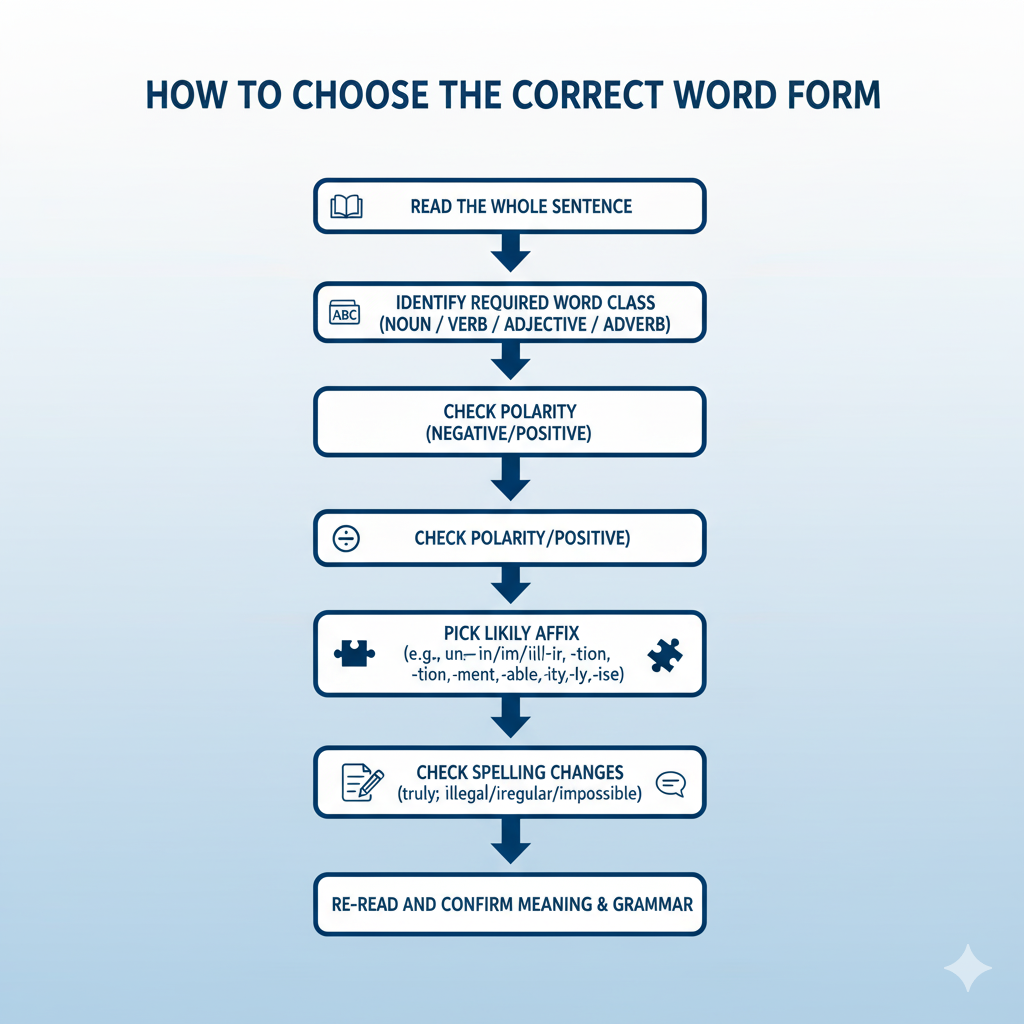
- Scan first to identify the required word class.
- Check polarity (positive/negative): friendly vs unfriendly.
- Beware of spelling traps: truly, ill-/ir-/im- patterns.
- Build a personal list of high-frequency affixes and irregulars.
- After filling, re-read: does the form fit grammar and meaning?
20 Word Formation Exercises for Practice
Ready to put your knowledge into action? These carefully selected activities give you hands-on experience with vocabulary building. They progress from foundational to advanced levels, matching common exam formats.
Each task focuses on practical application rather than rote memorisation. You’ll develop instincts for recognising patterns and choosing appropriate forms. This approach builds both confidence and competence.
We’ve organised them into three clear categories based on proficiency levels. Start with activities matching your current skills, then progress to more challenging ones. Regular practice creates noticeable improvement in your abilities.
B1 Level Word Formation Exercises
Begin your journey with these foundational activities. They focus on basic conversions using common prefixes and suffixes. You’ll transform nouns into adjectives and verbs into adverbs.
Simple patterns like adding ‘-ful’ to create ‘hopeful’ from ‘hope’ appear frequently. Similarly, ‘-ly’ turns adjectives into adverbs like ‘quick’ becoming ‘quickly’. These transformations build your core understanding.
Example activities include converting ‘sun’ to ‘sunny’ or ‘friend’ to ‘friendly’. You’ll also practise making opposites using ‘un-‘ as in ‘happy’ to ‘unhappy’. These exercises establish strong fundamentals.
Completing word charts helps reinforce different forms. For ‘analyse’, you’d work with ‘analysis’ (noun), ‘analyse’ (verb), ‘analytical’ (adjective), and ‘analytically’ (adverb). This systematic approach develops versatility.
These initial tasks prepare you for more complex challenges ahead. They’re designed to be approachable yet effective for skill development.
B1 Exercises (1–8)
- This soup is quite ______ for a winter day. (HEART)
- Please be ______ when handling the glass vases. (CARE)
- The new policy was ______ by most employees. (SUPPORT)
- My phone is totally ______; I forgot to charge it. (POWER)
- She spoke so ______ that everyone understood the instructions. (CLEAR)
- The view from the hill was ______. (BREATH)
- He answered the teacher ______ because he was nervous. (POLITE)
- We need to ______ our plan before presenting it. (SIMPLE)
B2 First (FCE) Word Formation Exercises
At this level, activities directly mirror actual exam components. They draw from reliable Cambridge English materials to ensure authenticity. You’ll encounter tasks like FCE062 through FCE079.
In one typical exercise, you might see: “Ensure you have ______________ clothing on” with the root “protect”. The correct transformation is “protective”. This tests both vocabulary and grammatical awareness.
Exam strategies become crucial here. Always read the entire text for context before attempting answers. Determine whether the gap requires a noun, verb, adjective, or adverb.
Consider positive or negative meanings too. “Unfriendly” versus “competitiveness” demonstrates how affixes change connotations. Walkthrough videos for exercises like FCE062 provide valuable guidance.
These resources break down thought processes step by step. They show how experts approach each question systematically. This modelling helps develop your own problem-solving strategies.
“Context is king-always understand the full sentence before deciding on word forms.”
Additional exercises include FCE063 through FCE079, each focusing on different patterns. Consistent practice with these materials builds exam readiness effectively.
B2 First (FCE) Exercises (1–7)
- The coach’s methods improved the team’s overall ______. (PERFORM)
- There was strong public ______ to the proposed law. (OPPOSE)
- The film’s ______ message is about kindness. (CENTRE)
- The company aims to increase ______ by cutting waste. (EFFICIENT)
- She has a real ______ for languages and learns quickly. (ABLE)
- To avoid confusion, please read the guide ______. (THOROUGH)
- Their ______ in the project surprised the entire class. (INVOLVE)
C1 Advanced (CAE) Word Formation Exercises
Advanced learners tackle more sophisticated transformations here. Exercises CAE034 to CAE063 challenge your skills with complex vocabulary. They require deeper analytical thinking.
One example question might be: “After a difficult ________, Michael went on to be a successful lawyer” with the root “bring”. The solution is “upbringing”, demonstrating prefix usage.
When uncertain, try common affixes like “de-” or “-ive” that often appear at this level. Always consider both grammatical function and overall meaning within the passage.
The complexity increases, but so does the satisfaction upon mastery. These activities prepare you for high-level communication and examination success.
For further reference, explore concise, exam-aligned summaries of prefixes and suffixes from reputable sources. They offer extra examples and irregular patterns to add to your study list. See more: Cambridge English – Word Formation overview.
Systematic practice across all levels brings the greatest benefits. Start with B1, progress through B2, and conquer C1 activities. Your vocabulary range and exam scores will show marked improvement.
C1 Advanced (CAE) Exercises (1–5)
- The scientist offered a highly ______ explanation of the phenomenon. (THEORY)
- After years of ______, the painter finally gained recognition. (OBSCURE)
- The mayor’s speech was full of political ______. (RHETORIC)
- The committee found his argument ______ and well-supported by data. (PERSUADE)
- The solution must be both ______ and ethically sound. (PRACTICE)
Want to expand your grammar-in-action toolkit? Don’t miss our Phrasal Verbs English: 25 You’ll Hear in the UK—a practical, British-English guide packed with real-world examples and short activities to help you retain new chunks naturally.
Conclusion
You’ve now explored how prefixes and suffixes build vocabulary and boost exam success. Regular practice with our twenty targeted activities helps you master this skill.
Remember to use walkthrough videos and consider word categories. This approach improves your accuracy in gap-fill tasks and overall language use.
Keep revisiting challenging parts and celebrate progress. Your dedication will lead to higher scores and greater confidence in real-life communication.
For further practice, explore additional resources like Cambridge books. You’ve got this—keep building your skills!
FAQ
What is the best way to practise these exercises?
The best way is to work through them systematically, focusing on one level at a time. Always check your answers and make a note of any new words or patterns you discover to build your vocabulary.
I’m preparing for the Cambridge B2 First exam. Are these exercises useful?
Absolutely! A dedicated section for B2 First (FCE) word formation exercises is included, which is designed to mirror the style and challenge of the exam’s Use of English paper.
How can learning prefixes and suffixes improve my English?
Understanding these building blocks helps you decode unfamiliar words, dramatically expanding your vocabulary. It allows you to work out meanings and change word classes (e.g., from a verb to a noun) with much more confidence.
Where can I find the answers to check my work?
Answers are provided for all the practice exercises, so you can independently check your understanding and learn from any mistakes.



2 thoughts on “20 Word Formation Exercises for B1–C1 Learners: Master Prefixes and Suffixes”