Introduction
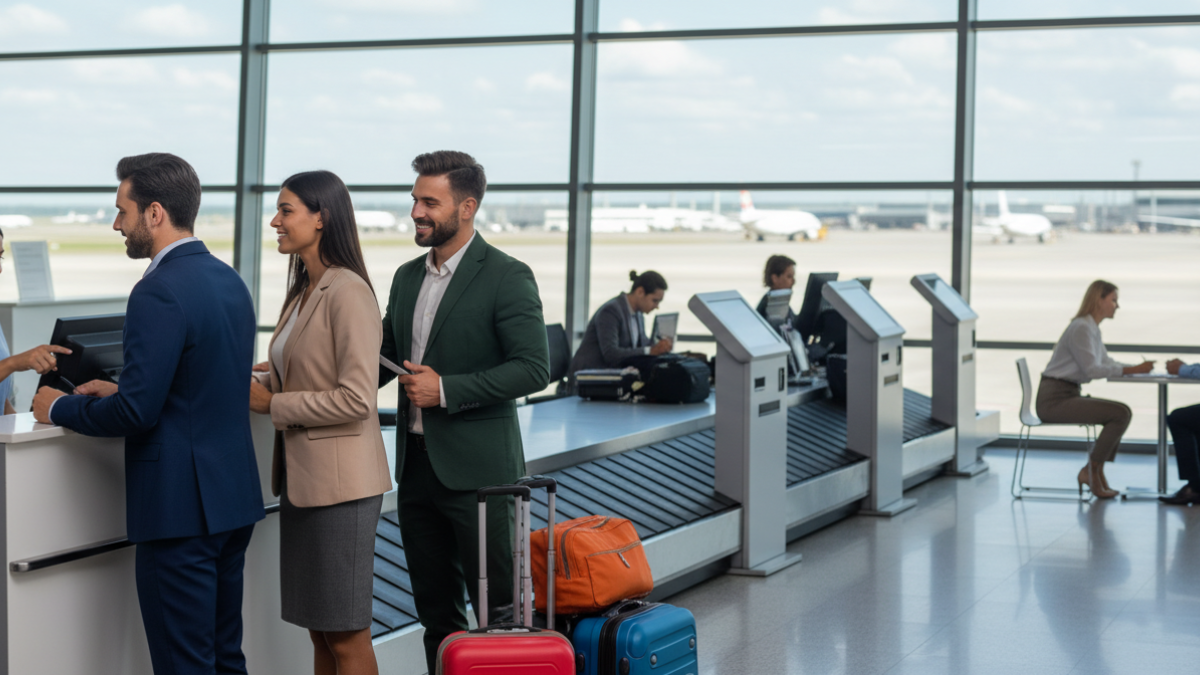
Airport Check-in English at B1 level is all about clear, useful talk. It’s for when you’re at airline counters, self-service kiosks, and bag drop points in the United States. It’s about the short chats that help you share important details and understand what staff need. You won’t need to worry about complex grammar or fast speech.
This guide is in a list format. It covers airline check-in phrases, typical questions, short airport check in dialogue models, and brief speaking tasks. It focuses on real travel communication, from confirming your booking to labelling your checked bag.
British English spelling and tone are used, but with common US airport terms. You’ll hear terms like boarding pass, carry-on, checked bag, and TSA. Plus, you’ll learn essential airport vocabulary to follow signs and instructions.
Travelling by air requires more than just a ticket — it requires confidence in communication. In this lesson, you’ll learn how to handle airport check-in conversations using clear and polite British English.
Key takeaways
By the end of this guide, you will be able to:
- understand common check-in questions
- respond appropriately to airport staff
- ask for seat preferences
- manage basic travel situations confidently
What to Expect When You Check in at the Airport in English
For many travellers in the United States, the first task is to check in at the airport in English. This can be at a staffed counter or on a screen. The process is straightforward: confirm your identity, match your booking, accept your luggage, and confirm your final destination and any connections.
The check-in area: counters, self-service kiosks, and bag drop
Most terminals have airline counters for full service and machines for quicker check-in. Travellers can print a boarding pass and luggage tags at self-service kiosks. Then, they can move on to bag drop, where staff take the suitcase and scan the tag.
Knowing basic bag drop vocabulary helps with quick handovers. Staff might ask about weight limits or where to place the case. The flow is designed to keep lines moving, so short answers are common. If a seat was not chosen earlier, the counter or kiosk may still offer seat selection during this step.
✈️ Airport Check-in: Key Vocabulary (Input Stage)
Here are essential expressions commonly used at the check-in desk:
- Passport – Official travel document
- Boarding pass – Document that allows you to enter the plane
- Baggage / Luggage – Bags you travel with
- Suitcase – Large travel bag
- Window seat / Aisle seat – Seat preference
- Departure time – Time the plane leaves
- Check in (verb) – To register for your flight
Example sentences:
- May I see your passport, please?
- Do you have any bags to check in?
- Would you prefer a window or an aisle seat?
- Your departure time is 14:35.
Common questions staff will ask you
At the counter or bag drop, staff often confirm the destination, the number of bags, and a contact detail. They might ask about safety rules, like liquids in hand luggage and lithium batteries. These questions can also appear on screens, so self-service kiosk English options may mirror the same wording.
Depending on the route, travellers may be asked about return or onward tickets. This supports entry rules for certain destinations and airline checks. In the airport check-in process, these questions are usually short and repeated in a set order.
What you may need to show: passport, visa, booking details
What is requested depends on whether the flight is domestic or international. For domestic US flights, a government-issued ID is commonly used. International travel typically involves a passport and, where needed, a visa or travel authorisation.
Booking details are also important, especially the booking reference, which may be called a confirmation number. If a loyalty account is used, frequent flyer information may be added during check-in. Having required travel documents ready can reduce pauses at the counter and make it easier to check in at the airport in English without repeating key details.
📝 Travel Practice – Check-in Simulation
✈️ Scenario
You are at the airport check-in desk. Your flight is to London and you have one suitcase.
🔎 Task 1 – Choose the Correct Option (Recognition)
- May I see your:
a) runway
b) passport
c) engine - Your flight departs from:
a) gate
b) belt
c) cockpit - Do you have any bags to:
a) board
b) check in
c) depart
✍️ Task 2 – Complete the Sentences (Controlled Practice)
Complete using: boarding pass – aisle – baggage – departure – suitcase
- May I see your __________, please?
- Do you prefer a window or __________ seat?
- What is the __________ time?
- Do you have any __________ to check in?
- Please place your __________ on the scale.
Airport Check-in English: Core B1 Phrases You’ll Use Every Time
In busy terminals, clear language is key. Airport Check-in English uses short, correct phrases. These are easy for staff to process quickly.
At the desk or kiosk, English is all about greetings and flight details. The phrases below help avoid common mistakes. This makes the process smoother.
Greeting and starting the check-in
- Hello. I’d like to check in, please.
- Good morning. I’m flying today and need to check in.
- Hi. Is this the queue for bag drop?
- Good afternoon. Here is my passport.
- Could you help me with the self-service kiosk, please?
Sharing your flight details clearly
- My full name is [first name] [surname], as on my passport.
- I’m flying to New York today.
- The airline is British Airways.
- My flight number is BA117.
- My booking reference is A1B2C3.
- My departure time is 19:30.
Confirming information and asking for clarification
Small checks reduce delays, especially when systems are busy. A short confirmation can prevent long corrections later. This is also useful when announcements are hard to hear.
- Could you spell that, please?
- My surname is spelt S-M-I-T-H.
- My date of birth is 14 May 1996.
- I have one suitcase to check and one cabin bag.
- Can you repeat the seat number, please?
- Sorry, what does “bag allowance” mean?
- Which gate is it, please?
- Is this a connection, or a direct flight?
- What does “oversize” mean for baggage?
Polite phrases for requests and problems
At a check-in counter, tone is neutral and respectful. Polite requests help when something is missing or unclear. These phrases keep the conversation moving without adding pressure.
| Situation | Polite B1 phrase | Why it helps |
|---|---|---|
| Kiosk will not scan a passport | Could you help me with the kiosk, please? | Signals a technical issue without blame, so staff can take over. |
| Booking cannot be found | It’s not coming up on the system. Could you check again, please? | Gives a clear problem statement and a simple next step. |
| Need to check a bag after online check-in | I’ve checked in online. Where do I drop my bag, please? | Shows current status and asks for location, which speeds up routing. |
| Unsure what to do after bag drop | What should I do next, please? | Prompts brief guidance on security, gates, and boarding order. |
| Seat or boarding details sound wrong | Sorry, could you confirm that seat and boarding time, please? | Creates a check point to catch mistakes before reaching the gate. |
English Phrases for Check in: Documents, Seats, and Special Requests
At the airport, clear language saves time. This set of English phrases for check in focuses on what staff need to hear first: documents, seating, and any support needs.
Talking about passports, visas, and travel authorisation
For passport and visa English, the goal is simple wording and quick confirmation. Useful lines include: “Here is my passport,” “My visa is in my passport,” and “My passport is valid until [month/year].”
For travel to the United States, some travellers use an approved ESTA under the Visa Waiver Program. Staff may ask: “Do you have an ESTA?” or “Can you show onward travel details?” Plain replies work well: “Yes, it is approved,” or “I have my return booking on my phone.”
Seat preferences: aisle, window, extra legroom
Seat preference English often comes down to three words: aisle, window, or middle. Common requests include: “Can I have an aisle seat, please?” and “Is there any extra legroom available?”
If seating together matters, short phrases help: “We are travelling together,” “Can we sit next to each other?” and “Can we be near the lavatories?” Agents may answer with availability language such as “only middle seats left” or “there is a fee for that seat.”
Special assistance and accessibility requests
When accessibility assistance airport services are needed, staff usually respond best to specific details. Clear options include: “I need wheelchair assistance,” “I have reduced mobility,” and “I need extra time to board.”
Communication needs can be stated plainly: “I am hard of hearing,” “Please speak slowly,” or “Could you write that down?” For tight connections, it can help to add: “I need more time for a terminal transfer.”
Travelling with children: basic phrases and vocabulary
For family travel airport English, staff may ask about ages, seating, and equipment. Simple phrases include: “This is our pushchair,” “We have a child seat,” and “The infant is on lap,” where that rule applies.
Other helpful lines are: “Can we board with family boarding?” and “Can we sit together, please?” If a bag contains baby items, a direct label often helps: “This bag is for baby supplies.”
| Scenario | Plain phrase (B1) | What staff may ask | Useful follow-up |
|---|---|---|---|
| Documents at the desk | “Here is my passport and booking details.” | “Do you have a visa or travel authorisation?” | “My visa is valid,” / “My ESTA is approved.” |
| Passport check | “My passport is valid until August 2029.” | “Is this your current passport?” | “Yes, it is my current passport.” |
| Onward travel proof | “I have a return flight confirmation.” | “Can you show onward travel information?” | “It is on my phone,” / “I can print it if needed.” |
| Seat request | “Can I have a window seat, please?” | “Aisle or window?” | “Window, if available,” / “Any extra legroom?” |
| Sitting together | “We are travelling together. Can we sit next to each other?” | “Do you want seats in the same row?” | “Yes, same row if possible.” |
| Accessibility support | “I need wheelchair assistance from check-in.” | “Do you need help to the gate?” | “Yes, and I need extra time for boarding.” |
| Hearing-related needs | “I am hard of hearing. Please speak slowly.” | “Do you need information in writing?” | “Yes, that would help.” |
| Travelling with children | “We have a pushchair and an infant on lap.” | “Will you check the pushchair at the gate?” | “Yes, please,” / “Can we use family boarding?” |
Airport Check in Dialogue Examples for Speaking Practice
These short models reflect the order and wording heard at many US airports. Each airport check in dialogue keeps turns brief. This allows B1 speaking practice to focus on clear details like flight, documents, bags, and timing.
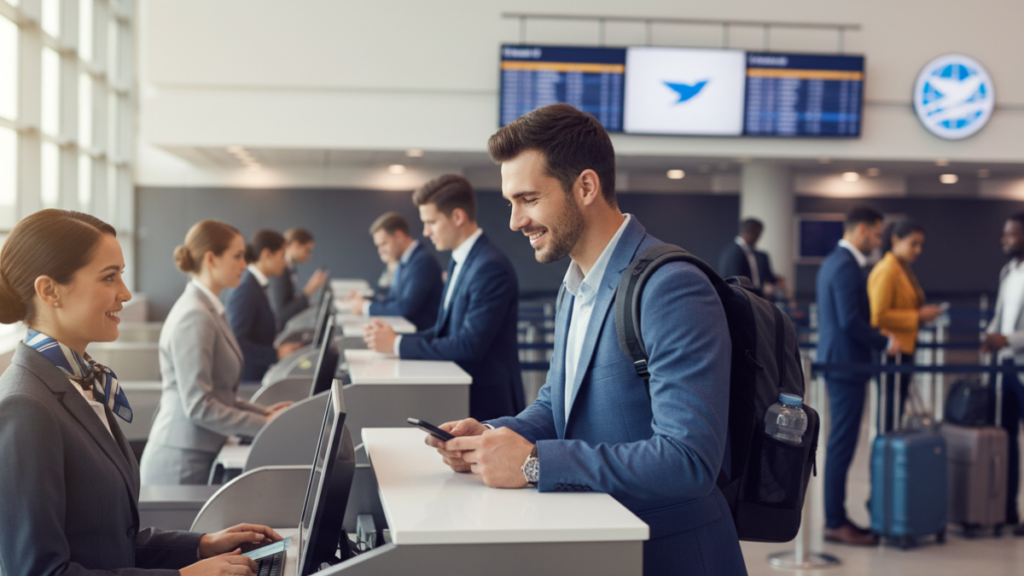
They also show how airline customer service English often sounds: polite, direct, and built around predictable questions. As Airport Check-in English goes, this type of check-in conversation English is usually steady in pace, even when the situation changes.
Dialogue at a staffed counter (standard check-in)
Agent: Good morning. May I see your passport, please?
Passenger: Yes. Here you are.
Agent: Thank you. What is your destination today?
Passenger: Chicago.
Agent: Great. How many bags are you checking in?
Passenger: One suitcase.
Agent: Please place it on the scale. Thank you. Would you like an aisle or a window seat?
Passenger: Aisle, if possible.
Agent: All set. Here is your boarding pass. Security is straight ahead, then follow signs for your gate.
Dialogue for bag drop after online check-in
Agent: Hello. Are you dropping a bag today?
Passenger: Yes. I checked in online.
Agent: Please scan your boarding pass here.
Passenger: Done.
Agent: Thank you. Attach this bag tag to the handle. Is this bag going to your final destination?
Passenger: Yes, to Seattle.
Agent: Great. Your bag is checked in. Keep this receipt until you collect it.
Dialogue for a missed connection or tight layover
Agent: Hi there. How can I help?
Passenger: My connecting flight is boarding soon. My first flight arrived late.
Agent: Understood. What is your flight number?
Passenger: It is on my boarding pass.
Agent: Thank you. Your gate has changed. The boarding time is 3:10, and the departure time is 3:40.
Passenger: If I miss it, what happens?
Agent: Please come back to this desk. We can look at the next available flight and rebooking options.
Dialogue for upgrade, standby, or seat change requests
Agent: Good afternoon. What can I do for you?
Passenger: Is an upgrade available today?
Agent: I can check. There may be a fee, depending on the fare.
Passenger: If there is no upgrade, can I change seats?
Agent: Yes. I can review seat availability. Would you prefer an aisle, a window, or extra legroom?
Passenger: Aisle, please. Also, can I be added to the standby list?
Agent: I can add you. If a seat opens, you will be called at the gate.
| Situation | Key question from staff | Clear passenger reply | Useful timing or process phrase |
|---|---|---|---|
| Staffed counter check-in | How many bags are you checking in? | One suitcase. | Place it on the scale. |
| Bag drop after online check-in | Is this bag going to your final destination? | Yes, to Seattle. | Keep this receipt until you collect it. |
| Tight connection | What is your flight number? | It is on my boarding pass. | The boarding time is earlier than the departure time. |
| Seat change or upgrade | Would you prefer an aisle or a window? | Aisle, if possible. | There may be a fee, depending on the fare. |
Across each check-in conversation English example, the language stays practical. It includes short requests, simple confirmations, and basic problem reporting. That is why Airport Check-in English works well as repeatable B1 speaking practice. It is especially helpful for travellers who want dependable airline customer service English at the counter and at bag drop.
💬 Model Dialogue (Input for Speaking)
Staff: Good afternoon. May I see your passport, please?
Passenger: Of course. Here you are.
Staff: Do you have any bags to check in?
Passenger: Yes, one suitcase.
Staff: Would you prefer a window or an aisle seat?
Passenger: A window seat, please.
Staff: Your boarding gate is 12 and boarding starts at 13:45.
Passenger: Thank you very much.
🗣 Task 3 – Mini Dialogue Practice (Guided Output)
Complete the dialogue:
Staff: May I see your passport, please?
Passenger: ____________________________.
Staff: Do you have any bags to check in?
Passenger: ____________________________.
Staff: Window or aisle seat?
Passenger: ____________________________.
Now practise reading the dialogue aloud.
Luggage and Baggage Vocabulary for Stress-free Check-in
Knowing the right baggage vocabulary in English makes travel easier. It helps you understand signs, talk to staff, and use screens at busy airports in the United States. At the counter or kiosk, it’s important to know the difference between checked and carry-on bags. Each has its own rules and screening steps.
A checked bag goes in the aircraft hold. A carry-on bag stays with you in the cabin. A personal item is small and fits under the seat. You might use a suitcase, backpack, duffel bag, or garment bag, depending on your trip and packing style.
Airline screens show how much you can carry. They list the number, weight, and size limits. If your bag is too heavy or large, it might be called overweight or oversize.
Signs are clear and helpful. “Bag drop” points to where you hand over checked items. “Oversize/Overweight baggage” shows where to go for big cases and sports gear. “Baggage claim” is where you pick up your luggage, and “TSA screening” is for certain items.
When talking about your bag, use words like hard-shell and soft-sided. Mention wheels, handles, locks, and zips. If your bag was damaged before, say so. For special items like sports gear or musical instruments, use specific terms.
Restricted items are talked about briefly. Things like lithium batteries and liquids have their own rules. Staff might ask you to declare certain items during screening.
| Term seen or heard | What it refers to | Where it comes up | Related phrase |
|---|---|---|---|
| Checked bag / checked baggage | Luggage handed to the airline for the aircraft hold | Counter, kiosk, bag drop belt | “One checked bag, please.” |
| Carry-on bag | Main cabin bag kept with the passenger | Gate, cabin baggage sizing frame | “This is my carry-on.” |
| Personal item | Smaller cabin item that fits under the seat | Check-in and boarding checks | “The backpack is my personal item.” |
| Baggage allowance | The number, weight, and size permitted by the fare | Booking summary, check-in screen | “What is the baggage allowance?” |
| Weight limit / size limit | Maximum allowed weight or dimensions for a bag | Scales, measuring frames, receipts | “It is within the limit.” |
| Excess / overweight / oversize | Bag exceeds allowance by count, weight, or size | Payment desk, special handling lane | “It is marked as overweight.” |
| Fragile | Handling label for breakable contents | Staffed counters, manual tag print | “Could it have a fragile tag?” |
| Bag drop / baggage claim | Hand-off point for checked items / collection area on arrival | Departure hall / arrivals hall | “Where is baggage claim?” |
Common Problems at Check-in and How to Respond in English
Many travellers in the United States face airport check-in problems. These include quick questions, long queues, and airline rules. Speaking clearly and calmly helps, even with complex issues.
For a quick refresher on English phrases for check in, this short guide can support last-minute practice: English phrases for airport conversations.
Overweight or oversized baggage
When a bag is over the limit, staff will tell you the weight and options. You can say: “It weighs 24 kilos. Is that over the allowance?” or “Can items be moved to my carry-on?”
Oversized items might go to a special desk. If there’s a cost, terms like overweight fee, oversize fee, and extra bag are used.
“Could you confirm the weight limit for this ticket, please?”
Name mismatch, expired passport, or missing documents
Checks often match the booking to your passport or ID. If your middle name is missing, staff might update the ticket or ask for more documents.
For international trips, expiry dates and visa details can lead to more questions. Being precise in English is key: “My passport expires in July. Is that valid for entry?” or “The ticket shows one surname; the passport shows two.”
Flight delay, cancellation, or rebooking
When flights are delayed or cancelled, new times and gates are often given. If a delay affects a connection, keep your language factual: “The inbound flight was delayed. What are my options for the connection?”
For rebooking, common phrases include “Can I be rebooked on the next available flight?” and “Could you print an updated boarding pass?” Staff might talk about standby, itinerary, and voucher depending on the airline and route.
Payment issues and extra fees
Extra charges can include seat selection, changes to the booking, or baggage fees English travellers might not expect. Payment problems often relate to card type, billing postcode, or a declined transaction.
Clear English phrases for check in can reduce confusion at the terminal: “What is the total amount, including taxes and fees?” and “Which payment methods are accepted here?” Asking for a receipt can also help with later claims or employer expense forms.
| Situation | Helpful wording | Key detail to confirm | Likely next step |
|---|---|---|---|
| Bag over the weight limit | “Is there a fee for this weight?” | Exact allowance in kilos or pounds | Pay at counter or move items between bags |
| Oversized item (sports gear or large box) | “Where is the oversize drop?” | Size rules and handling process | Directed to oversize belt or separate desk |
| Name mismatch on ticket and passport | “The booking name is slightly different. Can you check it?” | Spelling, middle name, and surname order | Agent verifies identity or advises on correction |
| Delay causes a missed connection | “I will miss the connection. Can you rebook me?” | Next available flight and connection time | Rebooking English conversation; new boarding pass issued |
| Extra charges at the desk | “Can you confirm the total before I pay?” | baggage fees English itemisation and currency | Payment taken, receipt offered, baggage tagged |
B1 Speaking Practice: Pronunciation, Fluency, and Confidence Tips
When practicing B1 speaking at the airport, focus on being clear rather than perfect grammar. At busy check-in areas, staff need to hear names, flight numbers, and other key details clearly. This is crucial because of the noise and rush.
Some sounds can be tricky for travel English. Spelling out surnames letter by letter helps avoid mistakes. It’s also important to distinguish between numbers like 13 and 30. Saying times like “eight fifteen” and “eighteen fifty” clearly is key.
Practicing common words from documents and signs is helpful. Words like passport, visa, terminal, and boarding pass are short but important. Saying them clearly, with a brief pause, can help others understand better.
For B1 level English, keep it simple. Short sentences and phrases help. Pauses are good for checking details without losing the flow. Asking short questions keeps the conversation polite and accurate.
- “Could you repeat that, please?” to verify a question
- “Let me check the booking reference.” to pause naturally
- “Is that correct?” to confirm a detail
Using the NATO phonetic alphabet can help with spelling. It’s used in travel and can be clearer than regular spelling. This method reduces misunderstandings and saves time.
| Check-in detail | What can go wrong | Clarity strategy used in Airport Check-in English practice | Example wording |
|---|---|---|---|
| Surname spelling | Letters sound similar over noise (B/P, D/T) | Spell slowly; switch to NATO terms when needed | “It’s B as in Bravo, A as in Alpha, R as in Romeo.” |
| Booking reference | Fast speech causes missing characters | Group characters; pause between groups; repeat once | “The reference is K7M… pause… 2QF.” |
| Numbers (bags, seats, gates) | 13 vs 30, 15 vs 50, and similar pairs | Stress the final sound; add a short check question | “One three, thirteen. Is that what you heard?” |
| Times and dates | 8:15 vs 18:50 confusion; mixed date formats | Say time clearly; add “a.m./p.m.” if relevant; state month in words | “Eighteen fifty, six fifty p.m., on 12 March.” |
| Document terms | Key word is missed or merged in a longer sentence | Pause before the key term; keep the sentence short | “Here is my passport. I also have a visa.” |
Being confident means controlling the conversation. Speak calmly, politely, and let the other person respond. This way, your pronunciation will be practical and your interactions will be smooth.
Quick Listening and Speaking Drills You Can Do Before Your Flight
Check-in at airports is fast, whether at counters or kiosks. Quick drills can help keep up and avoid missing important details. These exercises focus on key words like passport, bags, final destination, and seat.
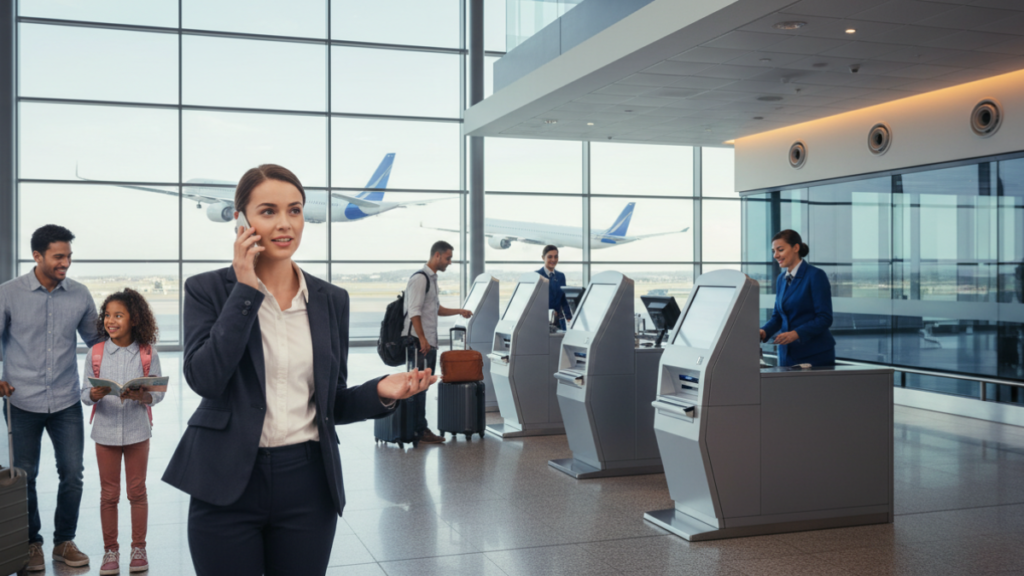
For more phrases that fit real US airport settings, check out this travel English vocabulary for airport phrases guide. It helps reinforce what you hear at counters, bag drops, and gates.
Shadowing practice with short check-in sentences
Shadowing means repeating what you hear right after, keeping the same rhythm. It’s great for airport English because staff often use clear patterns and prompts.
- “Good morning. I’d like to check in for my flight to Rome.”
- “This is my passport and my ticket.”
- “I have one carry on and one bag to check.”
- “Can I have a window seat?”
- “What’s my boarding time?”
- “Is this my final destination or do I change planes?”
For listening practice, focus on catching key nouns first (like passport, boarding pass, gate number). Then, repeat the whole sentence smoothly.
Role-play prompts: passenger and agent
Role plays at check-in work best with predictable questions and short answers. The same dialogue can be used with small changes to keep the language flowing smoothly under pressure.
| Prompt type | Agent says | Passenger replies | Keywords to listen for |
|---|---|---|---|
| Document check | “Please have your identification ready. Can I see your passport?” | “Yes. Here is my passport. I’m travelling to Rome.” | passport, identification, destination |
| Bag count and size | “How many bags are you checking today?” | “One suitcase to check and one carry on bag.” | check, carry on, suitcase |
| Seat request | “Do you prefer a window seat or an aisle seat?” | “A window seat, please, if it’s available.” | window, aisle, available |
| Connection check | “Is this flight direct, or do you have a layover?” | “I have a layover. My final destination is Rome.” | direct, layover, final destination |
| Gate and boarding | “Your gate number is on the screen. Boarding starts at 18:10.” | “Thank you. I’ll double-check the gate number.” | gate number, boarding, time |
Timed answers for typical check-in questions
Timed drills mimic the speed of real check-in. Answer quickly in one sentence within five seconds. This helps with B1 speaking practice and avoids delays.
- “What is your final destination?” → “My final destination is Rome.”
- “What is your flight number?” → “My flight number is 118.”
- “How many bags do you have?” → “I have one carry on and one bag to check.”
- “Do you want a window or aisle seat?” → “An aisle seat, please.”
- “Do you have any liquids or gels?” → “Yes, small toiletries in a clear bag.”
In airport listening practice, staff often repeat the same nouns and numbers. At check-in, listening for these first helps keep conversations short and clear.
🎭 Task 4 – Role-Play Simulation (Free Output)
Work in pairs.
Student A: Airline staff
Student B: Passenger travelling to London
Include:
- greeting
- passport request
- baggage
- seat preference
- boarding time
Keep the conversation polite and natural.
✈️ Improve Your Airport Communication Further
If you’d like to go beyond check-in conversations and master airport communication as a whole, explore our complete guide British English for Airports. This pillar article covers essential vocabulary, real-life dialogues and listening practice to help you navigate every stage of your journey with confidence — from arrivals to boarding.
✅ Reflection
Answer in one sentence:
What expressions from this lesson would help you feel more confident at the airport?
Conclusion
Airport Check-in English works best when travellers know the steps. This includes what happens at the counter, self-service kiosks, and bag drop. The process is usually the same: confirm identity, match flight details, and handle bags and seats.
Clear, short answers help avoid mistakes and speed up the process. The key English phrases for check in are similar across US airports. They cover names, destinations, dates, and baggage limits.
Phrases like “Could you repeat that?” or “Is that correct?” are also common. This article also discussed document language, including passport checks, visas, and travel authorisation. It also covered seat requests like aisle, window, or extra legroom.
Realistic dialogue examples showed how brief conversations sound in busy terminals. This includes standard check-in, bag drop after online check-in, and seat changes. Vocabulary for luggage and baggage was included, like carry-on, checked bag, oversized items, and weight allowance.
Common problems were also discussed, such as name mismatches, missing documents, delays, and extra fees. B1 speaking practice and listening drills were suggested to improve fluency before travel.
The main communication priorities are accuracy in personal and flight details. Travellers should make calm requests and politely check information when needed. The goal is to help travellers check in at the airport in English with better preparation. This is without assuming any specific airline, route, or traveller situation.
FAQ
What does “Airport Check-in English (B1)” cover?
It covers the English used at airport check-in points. This includes airline counters and bag drop areas. It uses short phrases for clear communication.
What questions do staff usually ask during check-in?
Staff ask for the destination and flight number. They also ask about bags and if any items need to be declared.
What documents may be needed for check-in in the United States?
For domestic flights, an ID is needed. For international flights, a passport and visa are required. Travel authorisation like ESTA may also be checked.
What is the difference between online check-in, a kiosk, and a staffed counter?
Online check-in is done before arriving. A kiosk prints a boarding pass. A staffed counter handles document checks and complex bookings.
What luggage words are most important at the check-in desk?
Key terms include “checked baggage” and “carry-on bag”. Useful words also include “baggage allowance” and “weight limit”.
What is the difference between “boarding time” and “departure time”?
“Boarding time” is when passengers start entering the aircraft. “Departure time” is when the flight leaves the gate.



5 thoughts on “Airport Check-in English (B1): Speaking Practice and Useful Phrases”