
Introduction
English pronouns may seem small, but they are crucial for meaning, clarity, and tone. This guide takes you from basic recognition at A1 to mastering them in formal and academic writing at C1. It’s made for Brazilian learners, linking to common Portuguese patterns.
This pronouns page follows a clear sequence: short explanations, examples, error correction, and answers. It builds towards mixed practice and classroom use. This way, learners can go from knowing rules to applying them in real situations.
First, we cover the basics: subject, object, and possessive forms. Then, we move on to more complex pronouns like relative and indefinite ones. Each step helps avoid common mistakes from Portuguese, focusing on formality, omission, and word order.

Key takeaways
- This pronoun guide A1–C1 covers beginner to advanced control in speech and writing.
- The ESL pronouns module uses a workbook flow: explain, practise, correct, and check answers.
- English grammar for Brazilian learners is addressed directly, with Portuguese-to-English transfer issues.
- The pronouns in English tutorial starts with core forms, then moves to more complex pronoun systems.
- English pronouns are taught for accuracy, clarity, and register, not only for test scores.
- The module prepares learners for real use: conversation, study, and classroom routines.
Orientation: what pronouns are and what you will learn
Before we dive into lists, let’s understand what pronouns are. They are small words that make sentences clear and natural. They help avoid repetition, keeping the focus on the message.
Definition of English pronouns (A1–C1 scope)
Pronouns are simple at first glance. They replace nouns, making our language more efficient. At higher levels, they manage references across paragraphs, not just sentences.
They also carry important grammar signals. Some show who is speaking or how many (I, you, we). Others show gender (he, she) or stay neutral (they). There are also forms for possession (mine), self-reference (myself), and linking (who, which, that).
As we move through levels A1 to C1, our skills grow. We learn to control tone, distance, and punctuation. This means going from basic questions to precise choices in complex sentences.
Learning goals for Brazilian learners
For Brazilian learners, mastering pronouns is key. It helps with reading speed and writing accuracy. This pronouns page aims to improve sentence control and advanced text references.
- Use subject and object pronouns accurately in simple statements and questions.
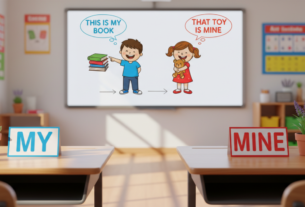
- Select possessive forms correctly (my vs mine), including after linking verbs: It is mine.
- Control reflexive and emphatic forms (myself) without adding them where English does not need them.
- Choose demonstratives for distance, time, and discourse reference (this/that) in conversation and writing.
- Build relative clauses with suitable pronouns and punctuation choices for defining and non-defining meaning.
- Use indefinite pronouns with correct agreement: everyone is, not everyone are.
These goals align with the typical progression through pronouns A1 to C1. They focus on form, meaning, and register.
How to use this module (study order and practice routine)
Follow a structured order to avoid confusion. Start with Sections 5, 6, 8, 9, and 10, then review diagnostics in Section 4. This order helps build from basic sentence roles to complex references.
Stick to a daily routine to track your progress. Read the rule, then write two example sentences by hand or in a notes app. Do a short error-correction set, check your answers immediately, and repeat with new items the next day.
Teachers can use the error-correction tasks for quick board work. This helps check understanding fast. The mixed practice is great for exit tickets, especially in classes that focus on speaking and writing.
System overview: types of pronouns at a glance
This pronouns page shows how pronouns replace nouns in English. They make sentences clear. In Brazil, learners see these forms in new ways. It’s good to know their functions and meanings.
Compact table of pronoun types and functions
Below is a table of pronouns in English. They are grouped by their role in a sentence. Notice where each form goes: before, after, or between clauses.
| Pronoun type | Main job (pronoun functions) | Core forms | Typical position | Quick example |
|---|---|---|---|---|
| Subject pronouns | Show who/what does the action | I, you, he, she, it, we, they | Before the main verb | They live in São Paulo. |
| Object pronouns | Show who/what receives the action | me, you, him, her, it, us, them | After verbs or prepositions | She called him after class. |
| Possessive adjectives | Mark ownership before a noun | my, your, his, her, its, our, their | Directly before a noun | That is our bus stop. |
| Possessive pronouns | Show ownership without a noun | mine, yours, his, hers, ours, theirs | Stand alone | This seat is yours. |
| Reflexive / emphatic pronouns | Point back to the subject or add emphasis | myself, yourself, himself, herself, itself, ourselves, yourselves, themselves | After the verb or after the noun for emphasis | She taught herself English. |
| Demonstrative pronouns | Point to things and manage reference in talk | this, that, these, those | Often before the verb or after be | These are the right answers. |
| Relative pronouns | Link clauses and add detail | who, which, that, whose, where | At the start of a relative clause | The app that you use is useful. |
| Indefinite pronouns | Refer to non-specific people or things | someone, anyone, no one; something, anything, nothing; each, either, neither; both, all; everyone / everybody | Varies; often subject or object | Someone left a notebook here. |
Level map (A1–C1): what to master at each stage
This map shows a study order for pronouns. It helps with English grammar. As tasks get harder, pronouns change roles.
- A1: Recognise I/me and he/him; use this/that for simple pointing; reduce repeated nouns in short sentences.
- A2: Add possessive adjectives (my/your); use these/those; start basic indefinite pronouns such as someone and anything.
- B1: Use possessive pronouns like mine; add reflexives in routines; build simple relative clauses with who/which/that.
- B2: Control defining vs non-defining relative clauses; choose register (who vs that); handle agreement patterns with indefinite pronouns.
- C1: Keep reference precise across sentences; avoid ambiguity in longer texts; manage punctuation in relative clauses and recognise whom in formal contexts.
For quick self-checking, match each sentence goal to the right types of pronouns in English. Then confirm the pronoun functions: subject, object, possession, reference, or clause linking.
Practice 1
English Pronouns
Pronouns make sentences shorter but can hide meaning. For learners in Brazil, it’s key to notice English pronoun form and function. Also, keep pronoun reference clear from one sentence to the next.
This unit offers quick checks for choosing pronouns in writing and speech. It also points out patterns from Portuguese that lead to mistakes in Brazilian English.
Pronoun form vs function (quick diagnostic)
Form is the word’s shape (I/me; my/mine). Function is its role in the sentence (subject, object, complement, or determiner). Knowing this helps spot errors.
Use these fast checks when editing:
- If the pronoun is before the main verb, it is usually a subject: “She lives in Recife.”
- If it is after a verb or preposition, it is usually an object: “They invited her”; “for him”.
- If it is before a noun, it works as a possessive adjective: “my phone”.
- If it stands alone to show ownership, it is a possessive pronoun: “This is mine.”
| Quick check | Likely function | Example | Common slip to watch |
|---|---|---|---|
| Before the main verb | Subject pronoun | “They work in São Paulo.” | Dropping the subject: “Work in São Paulo.” |
| After a verb or preposition | Object pronoun | “She called him.” / “with us” | Using a subject form: “She called he.” |
| Before a noun | Possessive adjective (determiner) | “Their bus is late.” | Using a possessive pronoun: “Theirs bus is late.” |
| Stands alone for ownership | Possessive pronoun | “This seat is yours.” | Using a noun phrase: “This seat is your.” |
Choosing the right pronoun: meaning, grammar, and register
Choosing pronouns is not just about grammar. It’s also about meaning. Each choice must match the person, number, and sentence role.
Pronoun reference is crucial in long texts. If “it” or “this” could point to two ideas, add a noun for clarity: “This rule” or “This change”. This small edit helps readers follow the argument.
Register also shapes choices. “Who” is natural for people, while “that” is common in speech and informal writing. “Whom” appears in very formal style, but most learners can focus on clear structure first.
Common transfer issues from Portuguese
Portuguese allows the subject to disappear, but English usually needs it. A frequent result of Portuguese interference English pronouns is “Is raining” instead of “It is raining”. Here, “it” has no real meaning; it fills the subject slot.
Another group of Brazilian English mistakes comes after linking verbs and comparisons. Learners may write “Me is…” when the sentence needs a subject form: “I am…”. After “than”, both “than me” and “than I” appear in English, but they differ in style and structure.
Reflexives also transfer in a misleading way. English uses “myself” for true self-action or emphasis, not for routine actions. So “I cut myself the hair” becomes “I cut my hair” or “I had my hair cut”, depending on the meaning.
Possession needs extra care because Portuguese “seu/sua” can be vague. English forces a choice: your, his, her, or their. This is where precise pronoun reference prevents confusion in emails, classroom writing, and workplace messages.
Relative clauses are another hotspot. Portuguese “que” covers many roles, but English splits the work across “who”, “which”, “that”, “where”, and “whose”. When choosing pronouns here, the key question is simple: is the noun a person, a thing, a place, or an owner?
Practice 2
Subject and object pronouns (I/me, he/him, we/us)
Choosing the right pronouns is key to clear communication. It’s about who does the action and who gets it. This is where I vs me and he vs him become clear.

Definition
Subject pronouns are the doers of the verb. Object pronouns receive the action or come after a preposition. In English, subjects are often stated, unlike in Portuguese. This makes writing and speaking clearer, especially for English learners from Brazil.
To explore this topic in greater detail, especially the common confusion between forms like I and me, you can read the article Subject and Object Pronouns: I or Me? Common Mistakes Explained. It offers a deeper explanation of how these pronouns work in sentences, highlights frequent learner mistakes, and provides clear examples to help you use them more accurately in everyday English.
Structure table: subject vs object position
| Role | Forms | Typical pronoun position | Model sentence |
|---|---|---|---|
| Subject | I, you, he, she, it, we, they | Before the main verb | They work. |
| Object (direct) | me, you, him, her, it, us, them | After the verb | I saw them. |
| Object (after preposition) | me, you, him, her, it, us, them | After for, with, to, from, etc. | The message is for him. |
Examples (everyday contexts relevant to Brazil)
- I live in São Paulo.
- Ana called me after class.
- We are studying for the Cambridge exam.
- The teacher gave us homework.
- I went to Rio, and it was hot.
- This gift is for her.
Common learner mistake
Many learners use an object form as the subject, especially at the start. For example, Me and my friend went… is incorrect. Instead, use My friend and I went… to follow correct pronoun position.
Practice 3
Possessive forms: possessive adjectives and possessive pronouns
In English, we use words next to nouns or alone to show ownership. This is important, especially when Portuguese seu/sua can mean more than one person. Choosing the right words makes our conversations clearer and kinder.
Definition
Possessive adjectives and pronouns show who owns something. Adjectives come before a noun: my bag, your keys. Pronouns replace the noun phrase and stand alone: mine, yours. English doesn’t change the form based on the noun’s gender.
This is why we choose between my vs mine and your vs yours based on grammar, not style. It helps avoid confusion, especially when Portuguese doesn’t make it clear who owns something.
Structure table
| Owner | Possessive adjective + noun | Possessive pronoun (stands alone) | Quick pattern |
|---|---|---|---|
| I | my notebook | mine | This is my notebook. / This notebook is mine. |
| you | your phone | yours | Is this your phone? / Is this phone yours? |
| he | his ticket | his | It is his ticket. / The ticket is his. |
| she | her umbrella | hers | That is her umbrella. / The umbrella is hers. |
| it | its history | (its is uncommon) | Brazil changed its flag in history. / Avoid “The flag is its”. |
| we | our seats | ours | These are our seats. / Those seats are ours. |
| they | their problem | theirs | It is their problem. / The problem is theirs. |
Examples
- This is my notebook.
- That seat is ours.
- Is this your phone or his phone?
- The blue umbrella is hers.
- Brazil changed its flag in history.
- For extra practice, use possessive adjectives and pronouns to check form and meaning.
Common learner mistake
Many learners mistakenly use of me or of him to show possession, because it feels like Portuguese. In English, it’s better to use possessive forms or an apostrophe: my father’s car. Using a verb can also be clearer: The car belongs to my father.
When learning English pronouns, many students struggle with the difference between possessive adjectives (my, your, his, her) and possessive pronouns (mine, yours, his, hers). Although they both express possession, they are used in different grammatical structures. If you want a clear and practical explanation with examples and exercises, read Possessive Pronouns Possessive Pronouns and Adjectives: My or Mine Explained Clearlyand Adjectives: My or Mine Explained Clearly, where you will learn exactly when to use each form in natural English sentences.
Practice 4
Reflexive and emphatic pronouns (myself, yourself, themselves)
Reflexive pronouns are used when the subject and object are the same. They clarify the meaning: She hurt herself. Emphatic pronouns, on the other hand, add stress but are not needed for grammar: I fixed it myself.
For Brazilian learners, the key is to choose wisely. English uses reflexive forms less often than Portuguese. So, common mistakes include adding a reflexive where English prefers a normal object pronoun.

The full set is easy to memorise. Just remember to match the form to the subject. Use it only when the action returns to the doer or when emphasis is needed.
| Pronoun | Reflexive meaning (needed) | Emphatic meaning (optional) | Brazil-focused note |
|---|---|---|---|
| myself | I blamed myself after the mistake. | I wrote the report myself. | After services: I had my hair cut is more natural than I cut my hair. |
| yourself | Don’t cut yourself with that knife. | You can finish it yourself. | In advice, English often uses a reflexive after verbs like hurt and cut. |
| themselves | They introduced themselves at the meeting. | They built the float themselves. | myself yourself themselves are common in classroom examples, but the role changes with meaning. |
Use reflexive pronouns after certain verbs like blame, enjoy, and introduce when the action returns to the subject. Use emphatic pronouns when the message is “and nobody helped”.
A key rule prevents common reflexive mistakes Portuguese speakers often repeat: do not use a reflexive as a normal object. He told myself is wrong because the object is me, not the subject.
Also avoid over-translating Portuguese patterns. In English, I shaved is often complete without adding a reflexive. Context decides if the focus is the action, the result, or the emphasis.
If you would like to deepen your understanding of reflexive pronouns and see how they are used in more contexts, you can explore the article Reflexive Pronouns in English: Rules, Examples, and Common Mistakes Explained. There, you’ll find a clearer breakdown of the rules, additional examples, and practical explanations that will help you recognise and use reflexive pronouns more confidently in everyday English.
Practice 5
Demonstrative pronouns (this, that, these, those)
In everyday speech, demonstratives help speakers point and organise meaning fast. The demonstrative pronouns this that these those signal what is near, what is far, and what matters in the moment. In Brazil, they are useful for travel, shopping, and office talk, because they act like clear English reference words. Getting this vs that right also makes instructions and opinions sound natural.
Definition
Demonstratives point to people or things and locate them in space, time, or the conversation. This and these tend to feel nearer, while that and those feel more distant. They can refer to objects you can see, places you can point at, or ideas you just mentioned. Used well, they keep speech clear and reduce repetition.
To explore demonstrative forms in greater detail, including when to use this, that, these, and those in different contexts, you can read the article This, That, These, Those? A Complete Guide with Exercises. It provides a clearer explanation of how these demonstratives work in English, along with practical examples and exercises to help learners practise and use them confidently in everyday communication.
Structure table: distance, number, and discourse reference
| Form | Number | Distance (space/time) | Discourse use (English reference words) | Quick example |
|---|---|---|---|---|
| this | Singular | Near (here/now; close to the speaker) | Often introduces a new point or an upcoming explanation | This is important: practise daily. |
| that | Singular | Far (there/then; away from the speaker) | Often refers back to a previous point, or evaluates it | I disagree with that. |
| these | Plural | Near (several items close by) | Groups nearby items or ideas into one clear reference | These are the keys. |
| those | Plural | Far (several items at a distance) | Points to a distant group or a previously mentioned set | Those are the buildings in Brasília. |
Examples (objects, places, and conversation reference)
- This is my passport. (in hand)
- That is the bus stop over there.
- These are my keys. (on the table)
- Those buildings are in Brasília.
- This is what you need to do: read and practise daily.
- I didn’t like that. (about a previous idea)
For ESL demonstratives practice, learners can pair a gesture with each sentence. Point close for this/these, and point away for that/those. Then repeat the same meaning without pointing, to check if the wording still works.
Common learner mistake
The most common error is mixing singular and plural: this shoes or that people. The fix is simple: match the demonstrative to the noun (or the implied noun). If the word is plural, choose these or those, even when the idea feels “near”. This is a key step in mastering this vs that choices under pressure.
Error-correction task (short sentences “from images”) + answer key
Practice 6
Relative pronouns (who, which, that, whose, where)
English relative clauses link ideas without repeating nouns. They use relative pronouns like who, which, that, whose, and where. These pronouns point back to a person, thing, place, or owner. It’s important to know the difference between defining and non-defining clauses, as a comma can change the meaning.
Definition
Relative pronouns introduce a clause that describes a noun. They can either identify a specific noun or add extra detail. In defining clauses, no commas are used. In non-defining clauses, commas are used, and that is usually avoided.
Structure table: people, things, possession, place
| Noun being described | Best choice | Common alternative | Typical use in English relative clauses | Punctuation note |
|---|---|---|---|---|
| People | who | that (mainly defining) | Subject or object: “the teacher who helped”; “the friend (who/that) I called” | No commas in defining; commas in non-defining |
| Things and animals | which | that (defining) | Objects and ideas: “the app which works”; “the film that won” | Use commas for non-defining with which |
| Possession (people or things) | whose | “of which” (more formal) | Ownership: “a company whose services are global”; “a car whose engine is noisy” | Commas depend on defining vs non-defining clauses |
| Place | where | “in which” (formal) | Locations: “the café where we met”; “the city where I studied” | Commas only when the place detail is extra |
Examples (defining vs non-defining, where relevant)
- The student who sits near the window speaks English well. (defining)
- The book that you recommended is helpful. (defining)
- Rio de Janeiro, which is famous for its beaches, is crowded in summer. (non-defining)
- That is the café where we met. (defining)
- It’s a company whose services are global. (defining)
Common learner mistake
Many learners struggle with commas in relative clauses. They often add commas in defining clauses. Also, using that in non-defining clauses is a common error in British English. Remember, commas are not just for looks; they show if information is essential.
Relative pronouns such as who, which, and that are commonly used to introduce relative clauses, which add extra information about a noun in a sentence. To explore this structure in more detail and see how these pronouns function within longer sentences, you can read the article Relative Clauses Made Simple: Who, Which, That Explained Clearly, which explains the rules with examples and practical guidance for learners.
Practice 7
Indefinite pronouns (someone, anything, nobody, each, both)
Indefinite pronouns talk about people or things in a general way. They are useful when we don’t know or don’t want to say who or what. In Brazilian classrooms, they help with clear rules, polite requests, and everyday talk.
These pronouns often appear in short, common patterns. For example, asking for something might use something. Negatives and questions often use anything. You’ll see them in notices and classroom instructions, where being accurate is key.
In English, people group by meaning, not gender. The group of indefinite pronouns like someone, anyone, and nobody is common in listening tasks and quick chats. It’s also good to know that everyone and everybody act the same in grammar.
| Group | Core forms | Typical use | Example |
|---|---|---|---|
| People | someone/somebody; anyone/anybody; no one/nobody; everyone/everybody | Offers, questions, negatives, general rules | Would you like someone to help? I didn’t see anyone. Nobody replied. Everyone must bring a pen. |
| Things | something; anything; nothing; everything | Requests, denial, broad statements | I need something for class. I didn’t buy anything. There’s nothing in the bag. Everything is ready. |
| Distribution and quantity | each; either; neither; both; all; none | One-by-one choice, two-item choice, paired items, totals | Each student writes alone. You can choose either option. Neither answer fits. Both are correct. None is missing today. |
Indefinite pronouns agreement can seem odd because meaning and grammar don’t always match. Words like everyone and someone are singular: Everyone is ready. This rule applies even when the group is big.
None is flexible in modern British English. It can take a singular verb when it means “not one”, or a plural verb when it means “not any”. For exams and formal writing, learners should follow the style taught in their course and keep it consistent.
The words each either neither both often cause confusion because they look similar but control different meanings. Each focuses on one person at a time, while both includes two together. Either offers one of two, and neither rejects both.
One common difficulty with indefinite pronouns is understanding how they agree with verbs in a sentence. For example, many learners wonder whether we should say everyone is or everyone are. Although these pronouns refer to multiple people in meaning, they usually take singular verb agreement in standard English. For a detailed explanation with examples and common mistakes, read our article about Indefinite Pronouns, where you’ll learn the rules clearly and see how they work in real sentences.
Practice 8
Final mixed practice and classroom application tips
This final block brings key choices together, so reference stays clear across a whole paragraph, not just one sentence. It works as English pronouns practice for self-study or a fast recap before a test.
Mixed practice: 8–10 questions (A1–C1 range) + answer key
Complete each item. Keep punctuation tidy in longer sentences.
- Choose: “___ am from Brazil.” (I / Me)
- Gap-fill: “Can you help ___ after class?” (I / me)
- Choose: “This is ___ book; that one is ___.” (my / mine)
- Choose: “___ shoes are near the door.” (These / This)
- Rewrite: “I met a teacher. The teacher works at a university.” Use a relative pronoun.
- Error-correct: “Everyone are ready.”
- Multiple choice: “The film, ___ was filmed in Rio, won awards.” (which / that)
- Gap-fill: “There is ___ on the table.” (something / someone)
- Choose: “Ana sat next to Paulo. I sat behind ___.” (he / him)
- Rewrite for clarity: “Maria told Maria’s manager about Maria’s plan.” Use pronouns.
Answers
- 1) I
- 2) me
- 3) my; mine
- 4) These
- 5) I met a teacher who works at a university.
- 6) Everyone is ready. (Indefinite pronouns like “everyone” take singular verbs.)
- 7) which. (Non-defining clause needs commas; “which” fits this style.)
- 8) something
- 9) him
- 10) Maria told her manager about her plan. (Use pronouns when the reference is clear.)
Mini-assessment: quick checklist for accuracy
Use this pronoun accuracy checklist after writing or speaking. Tick each point once.
- Each finite clause has a subject, including it and there patterns.
- Object pronouns come after verbs and prepositions: “help me”, “for them”.
- Possessive adjective + noun; possessive pronoun stands alone: “my notes” vs “mine”.
- Demonstratives match number and distance in context: this/these vs that/those.
- Relative clauses are chosen on purpose; commas only for non-defining clauses.
- Indefinite pronoun agreement is checked: “each is”, “everyone is”.
Classroom application tips (pairwork, correction routines, drilling)
These classroom grammar activities keep form and meaning linked, so students practise reference, not isolated words.
- Pairwork information gap: Learners describe a routine; the partner replaces repeated nouns with pronouns and checks meaning.
- Spot-the-mistake board race: Groups correct short sentences with common transfer errors, then give one rule in plain English.
- Substitution drilling: Quick swaps with prompts from daily life in Brazil (bus, café, online shopping, university): “I / me / my / mine”.
- Micro-writing: A three-sentence story using one demonstrative, one relative clause, and one indefinite pronoun.
Personal study tips for Brazilian learners (pronunciation and noticing)
For Brazilian learners English pronunciation, clarity often improves when pronouns are said in connected speech, not as isolated words. Practise weak forms in fast speech, such as “them” /ðəm/, and keep a clear /h/ in “he”, “him”, and “her” when needed.
Build noticing habits during reading: highlight pronouns and draw a short line back to the noun they replace. Record a one-minute summary, then reduce repeated nouns by swapping in accurate pronouns without losing reference.
| Pronoun focus | Common slip | Fast fix | One-line check |
|---|---|---|---|
| Subject vs object | “Me went…” after Portuguese structure | Place I/he/she/we/they before the verb; use me/him/her/us/them after it | Ask: “Is it doing the action or receiving it?” |
| Possessives | Using “mine” before a noun | Use “my/your/his/her/our/their” + noun; use “mine/yours…” alone | If a noun follows, it is an adjective form |
| Demonstratives | Number mismatch: “this shoes” | Match singular/plural and context: this/that vs these/those | Check: one item or many? |
| Relative clauses | Comma confusion in extra information | Use commas for non-defining clauses; avoid commas in defining clauses | If the clause is removable, use commas |
| Indefinite pronouns | Plural verb after “everyone/each” | Use singular verb: “everyone is”, “each has” | Replace with “each person”: verb stays singular |
Conclusion
This English pronouns summary wraps up by looking at the journey learners took. It begins with understanding subject and object roles. Then, it moves on to possession and reference tools like demonstratives and relatives.
Next, it covers non-specific reference with indefinites. Finally, it ends with mastering mixed control across full sentences.
In this recap, the results are clear and useful. Learners should pick pronouns based on their function and what they refer to. They should also avoid mistakes like extra subjects or unclear “it” references.
The goal is to ensure meaning is clear across sentences, not just to use the right forms.
This English grammar module wrap-up also suggests a simple routine for upkeep. A weekly review is best: redo a few error-correction tasks, then do a small set of mixed questions and check the answers. Teachers can reuse these tasks and keep track of common errors for better feedback.
The ultimate goal is to achieve accuracy and clarity, from beginners to advanced learners. A pronoun mastery checklist helps learners check their work before speaking or writing. This habit supports fluent reading and precise writing in school, work, and exams over time.
If you want to apply grammar concepts like pronouns more effectively in real communication, developing strong writing skills is essential. The article English Writing: A Complete Guide with Rules, Examples and Practice Activities offers practical guidance to help learners organise ideas, build clear sentences, and improve written English step by step.
FAQ
What is a pronoun, and why does it matter from A1 to C1?
A pronoun is a word that takes the place of a noun. It helps avoid repeating words and keeps sentences clear. At the lower levels, it’s key for building simple sentences. At higher levels, it helps link sentences together and keeps writing clear and formal.
Why do Brazilian learners often miss out subject pronouns in English?
In Portuguese, the verb ending often shows who is doing the action. This means you can sometimes leave out the pronoun. But in English, you need to say who or what is doing the action. This is why you might see It is raining instead of Is raining.
How can learners choose between subject and object pronouns (I/me, he/him, we/us)?
Here’s a simple trick: if the pronoun comes before the verb, it’s the subject. If it comes after, it’s the object. This rule also works with prepositions like with, for, and to.
What is the difference between possessive adjectives and possessive pronouns (my vs mine)?
Possessive adjectives come before a noun, like my book. Possessive pronouns stand alone, like mine. This is important because Portuguese can be tricky, but English is clearer with your, his, her, or their.
When should learners use relative pronouns (who, which, that, whose, where) and commas?
Relative pronouns introduce clauses that add details. Use who, which, or that for defining clauses. Non-defining clauses need commas and who or which. For possession, use whose; for place, use where or in which.


5 thoughts on “English Pronouns: Complete Guide from Basic to Advanced (A1–C1)”