Introduction
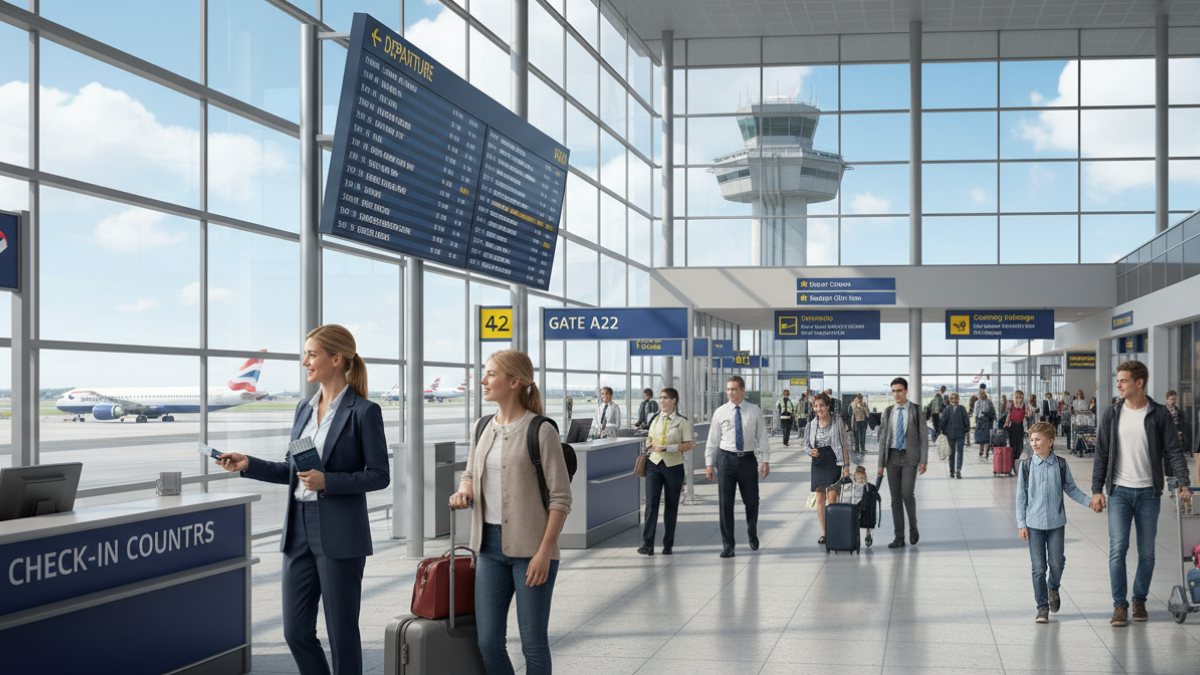
Airports need clear language, set routines, and quick decisions. This guide is for Brazilian travellers heading to the UK. It covers Airport English Vocabulary used on flights where British English is standard.
Learning airport English is more than just words. It’s about signs, announcements, and talking to staff. You’ll also learn formal terms for check-in, security, and boarding.
The guide uses British English spellings and terms. You’ll find words like “organise” and “queue”. It also includes polite phrases used in UK service.
Throughout the guide, there are exercises for each part of your journey. This helps you quickly learn and use key terms in real situations.
Brazilian travellers will find useful phrases for immigration, connections, and describing where you’re staying. The guide uses clear language that fits real airport procedures.
Key takeaways
- This British English guide focuses on airport English used in UK airports and international routes.
- It covers signs, announcements, staff questions, and passenger requests throughout your airport journey.
- British spellings and terms are used, including “organise”, “queue”, “trolley”, and “baggage reclaim”.
- English for airport travel is practised through short exercises at check-in, security, the gate, and arrivals.
- Brazilian travellers airport English is covered, focusing on immigration, connections, and travel plans.
- The language is polite and neutral, typical of UK service communication.
Why British English Matters for Brazilian Travellers at the Airport
In the UK, small language differences can affect how quickly a traveller understands signs, emails, and announcements. For Brazilian travellers, British English travel words often appear in the busiest moments, when time and clarity matter. Learning the right travel vocabulary in english also supports smoother chats with staff and clearer form-filling.
Much of airport English vocabulary is shared across countries, but UK airport terminology has its own habits. Word choice, tone, and spelling can shift meaning, even when the topic is familiar. This section focuses on high-use terms that show up from check-in to arrivals.
Common UK airport situations where word choice differs
UK airports often use queue rather than “line”, and trolley for a luggage cart. On arrival, signs may say baggage reclaim for luggage collection. Tickets and fares may use return where some travellers expect “round-trip”.
These terms appear on overhead signs, self-service kiosks, airline emails, and public-address announcements. Recognising these British English travel words helps avoid hesitation during security re-checks, gate changes, or a tight connection. It also supports quicker scanning of airport maps and terminal screens.
| UK airport terminology | Meaning in context | Where it is commonly seen |
|---|---|---|
| Queue | A line of passengers waiting | Security lanes, boarding, passport control |
| Trolley | Wheeled cart used to move bags | Arrivals hall, car parks, station links |
| Baggage reclaim | Area where checked bags arrive on belts | Arrivals signs, terminal maps, screens |
| Return (ticket) | Ticket for going and coming back | Airline websites, booking emails, receipts |
| Postcode | UK address code, used for delivery and forms | Online check-in, lost baggage forms, taxi apps |
Polite phrases and tone: sounding natural, not too direct
British service talk often sounds softer than direct requests in other varieties of English. Phrases like Could you…? and Would you mind…? are common at desks and gates. Small words such as just and a bit can also reduce pressure in a request.
Courtesy markers matter in fast exchanges, especially when staff must follow rules. A quick please, thank you, and sorry can keep the tone steady during check-in issues, security checks, or seat changes. This part of airport English vocabulary is less about grammar and more about social rhythm.
Spelling and vocabulary differences to watch for (e.g., “organise”, “queue”)
British spelling appears on travel documents and airport notices, so recognition matters even when pronunciation stays the same. Common forms include organise and organisation, plus travelling and cancelled. Another frequent pair is licence (noun) and license (verb).
These variations show up in airline policies, baggage rules, and border forms. For Brazilian travellers, seeing UK airport terminology in print can feel unfamiliar at first, even when the meaning is known. Building comfort with British English travel words supports quicker reading and fewer misreads under time pressure.
airport English vocabulary: Core Terms You Will Hear and Use
Knowing airport English vocabulary helps you move through an airport smoothly. English for airport travel relies on a few key words seen on screens, signs, and announcements. Learning these terms in the order you see them makes your journey easier.
Passenger journey overview: from departures to arrivals
Your journey starts in the departures hall. Then, you go through check-in or bag drop, security, and the departures lounge. After boarding, you’ll follow steps on the arrivals side: arrivals, passport control, baggage reclaim, and customs.
Common words include terminal, gate, departure time, and boarding time. For connecting flights, you might hear connection, transfer, and transit. Announcements may also use last call or final call when boarding is almost over.
| Stage on the journey | What the term usually means in context | Words often seen or heard | Common place where it appears |
|---|---|---|---|
| Departures | Area for flights leaving the airport | departures, terminal, check-in, bag drop | Large overhead signs and departure boards |
| Security | Screening point before the airside area | security, screening, liquids, trays | Queue entrance signs and staff instructions |
| Gate | Specific boarding point for a flight | gate, boarding time, final call | Gate screens and public announcements |
| Arrivals | Area for passengers landing at the airport | arrivals, passport control, baggage reclaim | Wayfinding signs after leaving the aircraft |
| Customs | Control point for goods brought into the country | customs, nothing to declare, goods to declare | Channel signs at the exit from baggage reclaim |
Signs and announcements: key words to recognise quickly
Airport signs use short, clear words for quick reading. You’ll see Departures, Arrivals, Transfers, Security, Gates, Information, Toilets, Lifts, Escalators, and Exit often. Signs like No entry and Closed are also common.
Announcements signal changes or urgency. You might hear delayed, cancelled, and rescheduled with new times or gates. Words like now boarding, go to gate, gate change, or boarding will commence shortly are key for airport travel.
Listening can be tough when gates are called with letter–number combinations, like A10 or B3. Airline names are often spoken quickly. Time is often given in a 24-hour format, which is common in airports. This is where knowing airport vocabulary helps you recognize things faster, even in noisy halls.
Essential documents and items: passport, boarding pass, baggage tags
Documents are crucial for airport English vocabulary. Staff check them at several points. The passport confirms your identity, and a visa may be needed for some destinations. A boarding pass links to your flight, seat, and gate.
Other useful items include a booking reference and an itinerary, which help confirm details. For checked bags, a baggage tag tracks your bag to the right flight. Travel insurance papers may also be asked for, so they’re part of airport vocabulary.
In Britain, hand luggage or cabin bag is different from checked baggage or hold luggage. Knowing these pairs helps at bag drop and the gate. This set of terms is practical and appears often on signs, screens, and staff questions.
Check-in Desk Vocabulary and Useful Phrases (British English)
At the check-in desk, language is brief and formal. For Brazilian passengers, this part of airport English vocabulary often feels fast. This is because several checks happen in minutes. Listening for set wording helps, especially when british english travel words differ from American forms.
Many airlines split the process into check in, bag drop, and document checks. The travel vocabulary in english here focuses on identity, route, and baggage status. Staff may also confirm a connecting flight, the boarding time, and a seat assignment.
Checking in: standard questions staff may ask
Common prompts are short questions with fixed meaning. “Where are you flying to today?” checks the destination, while “May I see your passport?” starts the identity check. “Do you have any luggage to check in?” separates hold luggage from cabin bags.
Security questions can sound personal but follow policy. “Has anyone given you anything to carry?” looks for unknown items in bags. “Are you travelling alone?” can affect screening notes, and “Do you have your boarding pass?” confirms the booking record.
| Airline check-in phrases | What staff are confirming | Key term to recognise |
|---|---|---|
| “Where are you flying to today?” | Route and final destination | destination |
| “May I see your passport?” | Identity and travel document validity | passport |
| “Do you have any luggage to check in?” | Whether bags go in the hold | hold luggage |
| “Is this your final destination?” | Whether there is a connection | connecting flight |
| “Your boarding time is on the pass.” | Time management for gate arrival | boarding time |
| “I can assign you a seat now.” | Seat allocation in the system | seat assignment |
Seating, upgrades, and special assistance requests
Seat language is often specific. An aisle seat sits next to the walkway, a window seat faces the view, and a middle seat sits between two passengers. An exit row may offer space, yet it can have extra rules for safety.
Extra legroom is sometimes described with seat pitch, meaning the distance from one seat to the next. Upgrade wording varies by airline, including upgrade, bid for an upgrade, and cabin labels such as premium economy or business. Availability and fare rules usually control what can be changed at the desk.
Support requests use standard terms that staff recognise quickly. Special assistance may cover wheelchair assistance, a mobility aid, or priority assistance through busy points. Some airlines also note help at security and boarding so the same information follows the booking.
Excess baggage and baggage allowance wording
Baggage rules are framed through limits and charges. Baggage allowance is the number of bags and the permitted weight limit and size limit. When a bag is heavy or large, staff may describe it as excess baggage or oversized baggage.
Some items need clear labels, such as sports equipment and a fragile item. Staff may also mention liquid restrictions, even before security, because liquids can affect what stays in cabin bags. In many airports, this wording appears on signs near the desks and bag drop lanes.
Fees are usually stated in neutral terms. Phrases like “charges apply” or “there is a fee” are common, followed by “would you like a receipt?” Airlines also distinguish pre-paid baggage from pay at the airport, which can change the total cost and the payment step. This mix of airport English vocabulary and british english travel words is typical of check-in interactions.
Security Screening Words: Trays, Liquids, and Prohibited Items
At many UK airports, the security area is called security screening or a security checkpoint. This part of english for airport travel moves quickly. Clear terms are important. Key words include tray, belt (the conveyor belt), scanner, metal detector, and body scanner.
Signs and staff instructions use short, direct words. For security screening, travellers often hear: “Place items in a tray”, “Remove laptops/tablets”, and “Empty pockets”. Other common lines are “Remove belts”, “Take off coats/jackets”, and “No sharp items”.
Airports group toiletries as liquids, aerosols, gels. In travel vocabulary, packaging words are key: travel-sized, clear plastic bag, and resealable. The term screening may appear on notices about what must be separated for checks.
| Term | Where it appears | Meaning in plain English |
|---|---|---|
| Tray | At the belt before the scanner | A plastic box used to hold items for X-ray screening |
| Conveyor belt | Leading into the scanner | The moving belt that carries trays through the X-ray machine |
| Metal detector | Walk-through arch after the belt | A gate that checks for metal on the body |
| Body scanner | Screening lane, usually after ID checks | A machine that checks for hidden items without physical contact |
| Pat-down search | Secondary screening area | A manual check by an officer, using hands over clothing |
Restricted language sounds formal but is consistent across airports. Airport English vocabulary includes prohibited items and restricted items. Examples are sharp objects, blades, some tools, and flammable items. Rules can vary by route and carrier.
Battery terms also appear at screening. A power bank may be allowed, but it’s often treated as a spare lithium battery item. Airlines set limits, so staff may ask for it to be separated, shown, or kept in hand luggage.
If something triggers a check, several terms are used. Secondary screening can include a manual inspection of a bag or a swab test, sometimes called a trace test. Items may be confiscated if they’re not permitted, or staff may ask travellers to dispose of something, meaning “bin it”.
Some airports use the word declare at security, especially when an item needs explanation before it goes through the scanner. For Brazilians using english for airport travel, learning this vocabulary reduces confusion at the tray and belt stage. It also helps when a quick question is asked in a busy lane.
Immigration and Passport Control: Travel Vocabulary in English
At passport control, the language is formal and brief. For Brazilian travellers, this is crucial because questions are quick and the setting is quiet. Clear, factual wording is key, especially for dates, addresses, and how long you’ll stay.
Purpose of travel: visiting, business, transit, studies
Border officers sort arrivals into categories. Common labels are tourism/holiday, visiting family or friends, business trip, conference, transit, and study. Work might also be mentioned, depending on entry rules and visas.
Supporting terms often come with the purpose. These include where you’ll stay, an address, an invitation, a return or onward ticket, and a travel plan. They might also ask about your funds and how long you plan to stay, which are common in travel vocabulary in english.
| Purpose stated | Words often linked to it | Typical detail requested |
|---|---|---|
| Tourism / holiday | Accommodation, booking, return ticket, itinerary | Hotel name, city, departure date |
| Visiting family / friends | Invitation, address, contact number, length of stay | Where the host lives and how long the visit lasts |
| Business trip / conference | Meeting, conference pass, employer, schedule | Company details and event location |
| Transit | Onward flight, connection, boarding pass, gate | Final destination and time between flights |
| Study | Course, university, term dates, proof of funds | Institution name, start date, funding source |
Common immigration questions and model answers
Many questions follow set patterns, making them useful for practice. They often ask what, where, how long, and whether.
- “What is the purpose of your visit?” — “Tourism for two weeks.” / “Business meetings in London.”
- “How long will you stay?” — “Ten days.” / “Until 18 May.”
- “Where will you be staying?” — “At a hotel in Manchester.” / “At my sister’s address in Leeds.”
- “Do you have a return ticket?” — “Yes, my return flight is on Friday.”
- “What do you do for work?” — “I work in finance.” / “I am a teacher in São Paulo.”
- “Is this your first visit?” — “Yes.” / “No, I visited in 2022.”
Model answers are short and specific. They use neutral time phrases and accurate place names. This helps avoid confusion in busy arrival halls. It also fits the language used in interviews and routine checks.
Problem-solving vocabulary: missing documents, overstays, refusals
When issues arise, the language becomes more administrative. You might hear about supporting documents, proof of accommodation, proof of funds, or entry clearance. An overstay means staying longer than allowed, while an extension is a formal request to stay longer.
Other terms might sound severe but have precise meanings. Refused entry means not being allowed in, and an interview is a set of questions. Detained usually means being held for further checks, often while documents are reviewed.
Technology is also part of airport processes. Biometrics include fingerprints, an eGate is an automated border gate, and a stamp may be added to the passport. These terms are standard in airport English vocabulary and often appear in English signage and forms used at the border.
At the Gate and Boarding: British English Travel Words
At the gate, screens and staff repeat the same words. For Brazilian travellers, knowing these words can help when things move fast.
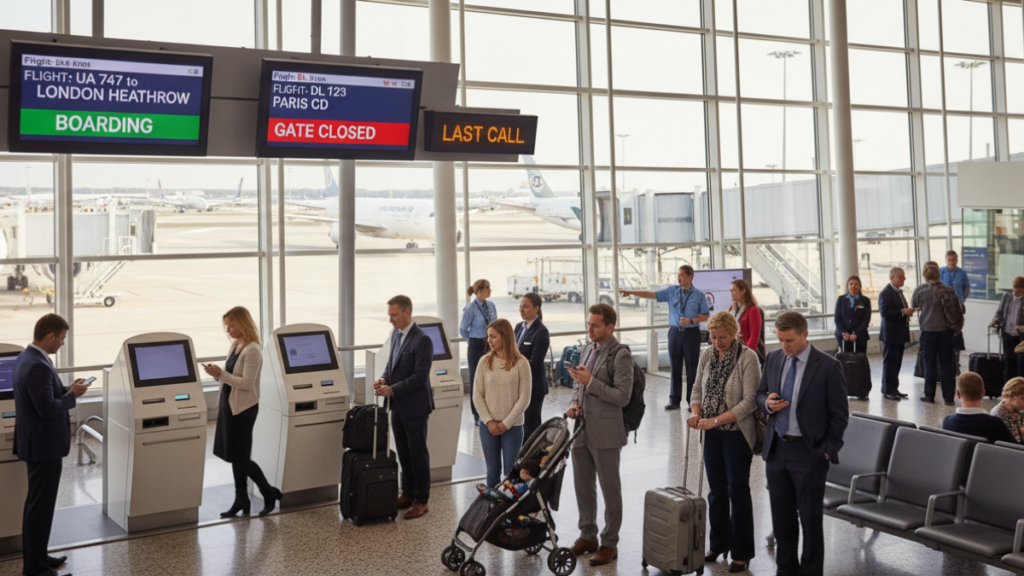
Boarding groups, priority boarding, and final call language
In airport travel, gate is where you start boarding. Boarding means getting on the plane, often after showing your pass.
A queue is the line to wait in. Airlines split it into boarding groups or zones. Priority boarding is for special groups, like those in premium cabins.
Final call means boarding is almost over. If you hear boarding closes, the gate will stop letting people in soon.
Seat, aisle, window, and overhead locker vocabulary
Once you start boarding, you’ll hear about seats and bags. Staff might say row and seat number. They might also talk about aisle, window, or middle seats.
Bag terms can be confusing but are important. Cabin baggage is your main bag. A personal item is smaller and fits under the seat.
Overhead locker is where you store your bags. A seat belt is what you wear when seated. It’s often mentioned during boarding.
| Term | Where it appears | Meaning at the gate and during boarding |
|---|---|---|
| Overhead locker | Cabin signage and crew directions | Storage above seats for cabin baggage that meets size rules |
| Under-seat bag | Gate checks and boarding reminders | Small personal item placed beneath the seat in front |
| Aisle / Window / Middle | Seat maps, boarding pass, cabin talk | Position of the seat within a row, used to guide passengers quickly |
| Row and seat number | Boarding pass and cabin announcements | Locator for seating, used when directing passengers to the correct place |
Delayed, cancelled, and rescheduled flights: key terms
When flights change, screens show delay or a new estimated time of departure (ETD). They might say boarding time changed, which affects when you start moving.
Rescheduled means the flight is moved to a new time. Cancelled means it won’t happen. Diverted means the plane goes to a different airport.
A gate change is common in busy airports. After a delay, you might hear about rebook, alternative flight, voucher, customer service desk, accommodation, and missed connection. These terms help when discussing what to do next.
On the Plane: Cabin Announcements and Passenger Requests
Once on board, the first messages set the tone and pace of the flight. For Brazilian travellers, knowing airport English vocabulary can make things easier, even when it’s busy. Airlines use clear, repeated phrases, making key terms stand out.
Cabin announcements include: “Welcome on board”, “Please stow your luggage”, and “Fasten your seat belt”. You might also hear “cabin crew”, “safety demonstration”, “emergency exits”, “life jacket”, and “oxygen mask”. During turbulence, “turbulence” is mentioned, along with a reminder to stay seated.
This vocabulary is similar to what you see at the terminal. But on the plane, instructions are short and direct. They might be repeated. Listening for main nouns and verbs helps you understand what’s happening.
| What is heard in the cabin | What it usually means | Useful passenger response in British English |
|---|---|---|
| “Please stow your luggage.” | Put bags in the overhead locker or under the seat to keep aisles clear. | “Could you help me lift this into the overhead locker, please?” |
| “Fasten your seat belt.” | Secure the belt, often for take-off, landing, or turbulence. | “My seat belt is stuck; could someone assist, please?” |
| “Safety demonstration.” | Instructions on exits, life jacket, and oxygen mask. | “Sorry, could you repeat that last part, please?” |
| “We are preparing for landing.” | Cabin tidy-up, seats upright, trays away, and final checks. | “Is there a landing card for this route?” |
When asking for something, being polite and specific helps. In British English, use “Could I have…?” and “Would it be possible…?” for service and comfort. Common requests include a blanket, water, a hot drink, or a soft drink. It’s good to mention your needs early.
- “Could I have some water, please?”
- “Would it be possible to change seats if one is free?”
- “I have allergies; does this meal contain nuts?”
- “The screen is not working; could you take a look, please?”
Food and sales words also appear in brief announcements: “meal”, “snack”, “special meal”, and “duty-free”, where offered. These terms are part of the airport English vocabulary seen at the gate. But they are used faster in the cabin, sometimes with a trolley moving down the aisle.
Near arrival, updates cover local time, time difference, and onward travel like connecting flights. Another common verb is “disembark”, meaning leave the aircraft after landing. This final set of in-flight announcements vocabulary links neatly back to travel vocabulary in English used in arrivals, signs, and border checks.
Arrivals, Baggage Reclaim, and Customs: English for Airport Travel
After landing, knowing airport English vocabulary makes travel smoother. It’s all about spotting signs quickly and using the same words as staff and screens.
This part focuses on the last steps: finding your bags, reporting any issues, and going through border checks. It also covers arrivals and customs vocabulary found on UK-style signs.
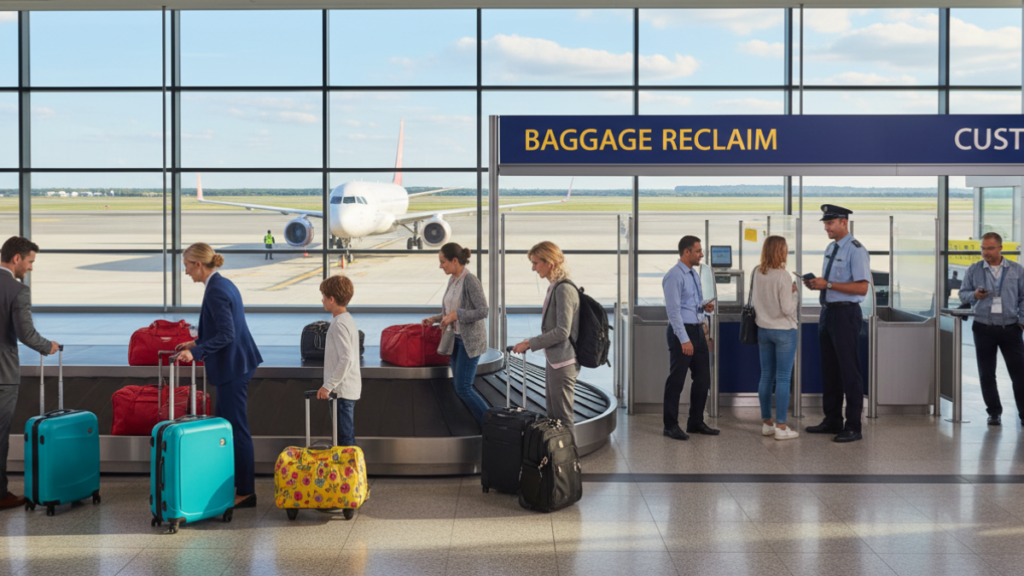
Following signs: arrivals hall, baggage reclaim, customs channels
Most terminals guide you through Arrivals to the arrivals hall. Then, you head to passport control and baggage reclaim. At reclaim, bags appear on a carousel (the baggage belt). You might need a trolley for heavier bags.
Look out for signs saying exit, public area, and customs. Customs has channels like Nothing to declare and Goods to declare. Some airports also have EU and Non-EU lanes.
| Sign or screen term | What it points to | What to look for nearby |
|---|---|---|
| Arrivals hall | Main meeting area after border checks | Information desk, public transport, toilets |
| Baggage reclaim / Carousel | Where checked bags arrive | Flight number on monitors, trolley bay, baggage services desk |
| Customs: Nothing to declare | Route for passengers with no items to declare | Officers nearby, random checks, clear lane markings |
| Customs: Goods to declare | Route for passengers carrying restricted or taxable items | Declaration point, queue, questions about receipts and quantity |
Reporting missing luggage: lost property vs lost baggage
The terms can be confusing. Lost property means items left behind, like a phone or jacket. Lost baggage refers to a missing suitcase.
Airlines direct you to baggage services to report a missing bag. You’ll need to fill out a property irregularity report (PIR). Staff might ask for your claim tag and contact details.
Damage is reported with specific words, like damaged baggage or a broken wheel. This vocabulary helps describe issues clearly.
Declaring items at customs: duty-free and restricted goods
Customs questions are straightforward, using simple English. Terms include duty-free, allowance, restricted goods, and prohibited goods. Officers might ask for a receipt and the quantity and value paid.
Items like alcohol, tobacco, high-value goods, and food can trigger checks. The same questions appear in arrivals and customs vocabulary.
“Do you have anything to declare?”
“Are you carrying food products?”
“How much did you pay for this?”
For airport travel, knowing these phrases is as important as speaking them. Airport English is most useful when it matches signs, forms, and screens.
Airport Vocabulary Exercises: Practise What You Will Really Say
These exercises focus on quick choices, like reading signs or answering staff questions. They aim to make airport English fast and clear. This is especially helpful for Brazilian travellers, ensuring they can use the same words across different airlines and routes.
Matching exercise: signs, places, and actions
Matching exercises help learners quickly recognise signs. A sign points to a place and an action, making it easy to understand, even in busy terminals. This practice helps learners respond quickly without needing to translate.
| Sign on the wall | Place it points to | Action it suggests |
|---|---|---|
| Baggage reclaim | Arrivals hall carousel area | Collect checked luggage after landing |
| Transfers | Connection corridor or transfer desk | Follow signs to the next flight without exiting |
| Departures | Check-in and security zone | Go to check-in, then proceed through security |
| Passport control | Immigration desks | Present passport and answer entry questions |
| Gate change | Flight information screens | Check the new gate number and walk there |
Gap-fill dialogues: check-in, security, and boarding
Gap-fills make learning phrases feel natural. They focus on common phrases like check in a bag, go through security, and board the flight. This keeps learning relevant to real situations, not just lists of words.
- Check-in: “May I have your passport, please?” “Here you ___.”
- Check-in: “Are you checking any bags?” “Just this ___.”
- Security: “Please put your carry-on through the X-ray ___.”
- Boarding: “Your flight leaves from gate 15A. Boarding begins at ___.”
- Boarding: “There has been a ___ change. Please check the screens.”
For more context and varied phrases, check out travel English conversations in the airport. It supports learning without using idioms or slang.
Listening-style practice: interpreting announcements
“Listening” scripts help learners focus on key details like flight number, destination, and gate. This is crucial for understanding announcements, especially when they include numbers and times.
“United Airlines flight 880 to Miami is now boarding. Please have your boarding pass and identification ready. Final boarding call at 15:20. Proceed to gate 12.”
Extracting five key items from announcements is a useful task. It keeps learning practical and reinforces important words like boarding pass and gate.
Role-play tasks for Brazilian travellers: realistic mini-scenarios
Role-plays make learning relevant to real situations. They use polite language and focus on clear goals. Each scenario is brief, with only a few turns per speaker.
- Missed connection: request rebooking after a delayed inbound flight, then confirm the revised gate and boarding time.
- Special assistance: ask for help with mobility support and confirm where to wait near the gate.
- Passport control: explain purpose of visit using simple terms such as tourism, business, transit, or studies.
- Baggage problem: report that a bag did not arrive, using details from the baggage tag and the arrivals carousel number.
Each scenario uses the same vocabulary in different ways. This helps learners become familiar with it in various situations. It supports steady learning of travel vocabulary without relying on memorised scripts.
If you’d like to move beyond isolated vocabulary and see how these expressions function in real airport situations, explore our complete guide British English for Airports: Vocabulary, Dialogues and Speaking Practice. This in-depth pillar article expands on the terms introduced here, placing them into realistic dialogues and structured speaking tasks so you can confidently use British English at every stage of your airport journey.
Conclusion
This guide has covered airport English from start to finish. It shows how the UK uses special terms at airports. From checking in to going through customs, the language is key.
Every little detail counts when you’re at the airport. Words like organise and queue are important. Also, being polite is crucial in British airports.
The article went through each part of your airport journey. It talked about check-in, security, immigration, and more. It also covered what to expect when you arrive.
There are exercises to help you remember these words. They’re based on real airport situations. This will help you understand and use airport English better, especially if you’re from Brazil.
FAQ
Which British English travel words often confuse learners?
Words like queue, trolley, and baggage reclaim often confuse learners. Also, return ticket and postcode are different from what you might know.
What British spelling differences appear in travel documents and airport notices?
You’ll see differences in words like organise and travelling. Also, licence (noun) and license (verb) are used differently. These appear in airline policies and airport instructions.
What is the difference between “hand luggage”, “cabin bag”, and “hold luggage”?
Hand luggage is carried on board. Hold luggage is checked in and collected later. Cabin bag is another term for hand luggage.
What questions are typical at the check-in desk?
Staff ask about your destination, documents, and bags. They might ask about a connecting flight, seat, and boarding time.
What vocabulary is used at security screening in British English?
You’ll hear about security checkpoints, trays, and scanners. Instructions include “Place items in a tray” and “Liquids must be in a clear plastic bag”.
What travel vocabulary in English is most useful for immigration and passport control?
Key terms include purpose of visit, length of stay, and accommodation. Knowing these helps with quick answers at immigration.



1 thought on “Airport English Vocabulary with Exercises (British English Guide)”