
Introduction
Airports are busy places, and signs don’t always give the exact answer. This guide offers a simple way to ask for directions in English. Use short, clear questions that work well in the hustle and bustle of terminals.

Getting directions is like a communication task. First, get someone’s attention politely. Then, name the place or service you need. Finally, make sure you understand the details without long talks.
The examples cover arrivals, departures, transfers, and ground transport. They use British English, which is widely understood in airports around the world. For travellers from Brazil, English is often the common language in international hubs.
Key takeaways
- Airport directions work best as a four-step exchange: polite opener, clear place name, detail check, and confirmation.
- Short question patterns help when noise and queues make listening harder.
- British English phrasing is included because it is common and usually understood worldwide.
- Airport conversation practice in this guide uses model questions, typical replies, and mini-dialogues for repetition.
- Airport English for travellers from Brazil is most useful in international hubs where English is the default shared language.
- To ask for directions at the airport in English, it helps to confirm key points such as level, gate number, and walking time.
If you would like to expand your airport communication skills beyond asking for directions, explore our complete guide British English for Airports: Vocabulary, Dialogues and Speaking Practice. This comprehensive pillar article brings together essential airport vocabulary, practical dialogues, and structured speaking activities to help you build confidence in real travel situations using authentic British English.
Why airport directions English matters for travellers from Brazil
For those leaving Brazil, airports can be overwhelming. Timetables change, gates shift, and announcements are hard to hear. Knowing airport directions in English is essential.
Being able to speak English for travel helps with quick decisions. Asking the right question can save time. It also helps when staff need clear information, like a gate number.
Major airports have common challenges. Travellers often need to read signs quickly, find security lanes, or check gate changes. They might also look for baggage reclaim or a shuttle.
In these situations, clear language is key. Saying “Gate B12” is better than “my gate”. “Carousel 7” is clearer than “the belt”. This makes a big difference.
Knowing who to ask is also important. Staff handle official matters and access rules. But, other passengers might not know the airport layout well.
| Situation | Best person to ask | Reason | Useful wording |
|---|---|---|---|
| Gate changed on the departure board | Airline staff at the desk | They confirm real-time changes and boarding steps | Excuse me, has Gate 24 changed for this flight? |
| Not sure where baggage reclaim is | Airport information desk | They know the terminal map and signs | Where is baggage reclaim for arrivals from São Paulo? |
| Finding toilets or a cash machine | Nearby passenger or shop staff | Simple locations are usually easy to point out | Sorry, where are the toilets from here? |
| Connection requires another security check | Security staff | They explain re-screening rules and routing | Do I need to go through security again for this connection? |
Clear questions are calm, even when stressed. Use short sentences and one question at a time. If it’s loud, ask for repetition without shame.
To get directions in English, repeat key words. Saying “terminal”, “gate”, and “carousel” helps avoid mistakes. This makes the conversation clear and focused.
- Keep one target per question: terminal, gate, carousel, or shuttle.
- Repeat the key noun and number: “Terminal 3”, “Gate A6”, “Carousel 12”.
- Confirm with a short check: “So it’s straight on, then left at security?”
- What parts of an airport feel most time-sensitive, and why?
- When is it safer to ask staff rather than another passenger?
- Which words (gate, terminal, carousel) are most important to repeat clearly?
- How can background noise affect understanding, even with simple English?
- What does “confirming by paraphrasing” sound like in a short exchange?
Essential vocabulary for navigating terminals and signs
Airport signs move fast, especially after a long flight from Brazil. Knowing a few key words helps travellers find their way. This is crucial when time is short and noise is high.
Many airports use the same signs. You’ll see pictograms for toilets, baggage, and lifts. Look for bold arrows and short labels like T1 or T2. Gates are often grouped as Gates A–D, which means different concourses. When asking for directions, the language is simple and clear.
Key places
Arrivals is for passengers coming in, near passport control and baggage reclaim. Departures is for those leaving, before security and near check-in. These terms are key in airport vocabulary and are shown on boards.
Check-in includes bag drop and getting boarding passes, sometimes split. Baggage reclaim is where you collect checked luggage. Customs is after arrivals, where you declare goods. If you would like to practise the language used specifically at the check-in desk, including how to talk about luggage, seat preferences, travel documents and special requests, read Airport Check-in English (B1): Speaking Practice and Useful Phrases, where you will find guided role-plays and structured speaking tasks to build confidence before your next
| Sign on the wall | What it usually means | Typical clue on nearby signage |
|---|---|---|
| Arrivals | Route for passengers who have landed | Passport control, exit, baggage symbols |
| Departures | Route for passengers flying out | Security, gates, departure boards |
| Check-in / Bag drop | Desks for documents and luggage | Airline logos, queue barriers, “Desks 1–60” |
| Baggage reclaim | Area to collect suitcases | Carousel numbers, trolley icons, “Oversized baggage” |
| Customs | Controls after arrival | “Nothing to declare”, “Goods to declare” lanes |
Key services
An information desk gives general directions and confirms terminal letters and gate ranges. Customer service handles flight issues, refunds, and rebooking. These services are vital when you need precise directions.
Lost property is for items left behind, like phones or passports. Assistance offers mobility support and special services, like wheelchairs. Look for a help symbol or “PRM” for passengers with reduced mobility.
Transport words
A coach is a long-distance bus, shown with a bus icon and bay numbers. A taxi rank is the organised taxi queue area, often outside a specific door number. Knowing these terms helps avoid confusion between “Taxi” and private hire zones.
In rail areas, a platform is the boarding area for trains, linked to a line name and a number. A shuttle is an inter-terminal bus, used for transfers between T1 and T2. In Britain, Underground is the metro system, different from “subway” used elsewhere.
- Arrow + distance: “Gates A–D → 6 mins” can appear on overhead signs and in spoken directions.
- Letters and numbers: “Terminal 2”, “Concourse B”, and “Gate 52” are usually a sequence, not separate destinations.
- Pictograms: baggage, train, bus, and lift symbols often guide faster than text when moving through crowds.
Discussion questions can build speaking confidence with airport directions english while keeping the focus on meaning.
- Which airport terminal vocabulary items are easiest to recognise on signs, and which are often missed?
- How do Arrivals and Departures layouts differ in major hubs, and why does that affect directions?
- In what situations would an information desk be clearer than asking another passenger?
- How might “Underground” versus “subway” change understanding for travellers used to American media?
- What sign details (arrows, terminal codes, gate letters) matter most when repeating british english airport phrases?
ask for directions at the airport in English
Busy terminals can make it hard to hear and easy to miss a sign. For travellers from Brazil, a clear pattern helps reduce confusion when they ask for directions at the airport in English. A simple checklist works well: opener, destination, brief context, then confirmation.
Polite openers to get attention
In queues and corridors, short openers are easier to catch. They also sound calm, even when the area is loud. This kind of airport conversation practice builds a useful habit: get attention first, then ask the main question.
- Excuse me, could you help me, please?
- Sorry, can I ask a quick question?
- Hi, are you staff here?
- Excuse me, is this the way to Departures?
Best question patterns for fast, accurate help
High-accuracy airport questions in English are specific but not long. They usually fit one of three formats: location, route, or process. Adding key detail like terminal, gate, airline, flight number, and whether the traveller is transferring can reduce wrong turns.
| Question pattern | Best used for | Example with clear detail | Reply style to recognise |
|---|---|---|---|
| Location-focused: “Where is…?” | Finding a place that should be signposted | Where is security for Terminal 3? | “It’s next to…”, “It’s opposite…”, “You’ll see…” |
| Route-focused: “How do I get to…?” | Choosing the correct route through the terminal | How do I get to Gate 52 for British Airways? | “Go straight on”, “Turn left”, “Take the lift” |
| Process-focused: “Do I need to… before…?” | Checking steps such as control points and re-screening | Do I need to go through passport control before baggage reclaim? | “Yes, first… then…”, “No, you can go directly to…” |
| Direction check: “Which way is…?” | Picking the right corridor or level fast | Which way is the shuttle to Terminal 2 for a connecting flight? | “Follow the signs for…”, “Up one level”, “Past the escalators” |
Useful follow-up questions to confirm details
Follow-ups lower risk when signs are unclear or there are several similar exits. They also support airport conversation practice because they train listening for landmarks and short commands. Used well, these airport questions in English keep the exchange focused and quick.
- Is it far, or about how many minutes on foot?
- Is it on this level, or do I need to go upstairs?
- Should I take the lift or the escalator?
- Is security before or after the gates?
- Is it near the departures board or the information desk?
Common replies often use imperatives and landmarks, such as “Go straight on” or “It’s next to the departures board”. Recognising that phrasing helps when travellers ask for directions at the airport in English and need to act on the answer at once.
British English airport phrases that sound natural and polite
In busy terminals, the words you choose can change how helpful your question sounds. For those from Brazil, British English airport phrases might seem indirect at first. Yet, they help keep your requests clear and calm.
In travel English, using softeners and speaking slowly helps staff catch important words like terminal, gate, and baggage reclaim. This approach supports polite questions at the airport without slowing down.
“Excuse me” vs “Sorry” in British English
Excuse me is used when you need someone’s attention for a direct question or to pass through a tight spot. The tone is important here.
Sorry is used to soften an interruption, especially in queues and crowded areas. It acts as a gentle opener before asking polite questions at the airport.
| Phrase | Typical airport moment | What it signals in British English | Example using travel nouns |
|---|---|---|---|
| Excuse me | Approaching the information desk | Direct request; clear need for help | “Excuse me, where is the departures lift for Terminal 2?” |
| Sorry | Interrupting someone reading the departure board | Soft interruption; reduces pressure on the listener | “Sorry, is this the screen for Gate 18 departures?” |
| Excuse me | Moving past people near security trays | Permission to pass; polite boundary | “Excuse me, could I get past to the security lane?” |
| Sorry | Correcting a wrong turn near customs | Gentle reset; keeps the exchange friendly | “Sorry, do you mean I should go back towards passport control?” |
Polite softeners: “Could you…”, “Would you mind…”, “I was wondering if…”
Many British English airport phrases use softeners to make requests seem less abrupt. They are common in travel English because they are short and respectful.
- Could you…? fits quick requests: “Could you tell me where the taxi rank is?”
- Would you mind…? sounds more formal and often uses an -ing verb: “Would you mind checking if Gate 32 has changed?”
- I was wondering if… adds distance and caution: “I was wondering if there’s a shuttle to Terminal 5.”
With these phrases, speaking calmly helps the listener catch the key word. Stressing words like platform, coach, or carousel can prevent misreading directions.
Clarifying language: “Do you mean…?”, “So it’s…”, “Just to check…”
Directions in airports often have several steps, like “go past duty-free, take the escalator, then turn right”. Clarifying phrases help confirm meaning without sounding challenging, which supports polite questions at the airport.
- Do you mean…? resolves ambiguity: “Do you mean the lift beside security, or the one near arrivals?”
- So it’s…? summarises the route: “So it’s straight on, then left after customer service?”
- Just to check… verifies the last detail: “Just to check, baggage reclaim is on the lower level, right?”
Used well, these phrases make British English airport phrases practical, not vague. They also build steady English speaking for travel skills when noise, accents, and fast announcements compete for attention.
Realistic airport conversation practice: mini-dialogues you can copy
These short exchanges show how people talk in busy terminals. They ask quick questions and get clear answers. For those from Brazil, listening to these conversations helps build skills.
Replies often use sequencing like first, then, and after that. The examples below keep English natural. They match the real pace of airport interactions.
Finding the right gate and checking the departure board
Passenger: Excuse me, where’s the nearest departures board?
Staff: It’s just past security, on the left, next to the escalators.
Passenger: Thanks. Has the gate for São Paulo changed?
Staff: Please check the screen. If it changes, it will show the new gate and boarding time.
Passenger: So I should follow signs for Departures, then check the screen?
Staff: Yes, that’s right.
Getting to baggage reclaim and the correct carousel
Passenger: Sorry, where is baggage reclaim?
Passenger (another traveller): Go straight on, then turn right after passport control. It’s at the end.
Passenger: Do you know which carousel is for the flight from Lisbon?
Passenger (another traveller): Look at the monitors. They show the carousel number.
Passenger: If the bag doesn’t arrive, who should I speak to?
Staff: Go to Lost Property or Customer Service, opposite carousel 6. They will log a report.
Connecting flights and terminal transfers
Passenger: Hi, I’m connecting to Rio de Janeiro. Do I need a shuttle to Terminal 3?
Staff: Yes. First follow the purple Flight Connections signs, then take the shuttle train.
Passenger: How long does the transfer take?
Staff: About ten minutes, plus walking time.
Passenger: Do I have to go through security again?
Staff: It depends on your arrival gate. If the signs say Security, then yes.
Locating toilets, pharmacies, and food courts
Passenger: Excuse me, where are the toilets?
Staff: They’re opposite duty-free, next to the lifts.
Passenger: Is there a pharmacy in this terminal?
Staff: Yes. It’s behind the information desk, near Arrivals.
Passenger: And the food court?
Staff: After that, go up one level. It’s on the right, by Gate B12.
For learners, listening for landmarks like next to, opposite, and at the end helps. This style is useful when accents vary. Regular practice makes these patterns easier to notice and repeat.
| Situation | Typical question | Typical reply pattern | Key landmarks to listen for |
|---|---|---|---|
| Gate check | Where’s the nearest departures board? Has the gate changed? | Location first, then a step: “It’s past security… then check the screen.” | past security, on the left, next to the escalators |
| Baggage reclaim | Where is baggage reclaim? Which carousel is it? | Route plus source: “Go straight on… look at the monitors.” | after passport control, at the end, opposite carousel 6 |
| Connections | Do I need a shuttle to another terminal? Do I go through security again? | Sequencing: “First follow… then take…” with a condition | Flight Connections signs, shuttle train, if the signs say Security |
| Facilities | Where are the toilets/pharmacy/food court? | Landmark-based directions with floor changes | opposite duty-free, next to the lifts, up one level, by Gate B12 |
- Which replies are easiest to follow: those with landmarks, or those with step-by-step sequencing?
- In which situations is it safer to ask staff rather than another passenger?
- How can a traveller confirm a gate change without sounding abrupt in airport dialogue English?
- What phrases help most when background noise makes listening difficult?
Understanding directions: common phrases, prepositions, and landmarks
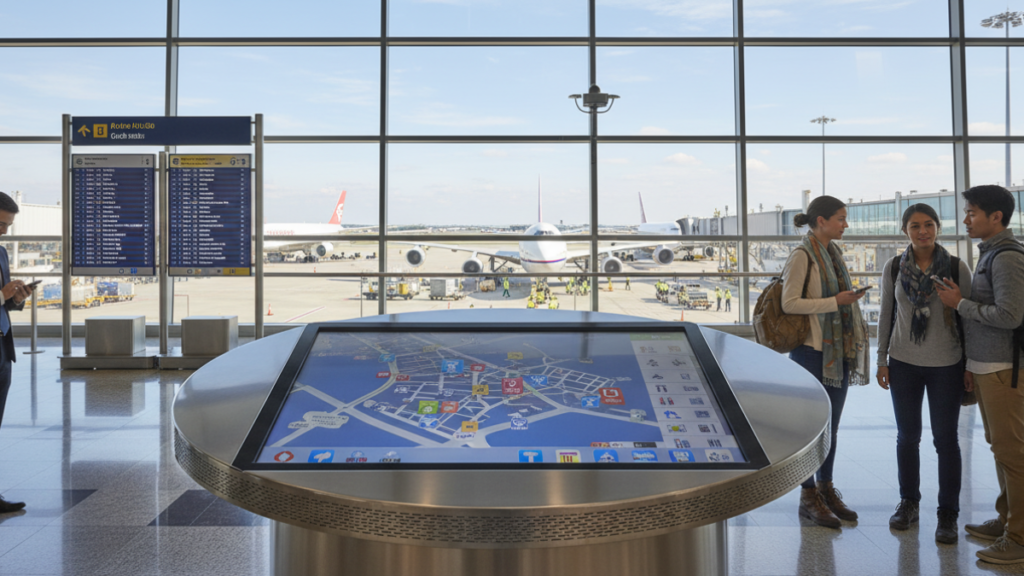
In busy terminals, it’s easy to get lost in the noise. Clear directions often use quick phrases, gestures, and signs. For those from Brazil, knowing how english prepositions for directions work can help follow spoken guidance better.
Directional language: left, right, straight on, past, towards, opposite
Staff often say things like “turn left” or “keep right”. “Straight on” is common in British English. It means to keep going without turning.
Some phrases can be tricky. “Past” means to go beyond something. “Towards” means in the direction of something, not necessarily reaching it. “Opposite” means facing across, like “opposite the lift”, which points to the other side of a corridor or open area.
| Phrase | Meaning in airport speech | Typical location clue |
|---|---|---|
| Go straight on | Continue forward without turning | Follow the main corridor past the shops |
| Go past security | Move beyond the screening point | Continue after the scanners and trays area |
| Walk towards departures | Head in that direction; the goal may be further on | Look for overhead “Departures” signs |
| It’s opposite the lift | It is across from the lift doors | Stand facing the lift; the place is behind you |
Distance and time: “a short walk”, “about five minutes”, “at the end”
Time estimates in airport directions are usually rough. “A short walk” can vary a lot. “About five minutes” is more of a quick guide than a promise.
End points are described simply. “At the end” usually means the last part of a corridor or the far edge of a hall. Spoken routes use english prepositions for directions like “at”, “by”, and “near” to place the destination.
Landmarks inside airports: escalators, lifts, security, duty-free
Landmarks help guide directions. Airport landmarks vocabulary includes escalators and lifts. These are easy to spot and are common meeting points.
Other common landmarks are security and duty-free. Directions often use these with english prepositions for directions. This helps listeners map the route to what they see.
- Which phrases sound closest in meaning to “go straight on”, and when might they differ in tone?
- How does “past” change the route compared with “towards” in a terminal corridor?
- Why can “about five minutes” be hard to judge at peak times?
- Which airport landmarks vocabulary items are easiest to recognise without reading signs, and why?
- How do english prepositions for directions help connect a destination to a landmark in spoken guidance?
English speaking for travel: pronunciation and listening shortcuts
In a busy terminal, clear signals are key for english speaking for travel. Background noise, distance, and announcements can make sounds unclear. A calm pace and clear key words often carry meaning better than extra speed.
For many Brazilian Portuguese speakers, pronunciation for travel English can feel harder. Consonant clusters and unfamiliar stress make words like customs, platform, information, and assistance tricky. Small choices help, like separating tricky clusters and keeping the main vowel clear.
Sentence stress also improves intelligibility in english speaking for travel. The listener often needs the core detail first: the gate, terminal, or city. When those items are stressed, staff can still understand the message even if the rest is less precise.
- Gate A12, not “the gate”.
- Terminal 3, not “the terminal”.
- Manchester or Lisbon, not “the flight”.
Listening skills airport English relies on quick recognition of numbers, letters, and set phrases. “Final boarding” and “last call” may arrive fast, and parts can be lost in noise. It helps to listen for anchors first, such as airline name, destination, and the change words: “now”, “delayed”, “cancelled”, or “gate change”.
Another feature is connected speech, where words blend in natural pace. “Go to” may sound like “guh-to”, and “next to it” can compress into a single run of sound. In listening skills airport English, this blending is normal, and it can explain why familiar words seem to vanish.
When meaning is unclear, asking again is a standard repair strategy, not a sign of weak pronunciation for travel English. Airport staff use short repeats every day, because announcements and face-to-face speech can be clipped or masked by noise.
| Airport item | What often causes confusion | Clear focus for pronunciation for travel English | Listening shortcut for listening skills airport English |
|---|---|---|---|
| Customs | Consonant cluster at the end can sound missing | Hold the final s sound to mark the word boundary | Listen for nearby words like passport and declaration |
| Platform | Stress may shift, making it harder to recognise | Stress the first part: PLAT-form | Catch transport cues such as train, shuttle, and numbers |
| Information desk | Long word with weak middle sounds in fast speech | Keep the main stress clear in inforMAtion | Listen for “desk” or “counter” as the anchor word |
| Assistance | Soft sounds may blend, especially in announcements | Make the ss sound clear and keep the final syllable light | Listen for context words: special, mobility, help |
| Gate A12 / Terminal 3 | Letters and numbers can be swallowed or masked by noise | Pause between letter and number: A … twelve | Focus on the pattern: letter + number, then repeat it quietly to confirm |
- Which airport words are most difficult to hear in a crowded space, and why?
- How does sentence stress change what a listener understands first?
- What is one connected speech example that has caused confusion in past trips?
- When an announcement is unclear, which “anchor words” can be listened for before anything else?
- How can repetition requests support english speaking for travel without slowing communication?
Problem-solving phrases when you’re lost, late, or confused
Even in well-signed terminals, a wrong turn can happen. Clear airport problem phrases help staff respond quickly, especially during transfers and gate changes. For travellers from Brazil, it also reduces time spent translating in the moment.
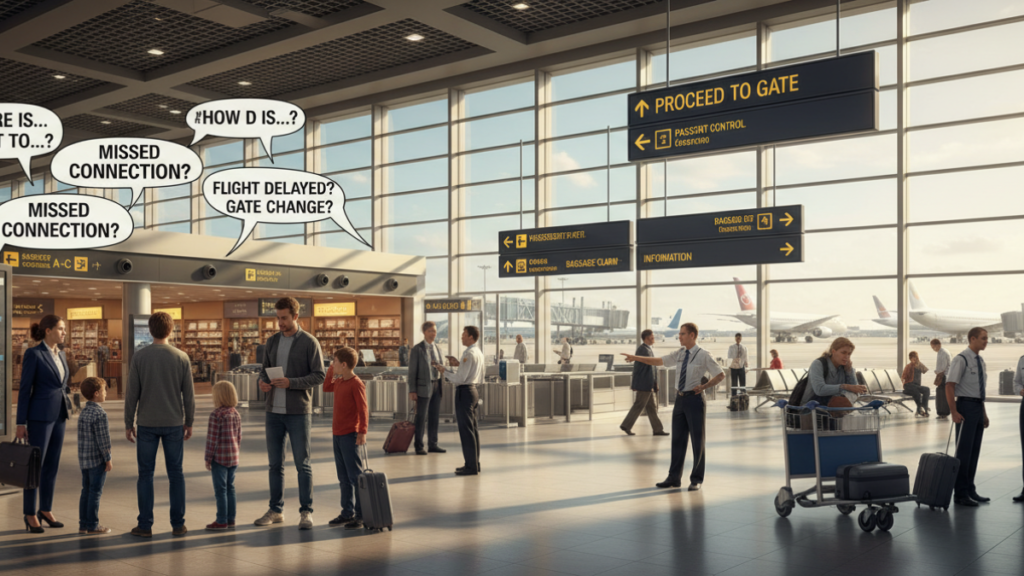
This set keeps the focus on three details: current location, destination, and time. When people ask for directions at the airport in English in a calm way, they often get shorter, more direct answers. Many british english airport phrases also sound softer, which can help when queues are long.
What to say if you missed a turning or went to the wrong terminal
When someone is misrouted, it helps to name the place they can see and the place they need. These airport problem phrases are brief and easy to repeat at an information desk or near security.
| Situation | Useful phrase | Key detail to add |
|---|---|---|
| Wrong terminal | Sorry, I think I’m in the wrong terminal. Where do I go for Terminal 2? | Airline name and flight number, if known |
| Missed a turning | I may have missed a turning. Is Gate 18 this way? | Nearest landmark: lifts, escalators, or duty-free |
| Time pressure | My flight boards at 14:20. What’s the fastest route to my gate? | Ask if a shuttle or train is required |
| Unsure of level | Am I on the right floor for Departures? | Current area: arrivals hall, check-in, or transfers |
These options match how people ask for directions at the airport in English when they need a quick correction. They also fit common british english airport phrases, with “sorry” used as a polite opener.
Asking someone to repeat or speak more slowly
Noise, accents, and fast speech can make directions hard to follow. Simple repair phrases can prevent a second mistake, without sounding blunt.
- Sorry, could you say that again, please?
- Could you speak a little more slowly, please?
- Just to check, you mean I go straight on, then left after security?
- So it’s Terminal 3, Gate B12, and then the shuttle?
Repeating the key steps shows attention and lets the other person confirm or correct. This is one of the most practical airport problem phrases for busy corridors and public address announcements.
Checking whether you need to go through security or passport control again
During connections, the most important check is whether screening must be repeated. When travellers ask for directions at the airport in English, they can also confirm process rules before joining a queue.
- Do I need to go through security again for transfers?
- Do I need to go through passport control again, or stay airside?
- Which desk can confirm this: the airline desk, the transfer desk, or airport staff?
- Where is the transfer security entrance from here?
These british english airport phrases keep the tone polite and factual. They also make it easier for staff to give directions that match the correct route, not just the nearest corridor.
Conclusion
Airport travel relies on signs, short announcements, and quick questions. For those from Brazil, knowing airport directions in English is key. It should be simple and clear, even with imperfect grammar.
Using clear words for places like arrivals and departures helps. It makes it easier to follow signs and directions. This way, travellers can navigate the airport more smoothly.
Polite questions in British English also help in busy terminals. When asking for directions, start with a brief introduction. Then, state where you need to go, like a gate or passport control.
Adding a small confirmation, like “So it’s near…?”, can avoid mistakes. This step ensures you’re on the right path without delay.
These short conversations are like real-life airport chats. They focus on getting to your destination quickly and efficiently. For more help, travel English vocabulary and airport phrases can be useful in other places too.
Effective direction requests follow a simple pattern. Start with a polite question, then state your destination. Add some context about your flight and end with a quick confirmation.
This structure helps with airport directions in English. It’s all about being quick and clear. With practice, asking for directions becomes easier and more confident.
FAQ
What does “airport directions English” mean in real airport situations?
It’s the simple English used to find places and services in terminals. It starts with a polite greeting, then clearly states the destination. Finally, it asks a quick question to confirm details.
Which British English airport phrases sound polite but direct?
Phrases like “Excuse me, could you tell me where… is?” are common. So are “Sorry, which way is…?” and “Could you point me towards…?”. For extra clarity, “Just to check, is it on this level?” and “So I go past security, then turn left?” work well.
What essential words on signs should travellers recognise in arrivals and departures?
Key terms include Arrivals (incoming flights), Departures (outgoing flights), Check-in (bag drop and boarding pass), Baggage reclaim (collecting checked luggage), and Customs (controls for goods declarations after arrival). Knowing these words helps when time is short.
When is it better to ask airport staff rather than other passengers?
Staff are best for rules and restricted areas, like security routes and passport control. They know about gate changes and transfer needs. While passengers can help with simple directions, they might guess or follow a different layout, leading to delays.
How can a traveller ask for clarification if instructions are fast or unclear?
Useful phrases include “Sorry, could you say that again?”, “Could you speak a bit more slowly, please?”, and “Do you mean the lift near the duty-free?”. A quick summary helps too: “Just to check, it’s five minutes straight on, then right at the escalators?”


1 thought on “How to Ask for Directions at the Airport in English (Conversation Practice)”