
Introduction
Have you ever wondered why some people speak English with such effortless charm and clarity, while others struggle to be understood? The secret often lies not in the words themselves, but in how they are delivered.

This comprehensive guide focuses on mastering key elements like sentence stress, intonation, and vowel reduction in Received Pronunciation (RP). Contrary to popular belief, there isn’t just one british accent; the UK boasts a rich tapestry of regional accents and dialects. RP, however, remains a widely recognised standard.
Designed for B2 learners, this article offers practical tips and techniques. You’ll discover how active listening, imitation, and consistent practice can transform your pronunciation. We’ll use resources like the BBC and expert tutorials to help you get started.
By the end, you’ll not only sound more like native speakers but also gain confidence in your overall communication. Ready to begin?
Key Takeaways
- There is no single British accent; numerous regional variations exist.
- Received Pronunciation (RP) is often considered the standard benchmark.
- Mastering sentence stress and intonation is crucial for clarity.
- Active listening and imitation of native speakers accelerates learning.
- Practical exercises and consistent practice lead to noticeable improvement.
- Incorporating authentic resources like the BBC enhances pronunciation skills.
- Improving these elements boosts overall communication confidence.
What Exactly is the “British Accent”?
When people imagine a British manner of speaking, they often picture a single, uniform sound. This common misconception overlooks the rich tapestry of regional variations found across the United Kingdom.
The Myth of a Single British Accent
The United Kingdom hosts an incredible diversity of speech patterns. These variations can change dramatically from region to region, sometimes even between neighbouring villages.
Different areas have distinct ways of speaking. You might encounter English, Welsh, Northern Irish, or Scottish varieties. Each has its own unique character and charm.
Understanding this diversity helps learners appreciate the complexity of the language. It prevents oversimplification and enhances cultural understanding.
“The richness of British speech lies in its regional diversity, not in any single standard.”
Received Pronunciation (RP): The Standard Benchmark
Among this variety, Received Pronunciation stands out as a common reference point. Phonetician Daniel Jones codified this accent in the early 20th century.
RP is often called “BBC Pronunciation” due to its historical association with the broadcaster. It serves as the standard accent of Standard English, primarily spoken in southern England.
This prestige dialect appears frequently in formal settings, education, and media. For many learners, it represents a clear and neutral target for pronunciation practice.
| Feature | RP | Regional Varieties |
|---|---|---|
| Vowel Sounds | Distinct and reduced | More open and varied |
| Rhythm | Regular and measured | Often more rhythmic |
| Intonation | Subtle pitch changes | Wider pitch range |
| Formality Level | Formal settings | Everyday conversation |
Your choice of accent depends on personal goals. RP offers clarity and widespread recognition, while regional dialects provide authenticity and local connection.
Remember that RP remains a valuable reference point. It helps learners master key pronunciation features covered later in this guide.
Understanding the Different British Accents and Dialects
Did you know that the way people speak across the UK varies more than you might think? From the rolling hills of Scotland to the bustling streets of London, each region has its own unique flavour of English.
This variety makes the language rich and fascinating. It also presents an exciting challenge for learners. Exploring these differences helps you understand real-world conversations better.
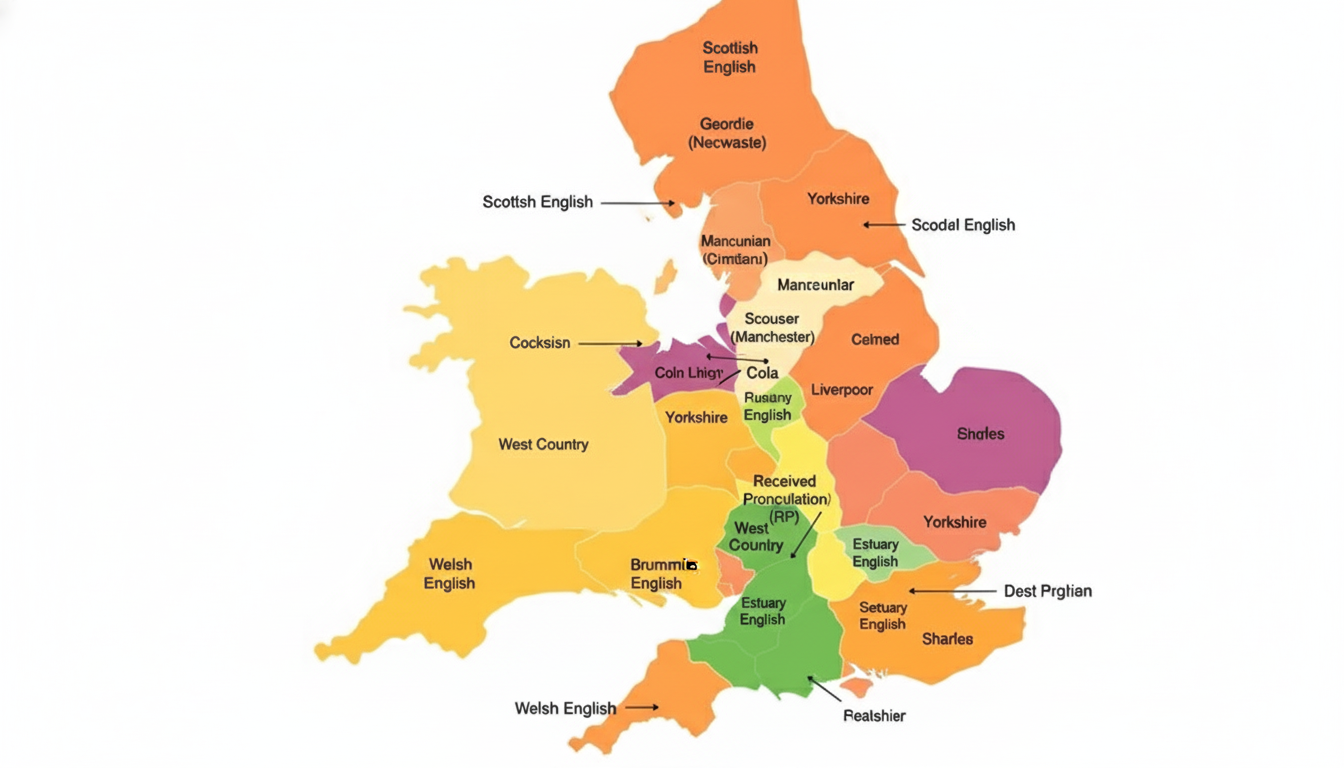
Let’s look at some prominent examples. You’ll see how pronunciation and vocabulary shift from place to place.
Received Pronunciation (RP) / The Queen’s English
RP is often heard on international media like the BBC World Service. It represents a prestige dialect associated with formal settings and education.
However, very few people in the UK actually use this manner of speaking daily. It remains a useful reference for learners due to its clarity.
Cockney
This famous dialect comes from London’s East End. It features distinctive sounds like glottal stops and the replacement of ‘th’ with ‘f’.
For example, “think” might sound like “fink”. Cockney also uses colourful rhyming slang, adding playful twists to common phrases.
Estuary English
Spoken along the Thames Estuary, this accent has gained popularity in southeastern England. It blends features from both RP and Cockney.
This creates a modern, accessible sound that many people find appealing. It’s often heard in everyday conversations across the region.
Northern, Scottish, and Welsh Varieties
Northern accents, like those in Yorkshire, often change words ending in ‘ee’ sounds to ‘eh’. So “nasty” becomes “nasteh”.
Scottish English shows huge variation. Remote areas like Shetland have stronger accents, while cities like Glasgow have their own distinct patterns.
Welsh English carries unique intonation and vocabulary influences from the Welsh language. This gives it a musical quality that’s quite charming.
Northern Irish accents tend to drop letters, making “Northern Irish” sound like “Nor’n Ir’sh”. They also have a melodic, rhythmic flow.
| Dialect | Region | Key Features | Example |
|---|---|---|---|
| RP | Southern England | Clear vowels, formal tone | Used in broadcasting |
| Cockney | East London | Glottal stops, th-fronting | “Think” → “Fink” |
| Estuary | Thames Valley | Mix of RP and Cockney | Modern, widespread |
| Geordie | Newcastle | Final ‘r’ as ‘ah’ | “Car” → “Cah” |
| Scouse | Liverpool | Nasal tones, unique rhythm | Distinct vowel sounds |
| Brummie | Birmingham | Flat intonation | Often misunderstood |
Listening to examples of these accents will greatly improve your comprehension skills. It makes recognising different speakers much easier.
Understanding regional varieties enriches your learning experience. It helps you appreciate the diversity you might encounter in media or travel.
How to Master British Sentence Stress
Have you noticed how some English speakers have a musical quality to their speech? This rhythm comes from mastering sentence stress, a crucial element that gives the language its distinctive flow.
Getting the stress patterns right makes your speaking sound more natural. It helps native speakers understand you better too.
The Rhythm of Speech: Stressed vs. Unstressed Syllables
English has a rhythm created by alternating stressed and unstressed syllables. Stressed ones are louder, longer, and higher in pitch. Unstressed syllables are quicker and quieter.
This pattern creates the characteristic beat of the language. Think of it like music with strong and weak beats.
Here are some common examples:
- CON-trast (noun) vs. con-TRAST (verb)
- PRE-sent (gift) vs. pre-SENT (to give)
- RE-cord (noun) vs. re-CORD (verb)
Notice how the meaning changes with different stress placement. This shows why getting it right matters.
Contrastive Stress: Changing Meaning through Emphasis
You can change a sentence’s meaning simply by stressing different words. This is called contrastive stress.
Look at these examples:
- SHE gave him the book (not someone else)
- She gave HIM the book (not another person)
- She gave him the BOOK (not something else)
Each emphasis shifts what the sentence communicates. This way of speaking adds nuance to conversations.
| Sentence | Stressed Word | Implied Meaning |
|---|---|---|
| I didn’t say you should go | I | Someone else said it |
| I didn’t say you should go | say | I implied it differently |
| I didn’t say you should go | you | I said someone else should go |
| I didn’t say you should go | go | I said you should stay |
Mastering these patterns helps you avoid monotone speech. It makes your English sound more engaging and authentic.
Here are some practical tips for practice:
- Listen to BBC news readers and notice their stress patterns
- Record yourself speaking and compare with native speakers
- Practice with common phrases, emphasising different words each time
Consistent practice will significantly improve your pronunciation. You’ll start to develop that natural rhythm native speakers have.
Remember that sentence stress conveys emotion and clarity. It’s not just about sounds – it’s about communication.
This foundation in stress patterns leads nicely into understanding intonation. The rise and fall of your voice completes the musical quality of English speech.
The Role of Intonation in the British Accent
Have you ever listened to someone speak and felt their words carried an extra layer of feeling? That’s the magic of intonation – the rise and fall of your voice that adds colour to speech.
It’s not just about the words you choose. How you say them shapes your message. Intonation helps express emotions, ask questions, and show certainty.

In Received Pronunciation, intonation patterns have a particular character. They tend to be more subtle than in some regional varieties.
Mastering this aspect of pronunciation makes your speaking sound more authentic. It helps native speakers understand your intentions clearly.
Falling Intonation for Statements and Certain Questions
Falling intonation occurs when your voice pitch drops at the end of a phrase. It signals completion and certainty.
You’ll hear it in statements like “I enjoyed the film.” The voice falls on “film,” showing the thought is finished.
Wh-questions also use falling intonation. For example, “What time is it?” has the voice dropping on “it.”
This pattern conveys confidence and finality. It’s common in news broadcasts and formal speeches.
Rising Intonation for Questions and Uncertainty
Rising intonation happens when your voice pitch goes up at the end. It often indicates questions or uncertainty.
Yes/no questions typically use this pattern. “Is it ready?” has the voice rising on “ready.”
It can also show politeness or hesitation. Saying “Perhaps we could try another way?” with a rise sounds more open.
This intonation makes your speech sound inquisitive and engaging. It invites conversation rather than closing it.
| Intonation Type | Usage | Example | Effect |
|---|---|---|---|
| Falling | Statements, commands, wh-questions | “Close the door.” | Certainty, completion |
| Rising | Yes/no questions, uncertainty | “Are you coming?” | Openness, politeness |
| Fall-rise | Doubt, hesitation | “Well, I’m not sure…” | Uncertainty, caution |
| Rise-fall | Strong feelings | “That’s amazing!” | Excitement, surprise |
Notice how BBC presenters use these patterns. Their intonation is clear but not exaggerated.
Incorrect intonation can cause misunderstandings. You might sound rude or unclear even with good pronunciation.
Here are some practical tips for practice:
- Shadow audio clips from authentic sources
- Focus on the musical flow of conversations
- Record yourself and compare with native speakers
Pay attention to intonation in daily interactions. Notice how meaning changes with pitch.
Mastering intonation adds nuance to your speech. It makes your communication more engaging and authentic.
Combine this practice with sentence stress and vowel work. This comprehensive approach yields the best results.
A Guide to RP Vowel Reduction
Have you ever listened to a native speaker and noticed how effortlessly their words flow together? This smoothness often comes from vowel reduction, a key feature of Received Pronunciation.
Vowel reduction helps create that connected, fluid sound. It makes speech more natural and easier to understand.
Mastering this aspect of pronunciation can transform your speaking. It brings you closer to the rhythm and flow of native speakers.
The Schwa Sound: The Most Common Vowel in English
The schwa sound /ə/ appears everywhere in English. It’s the most common vowel sound in the language.
This neutral sound occurs in unstressed syllables. It helps words flow together smoothly.
For example, “the” becomes /ðə/ when unstressed. “About” sounds like /əˈbaʊt/ with a schwa at the start.
Recognising and using the schwa improves your rhythm. It makes your speech sound more natural and connected.
“The schwa is the secret ingredient that makes English speech flow like music.”
Key Vowel Shifts: From ‘a’ to ‘o’ and Beyond
Several vowel sounds shift in distinctive ways. These changes create the characteristic sound of this accent.
The ‘a’ sound often resembles the American ‘o’. For example, “cat” becomes “caht” /kɑːt/.
Other vowels change too. The long ‘u’ gains a ‘y’ sound, making “stupid” sound like “styupid”.
Short ‘u’ sounds like the ‘u’ in “put”. “Under” becomes “oohn-duh” with this shift.
These vowel changes might seem small. But they make a big difference to your overall sound.
Pronouncing Common Words the British Way
Many everyday words have distinct pronunciations. Learning these helps you sound more authentic.
Here are some common examples:
- Water → WAH-ta
- Schedule → SHED-ual
- Advertisement → uhd-VER-tis-ment
- Privacy → PRIV-uh-see
- Neither → NIGH-thuh
Notice how final ‘r’ sounds become soft ‘uh’. “Perspire” becomes “perspi-uh” with this change.
Some words have silent letters too. “Hello” often loses its ‘h’, becoming “ello”.
These pronunciation patterns might feel strange at first. With practice, they become natural.
| Word | American Pronunciation | British RP Pronunciation |
|---|---|---|
| Vitamin | VYE-ta-min | VIT-a-min |
| Mobile | MOH-bul | MOH-bye-ul |
| Niche | nitch | neesh |
| Often | OFF-ten | OF-uhn |
| Herb | urb | hERB |
Practising these words regularly improves your accent. It helps you sound more like native speakers.
Focus on the vowel sounds and rhythm. This attention to detail makes your speech clearer.
Consistent practice with these patterns yields great results. Your pronunciation will become more accurate over time.
Remember that vowel reduction creates smooth, connected speech. It’s a crucial element of authentic pronunciation.
For authoritative reference and extra practice on weak forms and the schwa /ə/ in British English, see BBC Learning English’s pronunciation resources: BBC Learning English – Pronunciation.
Practical Tips for Practising Your British Accent
Ready to transform your pronunciation skills with actionable strategies? These practical methods will help you develop authentic speech patterns through consistent, engaging practice.
Focus on building muscle memory and listening skills. Small daily efforts yield significant results over time.
Actively Listen and Imitate: The Power of the BBC
BBC programmes offer excellent models for Received Pronunciation. Watch news broadcasts and documentaries to hear clear examples.
Pay attention to how presenters form words with their mouth, tongue, and lips. Notice their speech rhythm and pacing.
Record yourself speaking the same content. Compare your recording to the original to identify areas for improvement.
This comparison work helps you notice subtle differences in vowel sounds and stress patterns.
Utilise Video Tutorials from Expert Coaches
Online videos provide structured learning from qualified instructors. Patricia Fletcher and David Ley offer excellent tutorials.
Their lessons break down complex pronunciation techniques into manageable steps. You’ll learn proper mouth positioning and intonation patterns.
Follow along with exercises designed to build specific skills. Regular practice with these resources accelerates your progress.
“Consistent imitation of quality models is the fastest path to accent acquisition.”
Incorporate British Slang into Your Practice
Using everyday expressions makes your speech sound more natural. Slang adds authenticity to conversations.
Start with common terms like “cheers” for thank you and “mate” for friend. These words appear frequently in casual speech.
Here are some useful examples to practise:
- Ace – Excellent or awesome
- Bloke – A man
- Bloody – Intensifier meaning “very”
- Fit – Attractive
- Gutted – Deeply disappointed
- Lad – Young man
- Quid – Pound sterling
- Rubbish – Nonsense or poor quality
Incorporate these terms into daily practice sentences. This helps them feel more natural in conversation.
| Practice Method | Resources | Frequency | Key Benefit |
|---|---|---|---|
| Active Listening | BBC programmes, podcasts | Daily | Develops ear for rhythm |
| Video Tutorials | Patricia Fletcher, David Ley | 3-4 times weekly | Structured technique building |
| Slang Incorporation | Common expressions list | Daily conversation | Adds authenticity |
| Recording Comparison | Recording device | Weekly | Tracks progress objectively |
| Native Speaker Practice | Language exchanges, cultural organisations | Weekly | Real-world feedback |
Practising with native speakers provides invaluable feedback. Join language exchange programmes or visit local British pubs.
These interactions help you test your skills in real conversations. You’ll learn natural pacing and responsive speaking.
Online communities offer additional support and motivation. Connect with fellow learners to share tips and experiences.
Remember that accent development takes patience. Celebrate small improvements along your journey.
Consistent practice creates lasting change in how you sound. Your efforts will transform your communication skills over time.
To build fluency beyond this B2 guide, explore our broader pronunciation hub, where you’ll find step-by-step lessons on stress, rhythm and connected speech to reinforce today’s drills: Phrasal Verbs.
Conclusion: Your Path to Speaking with a British Accent
You’ve explored the rich diversity of UK speech patterns and learned key techniques. Mastering sentence stress, intonation, and vowel reduction transforms your pronunciation.
Remember, consistent practice with BBC resources and video tutorials brings real progress. Celebrate small improvements as you refine your sound.
This journey enhances both speaking and listening skills while deepening cultural appreciation. Stay patient and enjoy each step.
Keep practising with native speakers and explore regional varieties for fun. Your efforts will yield impressive results over time.
Ready to continue? Share your progress and join our learning community for ongoing support!
FAQ
Is there just one British accent?
Not at all! The UK is full of different regional sounds. What many people think of as a typical British voice is often Received Pronunciation, which is just one of many.
What is Received Pronunciation?
Often called RP or the Queen’s English, it’s a neutral accent not tied to a specific region. It’s frequently used in national media and is a common model for learners.
How important is sentence stress?
It’s crucial for natural-sounding speech. Putting emphasis on the right words helps you sound more fluent and makes your meaning clearer to listeners.
What is the schwa sound?
It’s a relaxed, neutral vowel sound (like the ‘a’ in ‘about’) and is the most common one in English. Mastering it is key to a more authentic rhythm.
What’s the best way to practise?
Listening is everything! Tune into BBC programmes, watch British films, and try to mimic the speakers. Even a little practice each day makes a big difference.
Should I learn slang?
It can be fun and useful for understanding everyday conversations, but focus on clear pronunciation and standard phrases first.



1 thought on “British Accent B2: Mastering Sentence Stress, Intonation, and RP Vowel Reduction”