
Introduction
UK airports are fast, loud, and busy. For Brazilian travellers, small language gaps can cause delays. This guide helps with British English for airports, focusing on common signs, screens, and announcements.

Airport language is more than just travel English. It includes everything from arriving at the terminal to checking in and going through security. The goal is to learn airport English that matches how it’s spoken and written in the UK.
The guide focuses on British English for Airports, including spelling, pronunciation, and polite phrases. British terms like “queue” and “trolley” are important. They shape how you speak with airport staff in English.
The article is divided into ten sections, covering vocabulary, dialogues, and speaking practice. It shows travel English phrases in use and offers short practice lines. It also addresses common Portuguese mistakes and pronunciation issues that affect understanding.
Key takeaways
- British English for airports is shaped by UK signage, announcements, and staff language.
- Airport English vocabulary covers the full journey, from check-in to customs and transfers.
- British airport terms can differ from American wording and may affect comprehension.
- Airport dialogues in English work best when they use short, standard exchanges and polite forms.
- Airport speaking practice supports clearer pronunciation in busy, noisy terminals.
- English for airport situations improves when common Portuguese-to-English pitfalls are recognised early.
Why Learn Airport English in British English as a Brazilian Traveller?
For Brazilian travellers going to the UK, knowing British English for airports is key. Signs, announcements, and staff questions often use local terms. When these match what you’ve learned, communication at UK airports becomes clearer.
Airport English moves fast. Airports are noisy, lines are long, and questions are quick. Knowing British airport words helps travellers catch important phrases, even when not facing the speaker.
“Can you pop your liquids in the tray, please?”
Common situations Brazilians face at UK airports
Many arrivals start by finding the right terminal and reading the departures board. Then, they check in, ask about baggage, and look for the gate. Later, they follow security screening instructions, often over background noise.
Gate changes and boarding groups can confuse if a message is missed. If a connection is missed, travellers go to an assistance desk for rebooking. These are situations where timing and specific wording are crucial.
- Locating terminals, departures, and the correct gate
- Asking about baggage allowance, tags, and oversize items
- Following security screening directions and tray rules
- Handling delays, cancellations, and tight connections with airport problem-solving English
British vs American airport terms that cause confusion
Some learners in Brazil start with American materials. But UK terms are used on signs and by staff. A small difference can slow understanding, especially when scanning screens and listening for updates.
| UK term used at airports | US term often learned | Where it shows up | Why it can matter |
|---|---|---|---|
| queue | line | Security lanes, check-in areas, boarding | Staff may direct passengers to “join the queue” quickly |
| trolley | cart | Baggage hall and car parks | Signs may point to “trolley return” locations |
| hand luggage | carry-on | Airline rules, security checks | Limits and instructions often use the UK wording |
| return | round trip | Booking checks, ticket questions | Staff may confirm “one-way or return” at speed |
| post | Service counters and forms | Some service points use “post” in instructions and labels | |
| trainers | sneakers | Security and lost property descriptions | Descriptions can be repeated back using UK terms |
How confidence and clarity reduce travel stress
Clarity comes from recognising common question shapes and polite phrasing. Staff may soften requests, which can sound less direct but still expects a quick response. British airport vocabulary helps in decoding these patterns faster.
When travellers can answer accurately, fewer repeats are needed at desks and checkpoints. This is helpful in solving problems like delays, cancellations, and rebookings. It also supports clear communication when quick decisions are needed.
Essential Airport English Vocabulary You Will Actually Use
This set of airport English vocabulary covers what travellers see, hear, and need to understand in UK terminals. It uses British English for airports, matching the language on boards, signs, and announcements.
For Brazilian travellers, UK airport terminology might seem familiar but has key differences. The goal is to help you quickly understand airport situations using clear meanings and short examples.
Parts of the airport: terminal, departures, arrivals, gate, carousel
A terminal is the main building for passengers, often split by airline or destination. Inside, Departures covers check-in, security, and the gates, while Arrivals is where passengers exit after landing.
A gate is the boarding area shown as a number or letter, often in phrases like “Gate number 42” or “Gate change”. In the UK, luggage collection is usually labelled baggage reclaim, and the moving belt may be called a carousel or baggage reclaim belt.
Documents and travel items: passport, boarding pass, visa, hand luggage
Staff commonly ask for a passport and boarding pass at check-in, security, and boarding. A visa or residence permit may be relevant at immigration, depending on travel status.
Hand luggage is what stays with the passenger on board, while hold luggage (also called a hold bag) is checked in. A frequent phrase is “hand luggage allowance”, and at security, “liquids bag” refers to the clear bag for small containers.
Signs and instructions: queue, closed, delayed, diverted, last call
This area overlaps with airport signs vocabulary, because meaning needs to be read quickly. A queue is a line of people, and “Keep to the queue” is common in busy areas.
Operational words affect timing: closed suggests an entry point or desk is not accepting passengers; delayed means later than scheduled; cancelled means the flight will not run. Diverted means the aircraft has landed at a different airport.
“Last call” or “Final call” signals urgency in announcements, and “boarding” shows passengers are being accepted at the gate. “Gate change” and “out of service” are also common on screens and near lifts, toilets, and escalators.
People and roles: check-in agent, ground staff, cabin crew, border officer
A check-in agent handles documents, seats, and hold bags at the desk or kiosk area. Ground staff is a wider term for airport and airline workers who support boarding, gate checks, and customer queries.
Cabin crew work on the aircraft and manage safety and service on board. In the UK, a border officer is linked to UK Border Force and checks entry rules, while a customs officer focuses on goods and declarations.
| UK airport terminology | Plain meaning | Where it is usually seen or heard | Example of travel English phrases |
|---|---|---|---|
| Departures hall | Main area before security for check-in and bag drop | Terminal maps, overhead signs, staff directions | “Departures hall is upstairs.” |
| Arrivals hall | Exit area after landing and immigration | Wayfinding signs, meeting points, public transport desks | “Arrivals hall is straight ahead.” |
| Baggage reclaim | Area where checked bags are collected | Large signs near belts, flight screens after passport control | “Which belt is baggage reclaim for this flight?” |
| Carousel / reclaim belt | Moving belt that delivers suitcases | Numbered belts, announcements for oversize luggage | “Bags are on carousel 6.” |
| Gate change | Boarding gate has been moved | Departure screens, push notifications, announcements | “There has been a gate change.” |
| Diverted | Flight landed at another airport | Arrival boards, airline messages, service desk updates | “The flight has been diverted.” |
Across British English for airports, the same words often repeat on screens, over tannoys, and in short staff questions. Learning them in context supports quicker decisions during English for airport situations, especially when time is limited and the terminal is crowded.
British English for airports
In UK airports like Heathrow and Gatwick, small words can make a big difference. British English signs and announcements are key. For Brazilian travellers, noticing these helps with smoother airport travel.
Key British terms and phrases for navigating UK airports
British airport terms are often straightforward. For example, you’ll find baggage reclaim instead of “baggage claim”. A trolley is for your luggage, and toilets is the usual sign.
“Lift” is used for elevators, and customer services handles any issues. These terms are common in UK airports.
Rail links introduce more phrases. “Platform” is for train stations, and “rail replacement” means buses are used instead. Airports like London Stansted and Manchester Airport use these terms.
| Sign or announcement wording | Meaning in plain airport language | Where it is often seen |
|---|---|---|
| Baggage reclaim | Area where checked bags arrive on the belt | Arrivals hall, near the carousel |
| Trolleys available | Carts for moving suitcases | Car parks, arrivals, baggage reclaim |
| Customer services | Help desk for delays, rebooking, and queries | Departures and arrivals concourses |
| Lift to departures | Vertical access to another level | Multi-storey terminals and car parks |
| Rail replacement buses | Buses operating instead of trains | Airport rail stations during disruption |
Pronunciation tips for high-frequency words (queue, luggage, schedule)
Getting the pronunciation right is crucial for words like queue. It’s pronounced /kjuː/ and often used in instructions. It’s easy to miss if you expect it to be longer.
Luggage is /ˈlʌɡɪdʒ/ with the stress on the first part. This helps in quick questions like “Any luggage to check in?” The UK uses /ˈʃedjuːl/ for schedule, but /ˈskedʒuːl/ is also common. Knowing both helps with announcements.
Polite British phrasing: softeners and indirect questions
British English often uses softeners like “Could you…?” and “Would you mind…?” They seem polite but are actually instructions. “Just to check…” is used to confirm details without being abrupt.
Phrases like “I’m afraid…” signal rules or limits, like baggage allowances. These indirect forms make the process smoother. They’re used in various airport interactions, from check-in to immigration.
Travel English Phrases for Check-in and Baggage Drop
At the desk, things move fast and every detail counts. The best travel English phrases for British airports are short and to the point. They confirm who you are, where you’re going, and when.
These phrases help with clear conversations at the airport. They ensure staff can check your passport name, booking details, or if you have a connecting flight. For Brazilian travellers, they help avoid asking the same questions over and over in a busy area.
Checking in: seat requests, special assistance, flight details
Check-in starts with quick questions: “What’s your surname?”, “Where are you off to?”, and “Do you have bags to check?” A simple answer is best, like your surname, destination, and flight number.
Service requests are straightforward: “Can I have an aisle seat?”, “We’re travelling together”, and “Is there a special meal?” For those with mobility needs, staff might ask if you need help, like a wheelchair or support for reduced mobility.
Staff often double-check information with questions like “Could you spell that?” and “Is that with a double ‘l’?”. In British airports, this is standard practice to ensure accuracy.
Baggage rules: allowances, overweight bags, fragile items
At baggage drop counters, rules are about allowances. Staff might say, “Your hold bag allowance is one bag at 23 kilos,” and “Hand luggage must fit the size guide.”
If a bag is too heavy, they’ll tell you straight: “It’s overweight,” or “That’s oversized.” They might ask if you want to pay a fee to check it in.
For fragile items, they use careful language: “Is anything fragile in the bag?”, and “This should be packed securely.” They might also ask about a pushchair, whether it’s checked in or taken to the gate.
| UK desk wording | What it usually refers to | Typical follow-up question |
|---|---|---|
| Allowance | The number of bags and weight included in the ticket | “How many hold bags are you checking today?” |
| Hand luggage | Bags kept in the cabin, with size and liquid limits | “Does your hand luggage fit under the seat?” |
| Hold bag | Checked baggage that goes in the aircraft hold | “Would you like this tagged to your final destination?” |
| Overweight / oversized | Above weight or size limits set by the airline | “Would you like to remove items or pay the excess baggage charge?” |
Problem-solving phrases: missing booking, name mismatch, rebooking
When a booking can’t be found, staff might say, “I can’t locate the booking,” or “Could you confirm the booking reference?”. A calm answer is best: “The reference is…”, “The flight number is…”, and “The passport name is spelt…”.
Name issues often stem from spelling: “There’s a mismatch with the name on the passport,” followed by “Is there a middle name on the ticket?”. In airport dialogues, the goal is to match the passport exactly, including any accents.
After missed online check-in or disruptions, staff offer options: “I can check you in here,” “Seats are limited,” and “We can look at rebooking.” These phrases keep the conversation structured, which is crucial in airports where time and accuracy are key.
Airport Dialogues in English for Security and Boarding
In UK airports like Heathrow and Gatwick, conversations are brief and to the point. For Brazilian visitors, British English can seem fast but follows a pattern. Knowing key phrases helps when audio is unclear.
At security, English focuses on simple actions and politeness. Staff might say “Could you…” or “Would you mind…”, even when they mean it. Paying attention to verbs like “place”, “remove”, and “separate” is crucial.
Officer: “Boarding pass, please.”
Traveller: “Here you are. Is this lane for all passengers?”
Officer: “Yes. Laptops out, liquids in the clear bag, please.”
Traveller: “All right. Do I need to take off my belt as well?”
Secondary screening can happen suddenly, so it’s important to stay calm and ask for clarification. British English often uses softeners like “just”, “a quick”, and “for a moment”. It helps to confirm what is being checked and what comes next.
Officer: “Could you step to the side, please?”
Traveller: “Of course. Is there a problem with my bag?”
Officer: “We need to take a quick look. Any sharp items or liquids over 100 ml?”
Traveller: “No. If you repeat that last part, please—did you say 100 ml?”
At the gate, English is about announcements and checks. Phrases like “now boarding” and “final call” signal when it’s time to go. Staff might ask for a passport and scan a boarding pass. Knowing travel English phrases helps with seat numbers and hand luggage size.
Gate staff: “We are now boarding. Passport and boarding pass, please.”
Traveller: “Here they are. Am I in group three?”
Gate staff: “Yes. Could you place your bag in the sizer?”
Traveller: “Certainly. If it does not fit, what are my options?”
Gate changes and delays are common. Repeating key facts back helps. UK announcements include gate letters, times, and reasons like “operational” or “air traffic control”. Asking clear questions can save time in busy queues.
| Moment | Typical UK staff wording | Useful traveller reply | Focus for understanding |
|---|---|---|---|
| Security entry | “Boarding pass, please. Keep moving.” | “Here you are. Is this the correct queue?” | Queue direction and lane type |
| Screening trays | “Laptops out. Liquids separate.” | “Understood. Do tablets count as electronics?” | Item categories and actions |
| Prohibited items check | “Any sharp objects or aerosols?” | “No sharp items. Is deodorant allowed in hand luggage?” | Yes/no control questions |
| Secondary bag search | “Could you step to the side for a bag check?” | “Of course. What item are you looking for?” | Polite directive and purpose |
| Boarding call | “Now boarding… Final call for…” | “Just to confirm, is boarding for flight BA… at gate A…?” | Flight, gate, and timing |
| Gate document scan | “Passport and boarding pass, please.” | “Here you are. Could you repeat the seat number you see?” | Names, seat numbers, and clarity |
| Hand luggage size | “Please place it in the sizer.” | “All right. If it is too large, will it be checked in?” | Conditional outcomes |
| Last-minute gate change | “Gate has changed. Please proceed to…” | “Thanks. Is it a long walk, and is boarding still on time?” | Location and schedule impact |
For airport dialogues in English, short confirmations are key. For example, “So gate B12, 18:40, is that right?” This style is typical in British airports, where clarity and speed are valued. With practice, security and boarding English become more familiar, as the same phrases keep appearing.
English for Airport Situations at Immigration and Customs
At UK airports, quick conversations can greatly affect your journey. For Brazilian travellers, speaking English at the border is crucial. It’s about giving clear answers to direct questions to keep things moving.

Purpose of visit: tourism, business, study, visiting family
Immigration officers often ask why you’re visiting. Quick and clear answers are best. Say “tourism”, “business”, “study”, or “visiting family”.
If more details are needed, stick to facts. Mention the event, university, or family ties. Using the same words as your documents helps avoid confusion.
Accommodation and plans: where you are staying, length of stay
Next, you’ll be asked about your accommodation and stay. Mention a hotel, flat, or family home, along with your stay duration and return date. Make sure your words match your documents.
Useful signs around the airport can help. They point to Arrivals, Baggage Claim, Restrooms, and Information. For a quick vocabulary check, airport vocabulary is handy under pressure.
Customs vocabulary: declare, prohibited items, duty-free allowance
After passport checks, customs look at what you’re carrying. You might hear “Nothing to declare” or “Goods to declare”. Remember, there’s a duty-free limit on certain items.
| Sign or term | What it means in practice | Typical items referenced |
|---|---|---|
| Nothing to declare | Used when carrying items within allowance and no restricted goods | Personal belongings; permitted gifts within limits |
| Goods to declare | Used when carrying items that exceed limits or need reporting | Alcohol, tobacco, large amounts of cash, higher-value purchases |
| Prohibited / restricted | Items that are banned or controlled, sometimes requiring permits | Some foods, plants, animal products, certain medicines |
| Duty-free allowance | A set limit before taxes may apply | Commonly linked to alcohol and tobacco; varies by rules |
Staying calm: clarification questions and polite repetition
Even the most confident speakers might miss something in a busy airport. British English values politeness and calm when asking for clarification.
- “Could you repeat that, please?”
- “Could you speak a bit more slowly, please?”
- “Do you mean the address where I’m staying?”
- “I’m not sure I understood the question.”
These phrases help in airport conversations. They ensure clarity over speed, which is key in both immigration and customs.
Airport Speaking Practice: Role-Plays, Prompts and Shadowing
Good airport speaking practice should feel like real airport life. In British airports, talks are short and polite. They often talk about times, documents, and how many bags you have.
Role-play scripts: traveller and staff (short, realistic exchanges)
Real airport talks are short and direct. Staff ask clear questions and use polite words like please and thank you.
| Moment | Staff line | Traveller line |
|---|---|---|
| Check-in | “Can I see your passport and boarding pass, please?” | “Yes, here you are. One bag to check in.” |
| Security | “Any liquids, laptops, or tablets in your bag?” | “Yes, a laptop. I’ll take it out now.” |
| Boarding | “Group three is boarding now. May I see your pass?” | “Of course. Am I at the right gate?” |
| Immigration | “What is the purpose of your visit to the UK?” | “Tourism. I’m staying for seven days.” |
Speaking drills: ask–answer patterns for speed and accuracy
Drills help you answer quickly and correctly. They use simple travel phrases. This makes sure you speak clearly and quickly.
- “Where are you flying to?” → “I’m flying to Manchester.”
- “What’s your flight number?” → “It’s BA248.”
- “How many bags are you checking?” → “One suitcase.”
- “Window or aisle?” → “An aisle seat, please, if possible.”
- “How long are you staying?” → “Until next Monday.”
Shadowing practice with model lines for British rhythm and intonation
Shadowing means you listen and repeat at the same time. It helps you learn the British way of speaking. This is important for airport English.
Start with simple lines like “Could you tell me where the bag drop is, please?” and “Sorry, could you repeat that more slowly?” In Brazilian Portuguese, words like pass, gate, and stamped end with soft sounds. Practice to keep these sounds clear but natural.
Self-recording checklist: pronunciation, pace, and politeness
Recording yourself helps you see how you sound. It’s especially useful in loud airport areas. It shows if you speak clearly at normal speed.
- Key words stay clear: dates, times, flight numbers, and surnames.
- Word stress is steady in common words like passport, boarding, and luggage.
- Vowel length contrasts are clear (for example, ship vs sheep).
- Pace is steady, with short pauses after key facts rather than rushed speech.
- Polite markers appear naturally: please, thank you, and indirect requests.
Common Mistakes Brazilians Make in Airport English (and Better Alternatives)
Many airport English mistakes come from speed, noise, and literal translation from Portuguese. In British English for airports, small word choices can change meaning, especially on signs and announcements. Clear airport English vocabulary helps keep exchanges short and reliable under time pressure.
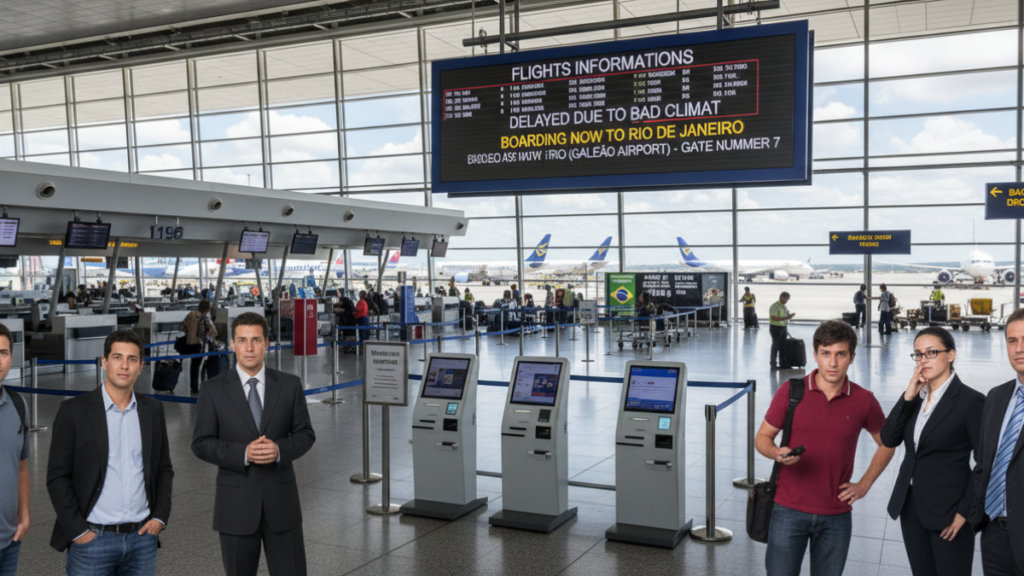
False friends are common. “Actually” often gets used to mean atualmente, but in English it signals correction or surprise. Another slip is “I have a doubt”, which sounds unusual in English for airport situations; staff will still follow, yet it can slow the exchange.
British wording matters in the UK. Staff usually understand American terms, but screens and tannoy messages often match British English for airports. Saying “line” or “carry-on” may work, yet “queue” and “hand luggage” fit the local pattern and reduce back-and-forth.
| Common phrasing heard from Brazilians | What it can sound like in a UK airport | Better alternatives (airport-ready) |
|---|---|---|
| “Actually, I’m here since Monday.” | “Actually” suggests a correction, not “currently”. | “I’ve been here since Monday.” / “I arrived on Monday.” |
| “I have a doubt about my gate.” | Unusual phrasing; may prompt extra questions. | “I have a question about my gate.” |
| “Where is the line for check-in?” | Understandable, but less aligned with signage. | “Where is the queue for check-in?” |
| “Is my carry-on ok?” | May lead to “Do you mean cabin bag?” | “Is this hand luggage within the limit?” |
| “I will take my luggage in the belt.” | “Belt” is vague; UK airports often say “carousel”. | “Where is baggage reclaim?” / “Which carousel is it on?” |
Pronunciation can also reduce clarity. Final consonants carry meaning in busy halls, such as “pass” versus “past”, or “gate” versus “late”. Number pairs are another risk: 13/30 and 15/50 can blur, so slower pacing helps in airport dialogues in English.
Pragmatics matter in service settings. Direct requests can sound abrupt without softeners, even when the message is polite in Portuguese. Many travel English phrases used in the UK add a small buffer, and clarification lines help when audio is poor.
- Clear request: “Could you tell me which queue to use?”
- Simple check: “Would it be possible to confirm my gate number?”
- When unsure: “Sorry, could you repeat that, please?”
- Noise and distance: “Did you say gate thirteen or gate thirty?”
In practice, the most dependable approach is short wording, British terms, and steady rhythm. That combination supports airport English vocabulary recall and keeps airport dialogues in English easier to follow, even when announcements change quickly.
If you’d like to expand your travel vocabulary beyond the terminal, explore our article Transportation in England: English Vocabulary and Conversation Practice (B1–B2). It will help you confidently use British English in trains, buses, the Underground and taxis, reinforcing the practical language introduced in British English for Airports and preparing you for real-life travel situations across the UK.
Conclusion
This guide has shown how to use British English at airports. It helps travellers from Brazil understand what to do when they arrive and leave. It covers important words and phrases used at airports.
It talks about documents, baggage, and important roles. This makes it easier to follow instructions. The guide also includes common conversations at security, boarding, and customs.
It offers tips on speaking English at airports. This includes role-plays and simple exercises. It also explains British English, pronunciation, and polite ways to speak.
By the end, readers should know key terms and how to use them. They can ask for help, repeat information, and clarify doubts. This makes British English for airports useful, not just a list of words.
FAQ
What does “airport English” cover in a UK travel journey?
Airport English includes everything from arriving at the terminal to boarding. It covers check-in, baggage drop, security, gate announcements, and immigration. It also includes customs, transfers, delays, cancellations, and customer service enquiries.
What is the difference between “hand luggage” and “hold luggage” in British English?
Hand luggage is kept with you in the cabin. It must fit size and liquids rules. Hold luggage is checked in and carried in the aircraft hold.
Who are the main airport staff roles travellers may speak to in the UK?
You might talk to check-in agents, ground staff, security officers, cabin crew, and border officers. Customs officers check bags after baggage reclaim.
What questions are common at check-in and baggage drop?
Staff ask for your passport and booking reference. They check your destination and flight number. They also ask about special assistance and bag details.
What phrases are typically used at UK airport security?
Staff use polite phrases like “Could you place liquids in the tray, please?” They might ask you to remove your laptop. You’ll hear terms like liquids bag and screening.
What should travellers understand about boarding announcements in the UK?
Announcements include “Now boarding” and “Gate change”. They tell you to have your passport and boarding pass ready. Staff check your seat number and hand luggage size at the gate.
What questions are typical at UK immigration, and what details matter?
Questions are about your visit purpose, where you’re staying, and how long you’ll stay. Clear details that match your documents are important.
What are common Portuguese-to-English mistakes Brazilians make in airports?
Mistakes include using “actually” to mean “currently”. Mixing US terms like “carry-on” and “line” can confuse because UK uses “hand luggage” and “queue”.


1 thought on “British English for Airports: Vocabulary, Dialogues and Speaking Practice”