Introduction
Airports run on fast decisions, clear signage, and short conversations. This guide on English for airport staff brings together practical B2 phrases used at check-in, gates, information desks, baggage services, and customer care. The aim is reliable airport customer service English that stays clear across accents and cultures.
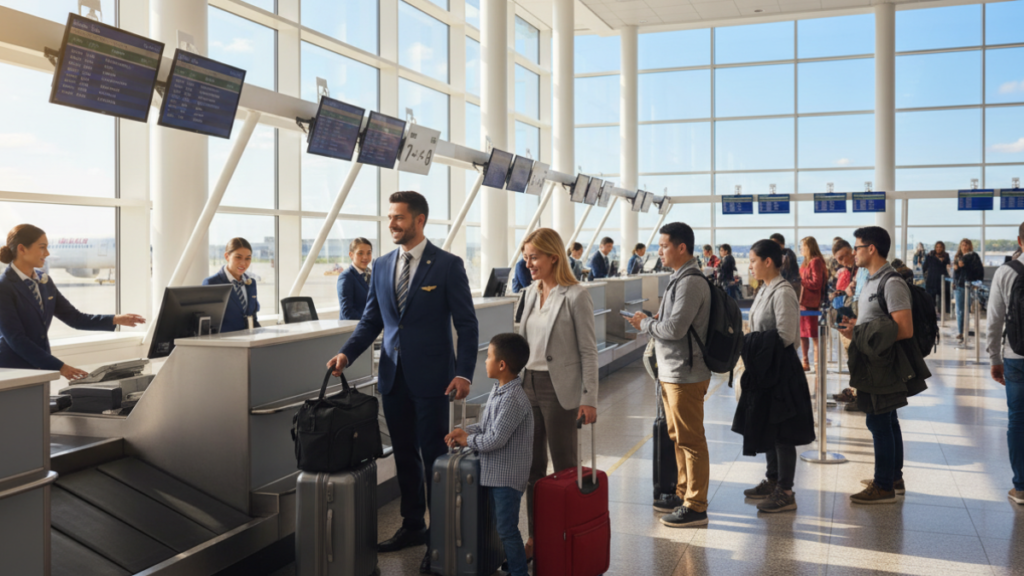
In international frameworks such as the CEFR, B2 (upper-intermediate) usually means a speaker can explain routine workplace issues in detail, handle most everyday problems, and adjust tone for formal service. In a professional English airport setting, that includes polite requests, accurate time and location details, and calm clarification when a passenger is unsure.
For Brazil-based teams working with international travellers, neutral English tends to travel best. This article organises airport customer service English by the passenger journey: arrivals and departures, check-in, security and boarding, immigration and customs, disruption handling, and complaints. Terms like “boarding pass”, “gate”, “connection”, and “liquids” appear only where they support clear communication, not operational training.
Key takeaways
- English for airport staff works best when phrases are short, neutral, and easy to repeat.
- B2 level supports clear explanations, polite tone shifts, and routine problem-solving.
- Professional English airport language prioritises accuracy for times, gates, queues, and documents.
- Airport customer service English is organised here by each stage of the passenger journey.
- Key aviation terms are introduced only when they improve clarity at the counter or gate.
- Neutral international English helps Brazilian staff communicate across diverse accents.
Why B2-level English matters in airport customer service
In major Brazilian hubs such as São Paulo–Guarulhos, Rio de Janeiro–Galeão, and Brasília, airports run on short timelines and clear signals. Passengers may be tired, stressed, or unfamiliar with local procedures. In that setting, English for airport staff at B2 level supports steady, high-clarity exchanges, even with noise, queues, and frequent announcements.
Airport customer service English works best when it stays consistent across teams. When staff explain a process in the same simple terms, passengers move faster through check-in, security, and boarding. This reduces repeat questions and keeps the flow predictable for everyone.
Meeting passenger expectations with clear, confident language
B2-level speaking helps staff give complete answers, not just short phrases. It supports giving a brief reason, offering options, and confirming next steps in one calm exchange. That matters when a passenger asks about a gate change, a document check, or what to do after missing a connection.
English for airport staff at this level also makes it easier to handle follow-up questions. Passengers often need the same point said in a slightly different way, with clear time markers and simple sequencing. Airport customer service English benefits from this flexibility without changing the core message.
Reducing misunderstandings in fast-moving airport environments
Small language errors can cause big delays. Risk areas include times and dates, seat and gate letters, baggage limits, liquids rules, and the order of steps in rebooking. Precision also matters when explaining what can and cannot be provided, including service limits and eligibility for assistance.
The table shows where misunderstandings often start, and what clear wording achieves in practice.
| High-risk message | What often goes wrong | What clear airport customer service English supports |
|---|---|---|
| Boarding time and gate updates | Passengers confuse boarding time with departure time, or miss a last-minute gate change | Short, repeated phrasing with the same key details: time, gate, and the next action |
| Baggage rules and fees | Unclear limits lead to repacking at the counter and longer queues | Exact numbers, units, and options stated once, then confirmed before the passenger leaves |
| Liquids and restricted items | Passengers misunderstand what must be removed or discarded at security | Step-by-step language that matches the order of checks, without extra wording |
| Document checks and entry requirements | Passengers assume a digital copy is enough, or miss a key condition | Neutral, direct phrasing that separates what is required from what is recommended |
| Rebooking steps after disruption | Passengers lose track of the sequence and return to the wrong service point | Clear sequence markers: first, next, then, plus a final confirmation |
Professional tone: polite, firm, and culturally aware
A professional tone protects both safety and fairness. Airport customer service English needs to sound courteous while still enforcing rules on queues, boarding groups, and restricted items. Clear boundaries can be set with calm wording, without sounding harsh or uncertain.
In an international mix common in Brazil, culturally neutral language reduces friction. Slang, humour, and region-specific expressions can confuse passengers or appear dismissive. English for airport staff is most effective when it stays plain, respectful, and easy to repeat across shifts.
- Clarity: short sentences with one main idea each, especially in noisy areas.
- Consistency: the same terms for the same steps, across counters and gates.
- Control: polite firmness that keeps queues moving and prevents escalation.
- Which airport situations tend to create the most confusion: times, rules, or directions?
- How can a staff member explain a “no” while still sounding professional and respectful?
- What types of slang or humour might be misunderstood in an international terminal?
- Why does consistent wording across different teams improve queue flow?
- How can staff confirm understanding without repeating the same sentence word for word?
English for airport staff: core principles for professional passenger communication
In Brazil’s busiest terminals, passengers often speak English as a second language. Clear, steady phrasing reduces stress and prevents small errors from turning into missed flights. For English for airport staff, the aim is simple meaning, delivered at a calm pace, with key details repeated.
Professional English airport standards also rely on structure. Staff tend to give one instruction at a time, then add a short link such as and or then. Numbers, times, and locations work best when said twice, with the same words each time.
Using neutral, international English (and avoiding confusing idioms)
Neutral, international English supports understanding across accents and travel backgrounds. It avoids slang and culture-based idioms that can sound unclear, even at B2 level. In English for airport staff, phrases are usually concrete and literal.
For example, instead of “You’re all set”, “Everything is ready” is easier to process. Instead of “Hang on a second”, “Please wait a moment” is clearer in a noisy hall. Professional English airport communication often chooses familiar verbs such as go, wait, show, and follow.
Polite modal verbs and softeners (could, would, may)
Modal verbs shape tone without changing the rule behind the message. In regulated areas such as boarding and security, wording still needs to be polite and direct. Professional English airport phrasing often uses could, would, and may to keep the voice firm but respectful.
“Show your passport” can sound abrupt. “Could you show your passport, please?” keeps the meaning while lowering tension. For English for airport staff, a softener like please or thank you also helps pace the exchange.
| Communication need | Less clear or too blunt | Professional English airport alternative | Why it helps in Brazil |
|---|---|---|---|
| Requesting documents | Give me your passport. | Could you show your passport, please? | Sounds respectful with non-native speakers and reduces defensiveness. |
| Directing movement | Go there. | Please go to Gate 12, then wait by the sign. | Adds a clear location and a simple sequence for crowded areas. |
| Managing restricted items | You can’t take that. | I’m sorry, you may not take this item through security. | States the rule calmly, which supports compliance and clarity. |
| Time pressure at boarding | Hurry up. | We need to board now. Would you please join this queue? | Keeps urgency while remaining polite and easy to follow. |
Checking understanding without sounding rude
Confirmation questions reduce errors in gates, terminals, and connections. They protect passengers from going to the wrong place, or misreading a time, especially when announcements are fast. In English for airport staff, checking is framed as support, not a test.
Short checks work best: “Just to confirm, is your destination São Paulo?” and “Can I confirm the terminal number with you?” Details like gate letters, times, and flight numbers are often repeated in the same order. Professional English airport delivery stays neutral, with a brief pause after key facts.
- “To confirm: Gate B7, boarding at 19:40.”
- “Could you confirm the connection time on your ticket?”
- “May I check: are you travelling with cabin baggage only?”
- “Would you like me to repeat the gate number?”
- Which idioms heard in films or social media could confuse a traveller in a terminal?
- How does repeating numbers and times change accuracy during boarding?
- When does a direct command become necessary, even with polite language?
- What makes a confirmation question sound supportive rather than judgemental?
- How might multilingual crowds in Brazil affect speaking speed and word choice?
Greeting passengers and offering assistance at arrivals and departures
At terminal entrances, information desks, arrivals halls, transfer areas, and departures concourses, first contact often sets the pace. In Brazil, airport teams may switch between Portuguese and airport customer service English within seconds, often with loud background noise and little time. Clear, neutral phrases help passengers move while keeping the tone professional. This is a core focus of English for airport staff at B2 level.
Warm greetings and first questions to identify needs
Short greetings work best when they lead to one clear question. Good airport customer service English keeps the opening polite, then narrows the purpose: check-in, baggage, transfers, mobility support, or document issues. Staff may also need to confirm flight number, airline, and destination to avoid sending passengers to the wrong queue.
In practice, many airports also offer meet-and-greet support, where an English-speaking greeter welcomes travellers near the air bridge and escorts them through passport control, baggage, and customs. A concise overview of this kind of help is described by airport assistance services, which reflects how structured greetings can reduce stress at arrival and departure points.
| Contact point | Useful opening in airport customer service English | Fast follow-up question | What it helps staff confirm |
|---|---|---|---|
| Arrivals hall exit | “Good afternoon. Welcome. How may I help?” | “Are you meeting a driver or collecting baggage?” | Pick-up method and whether baggage claim is needed |
| Transfer corridor | “Hello. Are you connecting to another flight?” | “Do you need to pass immigration here?” | Transfer type: connection with immigration vs transit |
| Self-service kiosk area | “Hi. Do you need help with check-in?” | “Are you checking a bag today?” | Best route: kiosk, desk, or bag drop |
| Information desk | “Good morning. What can I assist you with?” | “Which airline and what is your flight number?” | Accurate directions and correct service counter |
Offering help proactively during busy periods
During peak waves, confusion clusters around kiosks, bag drop, security entrances, and gate change screens. English for airport staff supports short, calm offers that do not slow the flow. The aim is to spot uncertainty early, then give a quick option: “This way for bag drop” or “Please join this queue for security”.
Time pressure also means staff should use simple words, avoid idioms, and keep voice pace steady. In airport customer service English, a helpful habit is to repeat key details once: gate, time, and the next step. This lowers errors when announcements are hard to hear.
Directing passengers to the right service point
Directions are clearer when they include one landmark, the floor level, the sign name, and an estimated walking time. Staff also need to state whether the passenger must pass security or immigration first, as this changes the route. Airport customer service English benefits from concrete phrasing such as “Level 2”, “Departures”, “Transfer”, and “Passport Control”.
For travellers using expedited support at major hubs across Asia Pacific, Europe, the Middle East, and Africa, greeters may escort them to check-in, immigration, a lounge, or the boarding gate. This matches the same direction-giving logic used in English for airport staff: accurate wayfinding, minimal repetition, and steady, polite language.
- Landmark + sign name: “Follow the signs for Departures, past the coffee shop.”
- Floor level: “Take the lift to Level 3.”
- Walking time: “It is about five minutes on foot.”
- Control point check: “You must clear security before you reach Gate B.”
- Confirmation question: “Could you repeat the gate number, please?”
“Good evening. To reach Gate C12, please go to Level 2, follow the signs for ‘Gates C’, and allow about seven minutes. You will pass security first.”
- Which short opening question best separates transfer passengers from arrivals passengers?
- How can background noise change the choice of words in airport customer service English?
- What direction details reduce wrong turns: landmarks, floor levels, signage names, or walking time?
- When is it necessary to mention security or immigration before giving directions?
- Which phrases in English for airport staff sound polite without adding extra length?
Check-in and baggage support phrases for airline staff
At check-in, clear questions help passengers move faster and avoid rework. In Brazil, this often includes tourists on domestic routes and international departures in the same terminal, so professional English airport wording needs to stay simple and precise. A useful airline staff English phrase checks the booking first, then confirms the next step without sounding abrupt.
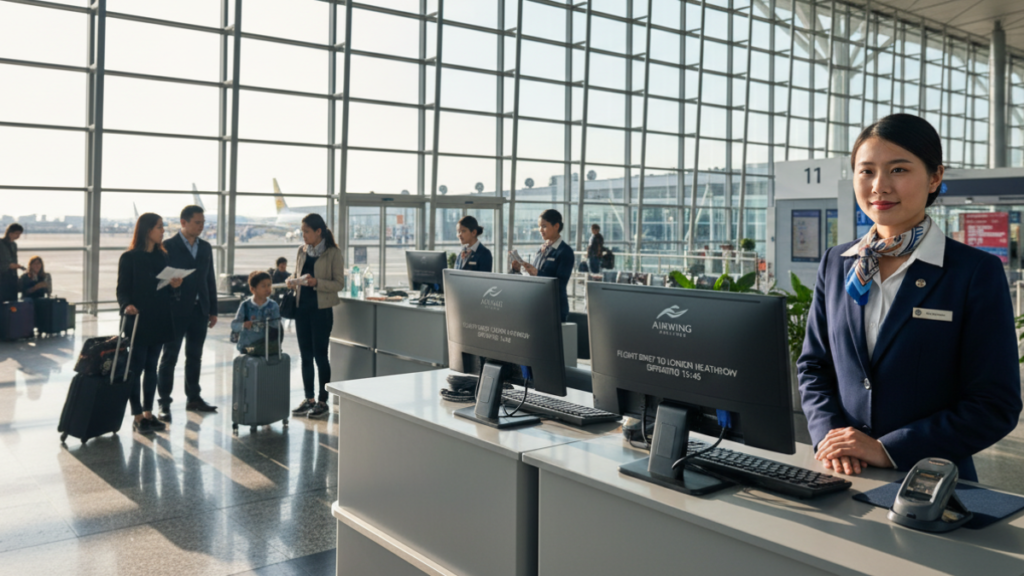
Document checks work best when the request is direct and paired with a reason. Staff may ask, “May I see your passport, please?” and, for some itineraries, “Do you have a visa or onward ticket?” Another professional English airport line is “Could you confirm your full name as it appears on the booking?” which reduces spelling issues in boarding passes and bag tags.
Once details match, seat and assistance questions should be brief. An airline staff English phrase such as “Would you prefer an aisle or window seat?” keeps the tone neutral. For special cases, “Do you need assistance at the airport today, such as a wheelchair?” helps clarify needs without assumptions, especially when language levels vary.
| Check-in moment | Passenger-facing wording | Purpose in a professional English airport setting |
|---|---|---|
| Confirm itinerary | “You are travelling to London today, via São Paulo, is that correct?” | Confirms route, dates, and connections using plain, international English |
| Request documents | “May I see your passport and any required visa, please?” | Sets a clear expectation and avoids vague “papers” language |
| Baggage allowance | “Your allowance is one cabin bag and one checked bag up to 23 kilos.” | States limits in a measurable way to reduce disputes at bag drop |
| Overweight or extra bag | “This bag is over the allowance. The extra fee is shown at the counter.” | Explains the issue without blame and keeps the process moving |
| Fragile or special items | “Is anything fragile, such as a laptop or glass, in your checked bag?” | Supports safe packing and sets realistic handling expectations |
| Battery restrictions | “Spare lithium batteries must be in cabin baggage, not in checked baggage.” | Communicates a safety rule in high-level, passenger-friendly terms |
| Bag drop and collection | “Please place your bag on the belt. Keep this bag tag for collection.” | Reduces lost-tag problems and supports later tracking |
Baggage problems often start with size and weight. A professional English airport approach is to name the issue, then give the next step: “This item is oversize; it needs to go to the special baggage counter.” For sports equipment, staff may add, “Please ensure it is packed in a suitable case,” which keeps expectations clear without making promises about handling.
Restrictions can be explained without long detail. An airline staff English phrase like “Sharp items and liquids over 100 millilitres must not be in cabin baggage” remains easy to follow. When a passenger is unsure, “Let’s check it together” can lower tension while keeping control of the process.
At arrivals, delayed or missing bags require a calm handover. Staff can direct passengers with a professional English airport line: “Please go to the airline baggage desk in the arrivals hall.” A practical airline staff English phrase then sets the file: “Do you have your bag tag number and a delivery address in Brazil?” which gathers what tracking systems typically need.
Timelines should stay realistic. A neutral line such as “We will contact you when we have an update” avoids overpromising, while still showing a process is in place. Another professional English airport option is “Most deliveries take one to three days, depending on the flight and customs checks,” which gives a range and explains why it can vary.
- “Could you place your passport on the counter, please?”
- “How many bags are you checking in today?”
- “Please confirm your contact number and email address.”
- “Keep your boarding pass and bag tag until you leave the airport.”
- Which phrases reduce confusion when a passenger has both domestic and international segments?
- How does wording change when explaining a fee versus explaining a safety restriction?
- What details are most important to collect for a delayed baggage report, and why?
- Which sentences keep the tone polite but firm during an overweight baggage discussion?
- How can staff set realistic timelines for baggage delivery without sounding dismissive?
Security, boarding, and queue management: calm, clear instructions
At security and boarding, language needs to be brief and standardised. Safety checks, compliance, and passenger flow depend on clear wording that does not change from one staff member to the next. For English for airport staff, the aim is to keep instructions consistent, even when the area is noisy and time is tight.
Airport customer service English also supports teamwork across airport security providers and airline gate teams. When staff use the same core phrases, passengers hear one message, not mixed signals. This reduces hesitation, repeat questions, and tension at pinch points.
Giving concise step-by-step instructions
Sequencing helps passengers act fast. One action per sentence is easier to follow than a long list. Repeating key nouns can prevent confusion, especially with trays, laptops, liquids, belts, and pockets.
Clear airport customer service English often uses the same nouns again and avoids vague words like “that” or “those”. In practice, this supports faster screening and fewer stopped lanes. For English for airport staff, it also lowers the risk of inconsistent wording between shifts.
| High-noise checkpoint focus | Less clear wording | Clearer, standardised wording |
|---|---|---|
| Trays and items | “Put your things here.” | “Place your items in a tray. Use one tray per passenger.” |
| Laptops and tablets | “Take it out, please.” | “Remove your laptop from your bag. Place the laptop in a tray.” |
| Liquids and gels | “Show me the liquids.” | “Place your liquids bag in a tray. Keep the liquids bag separate.” |
| Belts and pockets | “Empty everything.” | “Empty your pockets. Place your belt and keys in a tray.” |
Managing queues politely while staying authoritative
Queue language works best when it is calm and direct. Staff often need to direct line movement, keep access clear, and control boarding group order. A steady tone can sound firm without sounding harsh, which matters in airport customer service English.
Priority lanes, family lanes, and assistance lanes can also change the pace of a queue. Clear labels and simple phrases reduce arguments about who goes next. For English for airport staff, authority often comes from consistency, not volume.
- Movement: “Please move forward to the next marker.”
- Lane choice: “Families and passengers needing assistance may use this lane.”
- Boarding order: “Now boarding Group 2. Group 3, please wait behind the line.”
- Spacing: “Please keep the walkway clear.”
Handling restricted items and security refusals professionally
When an item cannot pass, the outcome needs to be stated in plain terms. It helps to name the item, explain the status, and outline the permitted options under policy. This approach keeps airport customer service English factual and avoids language that can escalate a refusal.
Coordination matters here. Security teams and gate teams can face the same passenger later, so wording should stay aligned across roles. For English for airport staff, consistent phrases reduce complaints based on “someone else said it was fine”.
- “This item cannot go through security.”
- “You can dispose of it, or return it to your checked baggage, if time allows.”
- “If you have questions about the rule, a supervisor can explain the policy.”
FAQ for speaking practice
- Which words make an instruction sound clearer in a noisy area: pronouns or repeated nouns, and why?
- How can queue phrases stay polite while still controlling pace and order?
- What details should be stated when a restricted item is refused to prevent repeat arguments?
- How does consistent wording between security and gate teams affect passenger trust?
- Which phrases help avoid blame while still communicating a firm decision?
Immigration, customs, and documentation: practical professional English airport phrases
At border control, passengers often ask about passport validity, visas, and entry rules. In a professional English airport setting, clarity matters more than speed. For English for airport staff, short sentences and a neutral tone can reduce stress in a crowded hall.
Documentation questions should be handled with care, especially in public areas. Staff can explain the process without giving legal advice. English for airport staff works best when it focuses on what to do next, what to present, and where to queue.
| Passenger question or issue | Neutral phrase in professional English airport use | Process-focused next step (Brazil) |
|---|---|---|
| “Is my passport valid for entry?” | Border officers check passport validity at immigration. Please have your passport ready and open at the photo page. | Direct to immigration desks or eGates where available; advise the passenger to speak to the Polícia Federal officer for the decision. |
| “Do I need a visa?” | Visa requirements depend on nationality and travel purpose. Immigration will confirm this at the desk. | Signpost to the correct immigration queue; if unclear, direct to the Polícia Federal area for guidance. |
| Missing document or no onward ticket | If a document is missing, immigration may need extra checks. Please step to the side so the queue can keep moving. | Point to the secondary inspection area; keep the conversation discreet and brief. |
| Name mismatch between passport and booking | Immigration uses the name shown in the passport. Please present any supporting documents you have. | Guide the passenger to speak directly with the officer; avoid interpreting eligibility or outcomes. |
| “I have a tight connection after immigration.” | Immigration comes first, then baggage reclaim, then customs. After that, connections follow the signs to Departures. | Explain the order of steps; direct to priority lanes only if the airport policy allows. |
| “What must I declare at customs?” | Customs will advise what is declarable. If you are unsure, it is safer to declare. | Direct to the declaration channel and signage; remind that customs officers make the final assessment. |
Good signposting is part of English for airport staff at B2 level. Large terminals can split flows for citizens, residents, and visitors. In Brazil, passengers may look for the Polícia Federal signs when they need extra checks or help with entry processing.
- Please join the non-residents queue on the right.
- eGates are for eligible passports only; the officer will confirm eligibility.
- Immigration first, then baggage reclaim, then customs.
- If you need to complete an arrival card, please use the desks near the entrance.
Customs questions can involve sensitive items, so plain language helps. In a professional English airport environment, staff should avoid guessing about prohibited goods. English for airport staff should stay factual, using terms like restricted items, declaration, and inspection without adding personal opinions.
For privacy, it may be better to discuss documents at the side desk.Please keep your passport in hand and follow the officer’s instructions.
- What is the difference between explaining the process and giving legal advice at immigration?
- Which words help keep a calm tone when a passenger is missing documents?
- How can staff explain the order: immigration, baggage reclaim, customs, without sounding rushed?
- Why is discreet language important when discussing passports and visas in public areas?
Handling delays, cancellations, and missed connections with empathy
During disruption, clear language is part of safe operations. In Brazil, a delay at São Paulo–Guarulhos or Rio de Janeiro–Galeão can quickly affect domestic and international connections. Strong airport customer service English helps passengers follow the same message across screens, apps, and service desks.
Professional English airport communication also supports consistency between airlines, ground handling, and terminal teams. The aim is simple: state the reason in plain terms, explain options in order, and share what is known now.
Apologising professionally and explaining the situation clearly
A professional apology recognises the impact without blaming any team. Short sentences are easier to process when passengers are tired or rushed, especially in a multilingual queue.
Common causes can be explained in neutral wording, such as weather disruption, air traffic control restrictions, or operational constraints. In airport customer service English, staff often pair the reason with the next practical step, so the message stays useful.
“I’m sorry for the disruption today. The flight is delayed due to air traffic control restrictions. The next update is expected at 14:30.”
Rebooking and rerouting language passengers understand
When a connection is missed, passengers usually want options ranked by outcome: earliest arrival, same-day travel, or keeping the original route. Professional English airport phrasing works best when it confirms the priority before listing alternatives.
- Next available flight: used when seats are limited and timing matters most.
- Standby: used when a seat cannot be confirmed yet, but travel may still be possible.
- Alternative route: used to describe a different city pairing or carrier pathway to reach the same destination.
- Overnight accommodation: used when travel cannot continue the same day and local policy applies.
Clear airport customer service English also checks key details without sounding abrupt: destination city, final connection, baggage status, and whether a visa or document affects transit.
Setting expectations about waiting times and next updates
Waiting feels longer when the timeline is unclear. Professional English airport updates are most helpful when they name a time for the next message, plus where passengers can track changes.
| Information passengers ask for | Clear wording that fits professional English airport use | What can be confirmed at that moment |
|---|---|---|
| Reason for the delay or cancellation | “The flight is delayed due to weather conditions affecting arrivals.” | Known operational cause, without assigning fault |
| Next update time | “The next update is expected at 16:10 on the screens and in the airline app.” | A specific time and the main channels |
| Rebooking options | “The next available flight is at 19:40, or there is an alternative route via Brasília.” | Options currently visible in the system |
| Queue expectations | “Current waiting time is around 25 minutes. Service desks are supporting rebooking and hotel requests.” | Approximate timing based on live demand |
| What is not confirmed yet | “A gate number is not confirmed yet. Please check the screens for the next announcement.” | Limits of information, stated plainly |
For busy hubs, the same approach helps tourists and connecting passengers moving between domestic and international areas. Airport customer service English remains most effective when updates are steady, consistent, and timed.
- Which wording reduces confusion most: a detailed explanation, or a short reason plus the next step?
- How can staff show empathy while keeping the message neutral and factual?
- What information should be confirmed before offering an alternative route?
- How does stating the next update time change passenger behaviour in queues?
- In what situations should staff say what cannot be confirmed yet?
De-escalation and complaints: difficult passenger scenarios
In busy terminals, complaints often arrive with stress, noise, and time pressure. Strong airport customer service English helps staff keep the exchange calm and structured, even when emotions rise. For English for airport staff, the first aim is to lower tension while gathering clear facts.

Effective de-escalation starts with acknowledgement that does not admit fault. Phrases such as “I can see this is frustrating” and “Thank you for explaining” can reduce confrontation. In airport customer service English, a neutral tone supports dignity on both sides.
Focused questions keep the complaint practical. Staff may ask for the flight number, the time the issue happened, and what outcome the passenger expects. For English for airport staff, summarising is equally important: “So the bag arrived damaged, and the damage was noticed at reclaim, is that correct?”
Clear boundaries matter in regulated areas, especially around safety and access. Language that explains limits can stay calm: “I cannot change that decision here, but I can explain the next steps” or “For safety reasons, this rule applies to all passengers”. Airport customer service English works best when it separates the person from the policy.
| Trigger point | Structured response in airport customer service English | Facts to record for handover |
|---|---|---|
| Denied boarding | “I understand this is upsetting. I will check the booking notes and explain what options are available at this desk.” | Booking reference, gate, boarding time, staff location, reason code shown in the system |
| Baggage damage | “Thank you for reporting it. Please show the damage and the baggage tag so the report is accurate.” | Bag tag number, arrival belt, time observed, photos taken (yes/no), report reference |
| Missed connection | “Let’s confirm the arrival time and the next flight options. I will summarise what is possible today.” | Inbound delay time, connection gate, rebooking outcome, advice given, queue point used |
| Seat dispute or queue jumping | “I will check the seat allocation on the system. Please allow me a moment, and we will resolve it in order.” | Seat numbers, boarding group, witness staff, any announcements made, passenger statements |
| Intoxication concerns or aggressive behaviour | “I want to help, but I need calm language. If this continues, I will call a supervisor for support.” | Exact words used, behaviour observed, time, location, supervisor contacted, security involvement |
When a claim is unclear or inaccurate, staff can confirm understanding without agreeing. English for airport staff often relies on careful wording: “I hear what you are saying; I will check what the records show”. This keeps the exchange fair while protecting service standards.
Escalation routes should be described in plain terms. Airport customer service English may point to a supervisor, a service desk, or a written complaint channel, while keeping expectations realistic. Accurate notes—times, flight numbers, and where staff were positioned—support smooth handovers between teams.
- Which phrases help acknowledge a complaint without accepting an incorrect claim?
- How can staff ask for facts when a passenger speaks quickly or changes the story?
- What wording sets a boundary politely in a safety-controlled area?
- Which trigger points are most likely to cause conflict in a crowded terminal, and why?
- What details make a handover note useful for the next team member?
B2 speaking practice for airport staff: role-plays and pronunciation focus
b2 speaking practice works best when it mirrors real airport turns. The exchanges are often short, repeated, and time-sensitive. A well-chosen airline staff English phrase can reduce ambiguity, especially at check-in, boarding, and service desks.
For Brazil-based teams, clarity matters more than “sounding native”. Intelligibility improves when staff keep a steady pace, finish key consonants, and use consistent patterns for numbers and times. This kind of b2 speaking practice also helps staff hold a neutral tone under pressure.
Short role-play scripts for common airport interactions
Role-plays can be built around predictable tasks: giving directions, confirming baggage rules, announcing boarding groups, and supporting missed connections. Each script can recycle the same airline staff English phrase, with small changes in flight details, dates, and gate areas. Repetition supports speed, while confirmation checks support accuracy.
- Information desk directions: short routes, landmarks, and “next to / opposite” language.
- Check-in baggage allowance: weight, size, fees, and a clear recap of options.
- Boarding group flow: group numbers, priority rules, and calm queue language.
- Missed connection support: rebooking basics, timing, and what happens next.
Key pronunciation points for clarity (numbers, times, gate letters)
Misunderstandings often come from similar sounds: 13 versus 30, 14:15 versus 14:50, or B versus D. Staff may reduce errors by separating digits when needed, such as saying “one-five” for 15, and by pausing between the gate letter and number. In b2 speaking practice, these items deserve focused repetition, not general conversation drills.
Portuguese speakers may need extra work on vowel length, “th” sounds, and consonant endings. For example, final sounds in “gate”, “seat”, and “flight” carry meaning, even when spoken quickly. A stable airline staff English phrase remains easier to understand when these endings are not dropped.
Useful fillers and turn-taking phrases for fluent service
Short fillers help staff avoid long silences while checking a system or locating details. They also signal control of the interaction, without sounding abrupt. Used well, an airline staff English phrase like “Just a moment, please” buys time and keeps the passenger informed.
| Service moment | Useful airline staff English phrase | Why it helps clarity | Pronunciation focus for Brazil-based speakers |
|---|---|---|---|
| Checking a booking | Just a moment, please. | Sets expectation and reduces perceived uncertainty | Clear final consonant in “moment”; keep “please” voiced |
| Confirming details | Could you confirm the flight number? | Creates a polite check without blame | Stress “confirm”; keep “flight” ending audible |
| Repeating key information | To confirm, your gate is B six. | Reduces B/D confusion and supports recall | Pause after “B”; separate letter and number |
| Clarifying time | Boarding is at one-four fifteen. | Prevents 14:15 vs 14:50 mix-ups | Separate digits; steady rhythm on “fifteen” |
| Handing over the turn | Thank you for waiting. How can I help? | Signals transition and reopens the exchange smoothly | Linking in “thank you”; avoid dropping “help” final sound |
In b2 speaking practice, these fillers and turn-taking moves fit naturally into role-plays. They keep the interaction moving while protecting accuracy in numbers, times, and gate calls.
If you would like to strengthen your overall airport communication skills, we recommend reading our complete guide British English for Airports: Vocabulary, Dialogues and Speaking Practice. This pillar article brings together essential airport terminology, functional expressions, and structured speaking activities to help both travellers and airport professionals communicate clearly and confidently in real-life situations across UK airports.
Conclusion
This guide has followed the passenger journey from greeting and check-in through security, immigration, boarding, and disruption. Each section grouped phrase sets around real airport tasks, where timing and accuracy matter. In that sense, English for airport staff works best when it matches the flow of the terminal and the pace of decisions.
Across all scenarios, B2-level service English relies on the same standards: clear wording, neutral tone, and polite modal verbs. It also depends on confirming key details such as times, gates, documents, and the next step. Used well, professional English airport communication reduces ambiguity without sounding harsh.
For international passengers travelling through Brazil, consistent language can mean fewer misunderstandings and steadier queue movement. It supports calmer exchanges during delays, missed connections, or complaints, where details must be repeated with care. Professional English airport phrases also help staff keep messages aligned across counters, gates, and support desks.
Viewed as a reference, the phrases and principles in this article support consistent communication across teams and shift handovers. English for airport staff is most effective when it stays repeatable, precise, and easy to understand. With that foundation, professional English airport service becomes more reliable in day-to-day operations.
FAQ
How can airport staff check understanding without sounding rude?
Clear confirmation questions reduce errors and missed flights. Useful patterns include repeating the key detail and asking for confirmation, such as “So you are travelling to Lisbon today, is that correct?” or “Your gate is B12; could you confirm you have that on your boarding pass?”
How should staff communicate about restricted items at security and boarding?
The priority is short, standard instructions and clear outcomes. Professional airport English should state what cannot pass, what the passenger can do next (dispose of the item or return it where permitted), and what must be done before proceeding, without blame or argument.
What can airport-facing staff say about immigration, customs, and entry requirements?
Staff can explain the process and where to go, but should avoid giving legal interpretations of eligibility. Practical wording includes directing passengers to the correct queue, explaining the step order (immigration, baggage reclaim, customs), and advising them to present documents requested by border authorities.
How can staff handle delays, cancellations, and missed connections in clear British English?
Good disruption language gives a brief reason, the next update time, and available options. Key terms include “next available flight”, “alternative route”, “rebooking”, and “connection”. Clear statements help passengers follow steps without assuming outcomes that cannot be confirmed yet.
What does de-escalation language sound like in a complaint situation?
De-escalation focuses on structure and facts. Airport customer service English should acknowledge the concern, ask focused questions, summarise what was heard, and explain limits calmly, including the next step such as a supervisor, a service desk, or a written complaint channel.
What is the best type of speaking practice for airport staff?
Targeted role-plays work well because airport interactions follow predictable patterns. Speaking practice often focuses on directions, baggage issues, boarding instructions, and rebooking. Pronunciation practice also matters for numbers, times, dates, and gate letters to prevent avoidable confusion.