Introduction
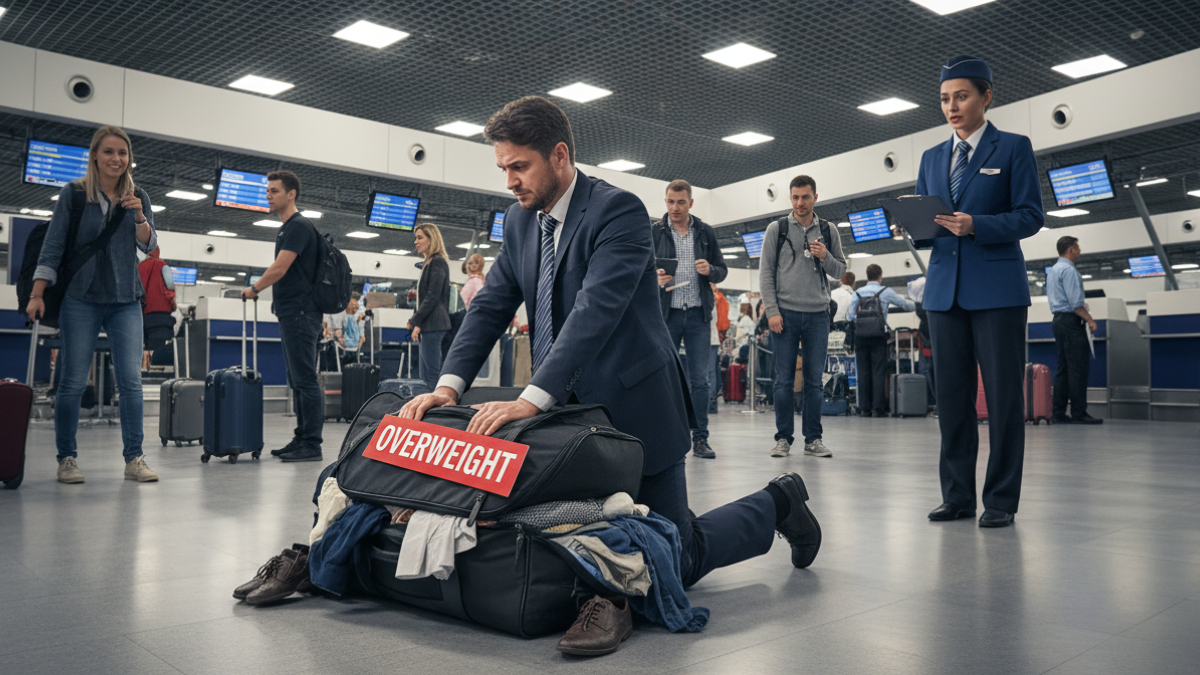
At international airports, a small weight difference can greatly affect the check-in process. Overweight Luggage at the Airport is usually checked at the scales. Here, staff compare each case with the baggage allowance on the ticket.
For many Brazilian travellers, English is the common language during transit and long-haul travel. Knowing overweight baggage English is crucial at the check-in counter. It helps when discussing limits, numbers, and policies.
This guide shows the real steps at the check-in counter English experience. It covers weighing bags, confirming allowances, and explaining options. It also talks about how excess baggage fees are quoted and how a calm reply can clear up confusion.
Readers will find practical phrases, short dialogues, and a role-play activity based on common airport routines. Key terms like baggage allowance and excess baggage fees are explained simply. There’s a focus on numbers and pronunciation.
If you would like to strengthen your overall airport communication skills, explore our complete guide to airport English, where you will find essential vocabulary, real-life dialogues, and practical expressions for every stage of your journey — from check-in to boarding.
Key takeaways
- Overweight Luggage at the Airport is typically identified when bags are weighed at check-in.
- Overweight baggage English helps travellers discuss limits, weight, and fees with fewer misunderstandings.
- Baggage allowance rules can vary by airline, route, cabin, and loyalty status.
- Excess baggage fees may be paired with alternatives such as repacking or buying extra allowance.
- Check-in counter English often includes set phrases that can be learnt and reused.
- Clear pronunciation of kilograms and prices supports faster, more accurate decisions.
Search results work best when the page title and snippet match what readers need. This post is about Overweight Luggage at the Airport. It uses clear language that Brazilians and others can understand, especially during check-in.
The content is practical, focusing on airport problem English phrases and excess baggage. The words are similar to what you see on airline screens and scales.
Brazilian travellers using English abroad
Brazilian travellers often switch to airline English at the counter. The pace can feel fast. This page uses standard airport wording, with kilograms for weight and simple price phrasing for fees.
The focus is on what you’ll hear and say during Overweight Luggage at the Airport. This includes excess baggage charges and quick options at check-in. The language is designed for use across major carriers like LATAM Airlines, TAP Air Portugal, British Airways, and Lufthansa.
| On-page field | Text shown | Main search intent covered | How it supports clarity for Brazilian travellers |
|---|---|---|---|
| Meta title | Overweight Luggage at the Airport: English Phrases and Role-Play Activity | Find practical English phrases for a baggage weight issue | Matches the topic exactly and stays easy to scan on mobile results |
| Meta description | Overweight Luggage at the Airport? Learn clear English phrases check-in staff use, plus airport problem English phrases you can reply with. Includes a short role-play and excess baggage vocabulary. | Check-in wording, replies, and a practice activity | Uses familiar terms, highlights role-play, and names excess baggage to reduce ambiguity |
| Audience angle | travel English for Brazilians using kilograms and fee language used at international airports | Reduce confusion about weight limits and costs | Reinforces kilograms, simple numbers, and standard fee phrasing heard at the counter |
- Does the page snippet make it clear that the focus is English phrases check-in staff use?
- Which words in the description best signal excess baggage and fees without sounding dramatic?
- How might kilograms versus pounds change the way travellers confirm limits at the counter?
- Which airport problem English phrases feel most useful when the queue is moving quickly?
- What makes travel English for Brazilians easier to trust: familiar airline terms, numbers, or a role-play?
Why overweight baggage happens and how airlines usually handle it
Overweight bags often start with a simple mistake at home. A suitcase can feel fine to lift, yet still break the baggage weight limit once it reaches the scales. This is common when travellers add last-minute items, such as gifts, souvenirs, or extra layers for a cooler cabin.
Weight can also hide in specific items. Heavy shoes, toiletries, and liquids can raise the total fast. Another cause is packing too much into one case, even when the checked luggage allowance would allow the same items if split across two bags.
On multi-leg trips, differences between airlines can catch people out. One flight may permit a larger checked luggage allowance, while the next is stricter on the baggage weight limit. In these moments, clear overweight baggage English helps when confirming what applies to the current route and ticket.
At check-in, staff usually weigh the bag and compare it with the ticketed allowance. If it is over, the airline baggage policy may trigger an excess baggage fee, or the option to buy extra allowance. In some cases, passengers are asked to remove items and repack so the bag meets the baggage weight limit.
Rules vary by airline and route, so outcomes can differ even at the same airport. Some carriers apply a per-bag cap, while others focus on bag count or travel zones. The airline baggage policy often sets how the excess baggage fee is calculated and what changes are permitted at the counter.
| Common check-in situation | What is checked | How charges are often set | What staff may offer |
|---|---|---|---|
| Bag exceeds the baggage weight limit by a small amount | Scale reading against the checked luggage allowance on the booking | Excess baggage fee based on extra kilograms or a fixed band | Remove items, or purchase extra allowance if available |
| Bag is within weight, but there are too many bags | Number of pieces allowed for the fare type | Fee per extra bag, sometimes higher at the airport | Pay for an additional bag or consolidate items into fewer pieces |
| Different allowances across connecting flights | Allowance shown per flight and operating carrier rules | Charge based on the strictest segment or the carrier handling check-in | Repack to meet the tighter rule, or buy extra allowance for that segment |
| Oversize or heavy single item (for example, large suitcase) | Per-bag cap and handling limits under the airline baggage policy | Fee based on weight, size, or special handling category | Move items to another bag, or reclassify as special baggage where permitted |
The airport setting can make these conversations harder. Queues move, space is limited, and decisions are made quickly. Using calm, precise overweight baggage English supports clear confirmation of weights, the excess baggage fee, and the options allowed under the airline baggage policy.
- Time pressure can lead to missed details, especially when more than one allowance applies.
- Noisy counters make numbers harder to catch, so repeating the baggage weight limit can prevent errors.
- Limited repacking space means travellers may need quick, simple language about what can be moved.
- Is the checked luggage allowance set by the ticket type, the route, or the operating airline?
- How does an airline baggage policy usually differ between domestic and international flights?
- When an excess baggage fee applies, what details are most important to confirm before paying?
- What makes numbers and units (kilograms and currency) easy to misunderstand at a busy counter?
- How might packing habits change when a trip includes airlines with different baggage weight limit rules?
Overweight Luggage at the Airport
At busy terminals, the counter exchange is often fast and formulaic. For Brazilian travellers, a few clear check-in English phrases can reduce stress when weight limits come up. This part introduces common wording tied to Overweight Luggage at the Airport, before moving on to fuller lists later.
What staff may say at check-in
Airline staff typically start with the facts: the bag has been weighed, it is over the limit, and a charge may apply. In overweight baggage English, the key point is often the allowance in the ticket rules, not personal judgement. Staff may also point to excess baggage options that keep the line moving.
The most common check-in English phrases include the allowance, the exact weight, and the fee. Staff may then offer standard paths: pay now, remove items, or buy extra allowance if the fare allows it. These are routine airport problem English phrases, and the tone is usually brief and neutral.
What you can say to stay calm and clear
A calm reply often begins with acknowledgement and a simple request for numbers. Clear check-in English phrases can confirm the limit and the bag’s measured weight, which helps avoid confusion with kilograms. In overweight baggage English, short questions are usually easier to understand over background noise.
It also helps to ask for options in neutral language, without disputing policy. Many counters can allow repacking to reduce excess baggage, or they can explain how the fee is calculated. These airport problem English phrases keep the exchange polite and efficient.
Key vocabulary: allowance, excess, fee, weigh, repack
The terms below appear often in Overweight Luggage at the Airport situations, especially during check-in. Seeing them in plain sentences supports comprehension before practising longer overweight baggage English scripts.
| Word | Meaning at the airport | Typical check-in English phrases | What it signals in practice |
|---|---|---|---|
| Allowance | The weight or number of bags included with the fare | “Your allowance is 23 kilos.” | The benchmark used to judge any excess baggage |
| Excess | The amount above the allowance | “You are two kilos in excess.” | A small overage may lead to a fee or repacking |
| Fee | The charge for extra weight or an added bag | “There is an excess baggage fee.” | Payment is one standard resolution at check-in |
| Weigh | To measure weight on the scale | “Please place the bag here to weigh it.” | The number on the scale becomes the reference point |
| Repack | To move items between bags to meet limits | “You can repack and try again.” | An option when passengers want to avoid or reduce a fee |
- Listening for the number first helps with most airport problem English phrases.
- Repeating the limit and weight back is a common check-in English phrases technique.
- Words like allowance and excess are often used together in overweight baggage English.
Essential overweight baggage English phrases to use at check-in
At a busy terminal, clear overweight baggage English can reduce delays and keep the exchange precise. The phrases below suit check-in desk English, where staff rely on short questions and exact numbers. They also fit airport problem English phrases used when the queue is moving and decisions need to be quick.
Polite openers and questions
These openers sound cooperative and help staff check the booking details without confusion about a baggage weight limit.
- Good morning. Could you please check whether this bag is over the baggage weight limit?
- Could you confirm the checked baggage allowance for this booking, please?
- Is the limit based on my fare, or on the airline’s route rules?
- Would you mind telling me what my options are at the check-in desk English counter?
- Could you please explain the next step if the bag is overweight?
Confirming numbers: kilograms, limits, and fees
Accuracy matters most with kilograms and prices. These overweight baggage English lines request a clear figure on the scale, the exact baggage weight limit, and the full excess baggage fee details.
- Could you please tell me the weight in kilograms, and show me the number on the scale?
- Sorry, could you repeat the weight in kg?
- Just to confirm, what is the baggage weight limit for one checked bag on this ticket?
- How much is the excess baggage fee, and what currency is it in?
- Is the charge per kilogram, per bag, or a fixed fee for this route?
- Could you please confirm the total amount before payment?
| What needs confirming | Useful phrase at the counter | Why it helps |
|---|---|---|
| Weight shown on the scale (kg) | Could you show me the number on the scale, please? | Reduces mistakes when the display is hard to read or the area is noisy. |
| Permitted baggage weight limit | What is the baggage weight limit for my fare? | Links the limit to the ticket rules, not guesswork. |
| How the excess baggage fee is calculated | Is the excess baggage fee per kilogram or a fixed charge? | Clarifies whether repacking changes the price. |
| Currency and total to pay | Could you confirm the total amount and the currency? | Helps avoid confusion between similar symbols and exchange rates. |
Asking for options: upgrade, extra bag, or redistribution
When airport problem English phrases are needed, it helps to ask about standard options without assuming they apply. These check-in desk English questions cover payment, extra allowance, upgrades, and rearranging items within the baggage weight limit.
- Can I pay the excess baggage fee here, or do I need to pay at another desk?
- Is it possible to buy extra baggage allowance for this flight?
- Is an additional checked bag allowed on this booking, and what would it cost?
- Would upgrading the fare change the baggage weight limit?
- May I redistribute items between bags if I stay within cabin rules?
- Could you please tell me the best option based on the airline policy?
For practice, which phrases feel most natural in overweight baggage English: the ones that confirm numbers, or the ones that ask for options? Which airport problem English phrases sound clear enough to use even when tired? At the check-in desk English counter, which question best confirms the baggage weight limit without slowing the process? Which wording makes the excess baggage fee structure easiest to understand?
Airport problem English phrases for negotiating fees and solutions
At the check-in desk, clear phrases can cut down delays. They keep the conversation focused. When dealing with overweight bags, calm words are key. Good English helps when decisions need to be made fast.
Requesting a waiver or discretionary help
For bags slightly over, asking for some flexibility is reasonable. These phrases are polite but acknowledge the rules. They’re useful when excess charges seem too high.
- Is there any flexibility with the weight limit today, or does it need to be exact?
- Could you please check whether a small excess can be handled as cabin weight, or under a different rate?
- Would it be possible to apply a courtesy adjustment, or is the system fixed on excess baggage charges?
- If there is no waiver, could you show the cheapest option available at this counter?
Explaining reasons (without oversharing)
Short explanations help agents understand, but long stories slow things down. In overweight baggage cases, clear, relevant, and verifiable statements are best. They support discussions without sharing too much.
- There are fragile items inside, so repacking needs to be done carefully.
- Some items are medical supplies, so the weight is difficult to reduce.
- A connecting airline has a different allowance, and the limits may not match.
- I can remove items if needed, but I would like to confirm the rules first.
Clarifying policies and getting details in writing
Understanding airline policies often starts with a simple question. Passengers might ask about excess baggage charges across their journey. They also want to know what proof they’ll get after paying. Useful information can be found in Airline operators’ documents, which help when checking receipts and charge notes.
| What to clarify | Customer service English airport phrasing | Why it matters |
|---|---|---|
| Whether the fee is per flight segment or for the whole journey | Could you confirm if this is charged per segment, or does it cover my full journey today? | Prevents paying twice on multi-leg trips and supports airline policy clarification. |
| Refund rules if the bag is repacked to comply | If I repack and bring it under the limit, is any part of these excess baggage charges refundable? | Sets expectations before items are removed or redistributed. |
| Where the rule is shown | Where can I see this policy: on the airline website, fare conditions, or on the receipt? | Creates a clear record if a different message is given later. |
| Payment methods and proof | Can I pay by card, and will I receive a receipt and a confirmation email showing the charge? | Helps track the payment and reduces disputes about excess baggage charges. |
| How the charge is described on documents | Could you note the reason for the fee on the receipt, including the weight and the allowance? | Supports later queries and keeps overweight baggage English details precise. |
Useful replies for common staff responses
Check-in exchanges happen quickly. So, it’s good to have ready phrases that keep things calm and clear. Most often, staff hear short, clear answers about numbers, limits, and options.

These phrases also work for connecting flights, where baggage rules can differ. For more on how allowances work across airlines, check this IATA interline baggage guidance for easy-to-understand info.
When they say the bag is overweight
First, acknowledge the message. Then, check the bag’s weight. This clears up confusion, especially when talking about kilograms and limits.
- “Understood. Could you confirm the weight on the scale, please?”
- “What is the permitted limit for this ticket: 23 kilos or 32?”
- “Is that the total allowance, or per bag?”
- “Could you show the reading again, please?”
When they say you must pay a charge
When an excess baggage fee is mentioned, focus on the amount, currency, and alternatives. Clear questions help avoid mistakes when converting prices or paying by card abroad.
- “How much is the charge in local currency, and is it per kilo or a flat rate?”
- “Is the excess baggage fee the only option, or can weight be reduced at the counter?”
- “Can payment be made by debit card, and will I receive a receipt by email?”
- “If I remove items now, can the bag be weighed again before payment?”
These replies are helpful because they keep the conversation practical and quick.
When they suggest removing items or buying another bag
If staff suggest repacking, ask about space and timing. Also, check if hand baggage will be weighed or measured, as this affects what can be moved.
- “All right. Where is the nearest place for repacking luggage?”
- “May I have two minutes to reorganise items, then re-weigh?”
- “If I move items to hand luggage, will it be weighed at this desk as well?”
- “Is it possible to add an extra checked bag on this fare and route?”
| Common staff message | Neutral reply | Follow-up question | What it clarifies |
|---|---|---|---|
| “Your bag is overweight.” | “Understood. Could you confirm the weight, please?” | “What is the permitted limit for this ticket?” | Scale reading and allowance in kilograms |
| “You need to pay.” | “How much is the excess baggage fee?” | “Is it per kilo or a flat rate, and in which currency?” | Total cost and how it is calculated |
| “Please remove items or check another bag.” | “I can repack. Where may I do that?” | “If I move items to hand luggage, will that be checked too?” | Repacking location and carry-on checks |
| “You can buy an extra bag.” | “Is an additional checked bag available for this booking?” | “Will it be tagged through to the final destination?” | Eligibility and through-checking on the itinerary |
“Could you please confirm the limit and the options available?”
- Which reply feels easiest to say at speed: confirming weight, confirming cost, or asking about options?
- How might airport problem English phrases change when there is a tight connection time?
- What details are most important to repeat back: kilos, number of bags, or currency?
- In overweight baggage English situations, when is it clearer to ask “per bag” rather than “total”?
- How can repacking luggage be requested politely without sounding demanding?
Luggage conversation practice: mini-dialogues you can reuse
This luggage conversation practice offers short, repeatable lines that fit a typical airport check-in dialogue. Each mini-script follows the same order: the issue is stated, numbers are checked, an option is chosen, and the next step is confirmed.
For Brazilian travellers using English abroad, this format supports clear decisions during Overweight Luggage at the Airport, especially when weight limits and prices must be confirmed fast. The focus stays on overweight baggage English that is practical and calm.
Short dialogue: paying the fee quickly
| Speaker | Airport check-in dialogue | Purpose |
|---|---|---|
| Check-in agent | Your bag is 25 kg. The allowance is 23 kg, so it is overweight by 2 kg. | Problem stated and numbers given |
| Passenger | Thanks for explaining. Please confirm the excess baggage fee in pounds. | Fee check and currency clarity |
| Check-in agent | It is £40 for the extra weight. | Fee confirmed |
| Passenger | All right. Can I pay by card? | Payment method chosen |
| Check-in agent | Yes. Please tap or insert your card here. | Next step |
| Passenger | Could I have a receipt, please? | Proof of payment |
| Check-in agent | Of course. Here is your receipt and boarding pass. | Process closed |
Short dialogue: repacking at the counter
| Speaker | Airport check-in dialogue | Purpose |
|---|---|---|
| Check-in agent | This bag weighs 24.5 kg. The limit is 23 kg. | Problem stated with weight |
| Passenger | Understood. May I repack and remove a few items here? | Permission to repack |
| Check-in agent | Yes, but please keep the area clear. Do you have time before boarding? | Time constraint raised |
| Passenger | Yes. What target weight should I reach to be within the allowance? | Confirms the goal |
| Check-in agent | 23 kg or less. | Target confirmed |
| Passenger | Thank you. Could you weigh it again after I repack? | Re-weigh request |
| Check-in agent | Yes. Place it back on the scale when you are ready. | Next step |
Short dialogue: adding extra baggage allowance
| Speaker | Airport check-in dialogue | Purpose |
|---|---|---|
| Check-in agent | Your suitcase is over the limit. You can pay for extra allowance or add another bag. | Options offered |
| Passenger | Please tell me the price to add extra baggage allowance today. | Requests clear pricing |
| Check-in agent | Extra allowance is £55. An additional bag is £70. | Compares options |
| Passenger | Does the extra allowance apply to the whole journey, or only this flight? | Scope confirmed |
| Check-in agent | Only this flight. Your return flight is separate. | Scope explained |
| Passenger | All right. I will buy extra allowance for this flight. What is my updated allowance in kg? | Chooses option and confirms limit |
| Check-in agent | Your updated allowance is 28 kg for this bag. | New limit stated |
Used together, these mini-dialogues keep the key terms in view: allowance, excess, fee, weigh, and repack. They also mirror common timing at Overweight Luggage at the Airport, where clear numbers reduce confusion at the counter.
- Which lines in this luggage conversation practice reduce delays during payment?
- In the repacking exchange, what phrases help confirm time limits and the target weight?
- How does the third airport check-in dialogue prevent mistakes about whether an upgrade applies to one flight or the full trip?
- Which parts of the overweight baggage English scripts make currency and kg easier to understand?
- When an excess baggage fee is unclear, which questions keep the tone polite and focused?
To deepen your understanding of real conversations at the counter, you can also practise with our Airport Check-in English speaking activity, designed to help intermediate learners simulate authentic check-in interactions with confidence and clarity.
Role play airport English: classroom or self-study activity
This role play is like being in a busy airport. It keeps the language simple. It’s great for pairs or small groups, especially for those in Brazil getting ready for international travel.

Each round lasts just a few minutes. It starts at the scales and then you have to decide: pay, repack, or change your booking. You’ll learn about overweight baggage and the phrases airport staff use when they’re under pressure.
Role cards: passenger, check-in agent, queue manager
The passenger has to stick to a tight budget and a strict bag-drop time. They need to confirm the weight, ask about the limit, and explain any fee clearly. The goal is to be accurate and polite, not to tell a long story.
The check-in agent has to follow the rules and keep things moving. They explain your options, repeat important numbers, and confirm what happens next. This makes the role-play feel real, especially when the passenger asks for a second check of the number.
The queue manager adds time pressure and fairness. They prompt quick turns, point to the repacking area, and remind everyone that others are waiting. This helps learners practice using airport problem English phrases without rushing or raising their voice.
Goals and constraints to make the role-play realistic
Constraints make the language sharper because learners have to choose words quickly. A short connection, a card that fails, or a hand luggage limit forces clear questions and brief answers. This makes learning about overweight baggage practical, not just theoretical.
| Constraint | What it changes at the counter | Language focus during role play airport English |
|---|---|---|
| Bag drop closes in 12 minutes | Shorter explanations and faster decisions | Confirming options clearly and repeating the final choice |
| Only card payment accepted | Cash is not useful, so the fee must be confirmed | Stating the price once, then checking it again for accuracy |
| Hand luggage limited to 8 kg | Repacking is possible but may create a new problem | Asking what can move to the cabin and what cannot |
| Tight budget for excess fees | Price matters more than speed | Comparing choices: extra bag versus paying overweight charge |
| One item must stay in the checked bag | Not everything can be moved during luggage conversation practice | Negotiating a workable split using simple, direct sentences |
Feedback checklist: clarity, politeness, and accuracy
- Clarity: Were kilograms, limits, and fees said with the right units and repeated when needed?
- Politeness: Did requests use calm forms such as “Could you…?” and “Would it be possible…?”
- Accuracy: Did the sequence match real check-in flow, from weighing to choice to confirmation?
- Control: Did the speaker stay brief and avoid side details, even under time prompts?
- Repair: When a number was missed, did the speaker ask for a repeat using airport problem English phrases?
For better retention, repeat the same check-in role-play with a different constraint each time. This keeps the structure the same but keeps the vocabulary fresh. Over several rounds, learning airport English becomes easier in real queues.
Pronunciation and numbers: avoiding misunderstandings with weight and prices
Airports can be noisy, making it hard to catch numbers clearly. This is especially true when announcements and queues get mixed up. Clear communication often relies on how numbers are said, not just what is said.
One big problem is the difference between -teen and -ty endings. “Fourteen” and “forty” can sound the same, but they mean different things. Saying the stress on the key syllable helps: FOUR-teen versus FOR-ty, with a brief pause before the unit.
Decimals need careful attention too. Saying 23.5 kg as “twenty-three point five kilograms” helps avoid missing the point. Many speakers find saying “kilo” quickly, then “kilograms” when confirming, clearer.
| Number area | How it is often said at the counter | Common misunderstanding | Clear confirmation in check-in communication |
|---|---|---|---|
| 14 vs 40 | “Fourteen kilos” / “Forty kilos” | -teen heard as -ty in noise | “Just to confirm: one-four, fourteen kilograms.” |
| 23.5 kg | “Twenty-three point five” | Point not heard; taken as 23 or 25 | “That’s two-three point five kilograms, correct?” |
| £150 | “One hundred and fifty pounds” | Heard as “fifty” only | “So the total is one hundred and fifty pounds, £150.” |
| R$ 1,200 | “One thousand two hundred reals” | Thousand missed; heard as 200 | “One thousand two hundred reals in total, is that right?” |
Prices can be tricky too. Saying “one hundred and fifty” clearly is better than “a hundred fifty”. Adding the currency name helps avoid confusion. Large numbers are easier to follow when spoken in groups, with a slight pause: “one thousand / two hundred”.
It’s also important to check the unit. Airlines often use kilograms, but pounds might be used in some cases. Asking about the unit calmly can prevent arguments at the scales.
Repeating back the full figure, including the unit and currency, is a good habit. It ensures the message is understood correctly. It also helps staff correct any mistakes early, before any charges are made.
- When hearing a number, repeat it with each digit once, then the full number in normal speech.
- Slow down on totals, and place strong stress on the number that changes meaning (such as teen versus ty).
- Say the unit every time: kilograms or pounds, and the currency name when discussing fees.
- For airport numbers English, ask for the figure to be repeated “slowly” if the environment is loud.
For Brazilian travellers, the comma-and-point difference can cause confusion. Hearing “point five” might be processed as a comma in Portuguese. Confirming the format in English can be helpful. This is why clear kilograms pronunciation and careful repetition are key for smooth decisions about baggage fees at the counter.
- Which number pairs in English are easiest to confuse, and why does stress help listeners separate them?
- How might decimal points create problems during airport numbers English when people are tired or rushed?
- What details should be repeated back to improve check-in communication when a fee is quoted?
- In what situations might a traveller hear pounds instead of kilograms, and how can the unit be confirmed politely?
- How do currency names and digit-by-digit repeats reduce mistakes with baggage fees English?
Cultural notes for Brazilian travellers using English at international airports
At international check-in desks, small differences in service style can affect check-in communication. For Brazilian travellers English abroad, the most useful approach is often calm, brief, and clear language, even when the queue is moving fast.
Politeness strategies in British and international English
In many British and international settings, politeness in English leans on indirect wording. Phrases that soften a request can sound more cooperative, especially during baggage questions and policy checks.
Common airport problem English phrases include: “Could you check that for me?” and “Would it be possible to look at the options?” This style keeps the focus on facts like limits, fees, and timing.
| Situation at the counter | More neutral phrasing | Why it helps in check-in communication |
|---|---|---|
| Asking for a review of the weight reading | “Could you weigh it again, please?” | Signals respect for the process while requesting a recheck |
| Requesting alternatives to a charge | “Would it be possible to move items to my carry-on?” | Frames the request as a practical option, not a demand |
| Confirming policy details | “Could you confirm the allowance and the fee, please?” | Invites clear numbers and reduces later disputes |
| Requesting time to reorganise items | “May I step aside to repack and come back?” | Respects the queue and shows awareness of time pressure |
Body language and tone at the counter
Non-verbal signals can support the words. A measured pace, steady volume, and a brief pause before replying can help staff hear details such as weights and prices.
Role play airport English can include these behaviours, not only sentences. In practice, a simple nod, eye contact, and listening without interrupting often makes check-in communication smoother when the counter is busy.
What to do if you don’t understand: useful clarification phrases
When a message is unclear, it helps to ask for the same information in a different format. For Brazilian travellers English abroad, this is often faster than guessing, especially with numbers.
- “Sorry, could you repeat that more slowly?”
- “Could you write the amount and the weight limit, please?”
- “Just to confirm, it’s 23 kilos and the fee is £60, is that right?”
- “Which option is cheaper: extra allowance or a second bag?”
These airport problem English phrases also fit role play airport English tasks, because they test listening, number accuracy, and tone. They keep check-in communication focused on the key details, without adding pressure to the exchange.
Questions for speaking practice
- Which forms of politeness in English sound most natural at a check-in desk: could, would, or may, and why?
- How can role play airport English include body language without turning it into acting?
- What are the main points that should be repeated back to confirm understanding during check-in communication?
- When might written numbers be safer than spoken numbers for Brazilian travellers English abroad?
Conclusion
Overweight Luggage at the Airport is a common issue. It happens when packed items, airport scales, and airline limits don’t match what travellers expect. Airlines usually have set ways to handle this: they confirm the allowance, weigh the bag, and offer options.
These options often include paying a fee, repacking, or buying extra allowance. The choice depends on the fare and route.
This guide has collected overweight baggage English for clear check-in talks. It includes phrase banks and airport problem English phrases. These focus on confirming the exact weight, checking the fee, and asking for changes at the counter.
This approach reduces stress and keeps the conversation factual and polite.
To make the language easier to remember, the guide uses short mini-dialogues. These mimic common outcomes. The role play airport English format also helps Brazilian travellers practice with small changes.
These changes include different weights, limits, and prices. Repeating these scenarios builds accuracy with key numbers and units.
In every scenario, the goal is the same: clear questions, clear figures, and clear choices. When allowances, weights, and fees are confirmed clearly, making decisions becomes easier. Clarity and accuracy are the main outcomes of this practice.
If you would like to expand your travel vocabulary even further, explore our complete airport vocabulary and travel conversation guide, where you will find additional expressions for security checks, boarding announcements, and in-flight communication.
FAQ
What does “overweight baggage” mean at airport check-in?
It means your checked bag is too heavy. Staff weigh it and compare it to the allowed weight. They then tell you what to do next, like paying extra or repacking.
Why does overweight luggage happen so often on international trips?
It often happens when you add souvenirs or gifts late. It also occurs on long trips with different airlines. Each airline has its own rules, even if you have one ticket.
Which questions work well for speaking practice about an overweight luggage situation?
Good questions include “Which option is more practical in a hurry: paying the fee or repacking?”, “Which details should be confirmed before paying: kilograms, currency, or whether the fee is per flight?”, and “How would the wording change when requesting help without sounding confrontational?”. Also, ask about getting the policy in writing and double-checking numbers.
Which English words are most important in an overweight baggage conversation?
Important words are allowance, excess, fee, weigh, and repack. These are used a lot when talking about overweight bags.
What are useful airport problem English phrases to ask about the limit and the fee?
Good questions are “What is the weight limit for this booking?”, “How many kilograms is it over?”, and “Is the fee per kilogram or a fixed charge?”. These questions help avoid confusion at the counter.
How can travellers confirm numbers like 23.5 kg and the total price?
Ask to see the weight on the scale and repeat the figure back. For example, “So it’s twenty-three point five kilograms, is that correct?” This helps avoid misunderstandings.