Introduction
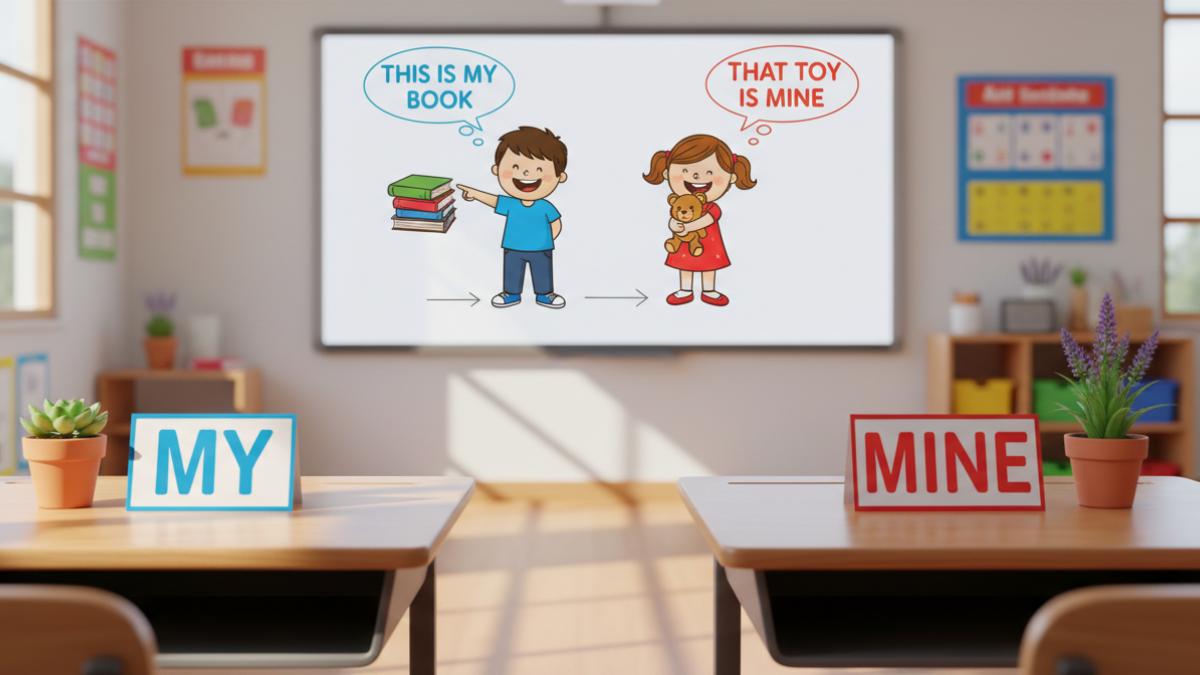
In English, small words can change a sentence fast. This lesson on Possessive Pronouns and Adjectives helps learners in Brazil choose between possessive adjectives like my and possessive pronouns like mine. The aim is simple: help the reader sound clear at home, at work, and at university.
In grammar, “possession” means more than owning a thing. It can show ownership (my bag), a relationship (my sister), or an association (my school). This is why Possessive Pronouns and Adjectives matter in everyday English, from a phone message to a document at the office.
For A1–A2, the core rule is the main focus: a noun comes after possessive adjectives, and no noun comes after possessive pronouns. For B1–B2, the reader will meet common patterns, including “a friend of mine” and forms after linking verbs. For C1, the lesson adds nuance, contrast, register, and how Portuguese habits can push learners towards the wrong choice.
The layout follows a digital workbook style. Short explanations come first, then clean examples. A Practice Section appears later, so learners and teachers can check progress with quick tasks.
Understanding the difference between possessive adjectives like my and possessive pronouns like mine becomes much easier when you see how they fit into the wider system of English pronouns. If you’d like a complete overview of all pronoun types — including personal, reflexive, relative, and possessive forms — explore our comprehensive guide from Basic to Advanced, where you’ll find clear explanations, examples, and practice activities for every level.
Key Takeaways
- Possessive Pronouns and Adjectives show ownership, relationship, or association.
- Possessive adjectives come before a noun: my phone, my documents.
- Possessive pronouns stand alone: mine, not followed by a noun.
- Level goals build from one clear rule to real sentence patterns and nuance.
- Examples stay in British English and fit common contexts in Brazil (work, home, university).
- The workbook structure supports both self-study and classroom use.
Why “my” and “mine” confuse learners of English in Brazil
In English for Brazilians, the main problem is that Portuguese often uses meu/minha where English splits the job into two forms. This is the core of my vs mine. One form sits before a noun, and the other stands alone, so the choice changes with the sentence shape.
Another trigger is the “missing noun” moment. In quick speech, a learner may ask, “Is this my?” when they have lost an item. In English, that sentence usually needs mine because the noun is not said. This is a structure issue, not a question of being formal or informal.
Daily contexts make possessive adjectives feel slippery at first. Family talk is common: “my mother” keeps the noun, but “mine” appears when the noun is understood. Classroom comparisons also push the pattern: “my answer” versus “yours”. These are high-frequency frames that show why my vs mine matters for clear meaning in English for Brazilians.
| Real-life situation | Form with a noun (possessive adjectives) | Form without a noun |
|---|---|---|
| Finding a phone on a desk | Is this my phone? | Is this mine? |
| Talking about family | That is my sister. | That sister is mine. |
| Checking work in class | This is my answer. | This answer is mine. |
Later, the article will focus on a simple rule and a quick decision test that fits everyday speech. It will also cover punctuation traps that often appear near possession, including its and it’s. This helps keep possessive adjectives and pronouns clear in reading and writing.
What are possessive adjectives (my, your, his, her, its, our, their)?
Possessive adjectives show who owns something. They answer the question Whose? and sit next to a noun. First, we need to notice if the noun is there.
These words are fixed in English: my, your, his, her, its, our, their. They don’t change for gender or number. So, the same word can go with many nouns.
How possessive adjectives work before a noun
The pattern is simple: possessive adjective + noun. It works with singular or plural nouns, and even uncountable ones. For example, “my luggage” and “my friends” are correct.
Possessive adjectives stay the same in all cases. For example, “your bag” and “your bags” are the same. His and her show who owns something, while its is used for animals and things when it’s clear.
| Form | Example phrase | Common use |
|---|---|---|
| my | my passport | Identity and travel details |
| your | your email address | Forms, logins, and contact info |
| his | his job | Talking about a person’s work |
| her | her homework | School, tasks, and study routines |
| its | its battery | Devices and everyday objects |
| our | our family | Shared groups and relationships |
| their | their house | Other people’s belongings or place |
Common noun phrases with “my” in everyday English
Many learners in Brazil find ready-made chunks helpful. Use them as a unit, not word by word: my name, my phone, my email address, my passport, my homework, my English.
For daily conversation, these phrases also help with rhythm: in my opinion, at my place, on my way, my turn. Keeping the noun after my makes the meaning clear.
Typical mistakes Brazilian learners make with possessive adjectives
A common error is leaving the noun out: “This is my.” In English, my must introduce a noun. So, the correct choice is from possessive adjectives pronouns: “This is mine.”
Another issue is doubling possession after a literal translation: “my of my friend”. In English, the options are “my friend’s” for one clear owner, or “a friend of mine” when the meaning is one person from a wider group.
Learners also mix her with hers. Her is a possessive adjective before a noun, as in “her bag”. HERS is used without a noun, so “This is her” is only correct when pointing to a person, not an object.
What are possessive pronouns (mine, yours, his, hers, its, ours, theirs)?
Possessive pronouns show who owns something when the noun is already clear. They stop repetition and keep speech smooth. The key set is mine yours his hers ours theirs, with its used less often as a pronoun.
In Brazil, learning this is important. Portuguese often keeps the noun, while English drops it. With possessive pronouns, the meaning stays the same, but the sentence gets shorter and cleaner.
How possessive pronouns replace a noun phrase
The basic move is simple: a possessive adjective plus noun becomes a possessive pronoun. My phone becomes mine when “phone” is understood.
They also work well in comparisons. My score is higher than yours is natural because “score” is implied after yours.
One form needs extra attention: his. It can be an adjective (his bag) or a pronoun (It’s his), so the context does the work.
| Goal in the sentence | With a noun phrase | With possessive pronouns |
|---|---|---|
| Avoid repetition | This is my seat, not your seat. | This is mine, not yours. |
| Make a clear comparison | Her result is better than his result. | Hers is better than his. |
| Point to a shared group | Our plan is different from their plan. | Ours is different from theirs. |
Using possessive pronouns after “be” and other linking verbs
The most common pattern is be + possessive pronoun. It’s mine. That’s yours. These are ours. Those are theirs.
Linking verbs also take them. Seem, look, and sound are frequent in everyday British English: It looks like hers and It sounds like yours.
- It’s his (not “It’s him” for possession).
- That one is mine (use mine without a noun after it).
- Those are theirs (plural meaning, same form).
Possessive pronouns after prepositions: “a friend of mine”
After a preposition, English often uses this structure: a/an + noun + of + possessive pronoun. The classic example is “a friend of mine”.
This usually means “one of my friends”, not “my friend” as a single, specific person. The same pattern works across mine yours his hers ours theirs: a colleague of hers, a neighbour of theirs, a teacher of ours.
It also fixes a common translation habit from Portuguese. English does not say a friend of me; it uses a friend of mine because the pronoun carries the ownership.
Practice
- Rewrite to avoid repetition: “This is my charger, not your charger.”
- Choose the best option: “That jacket looks like (your / yours).”
- Correct the phrase: “a friend of me” → ________.
- Complete the sentence with the right form: “Her keys are here, but his are not. I think these are ________.”
FAQs
- Can “his” be both forms? Yes. His car uses an adjective; The car is his uses a possessive pronoun.
- Is “its” a possessive pronoun? It exists, but it is rare. Most learners meet its as an adjective: its colour.
- Why do we say “a friend of mine”? Because the noun is followed by of and then a possessive pronoun, meaning “one among my friends”.
- Can I say “a friend of my”? No. After of, use a possessive pronoun: mine, not my.
- Is “This is yours book” correct? No. Use your book or This book is yours.
Possessive Pronouns and Adjectives
This page explains the main rule for Possessive Pronouns and Adjectives in everyday English. It helps learners in Brazil pick the right form quickly, for speaking and writing.
Both options show who owns something, but they look different. English often needs a clear sign to show who owns what.
Key difference: noun present vs noun omitted
Use possessive adjectives when the noun is there. The pattern is my + noun, like my seat or my key.
Use possessive pronouns when the noun is not there because it’s already known. The pattern is mine, as in It’s mine.
- Noun present: choose possessive adjectives.
- Noun omitted: choose possessive pronouns.
- English rarely leaves the owner without a form that signals possession.
Quick decision test: “Can I say the noun?”
Test 1: try adding a noun right after the word. If it works, choose my.
Test 2: if the sentence ends there, or the noun is already obvious in the context, choose mine.
Extra check: after linking verbs like is and are, the word is often a pronoun: mine, yours, hers.
Examples contrasting “my” and “mine” in the same context
| With a noun (possessive adjectives) | Without a noun (possessive pronouns) | What stays the same |
|---|---|---|
| This is my seat. | This seat is mine. | Ownership is the same; the noun moves or repeats. |
| I like my teacher. | That teacher is mine. | Both show the relationship; the second needs a clear context. |
| Where is my key? | This key is mine. | Meaning stays stable; the structure changes for clarity. |
When practising Possessive Pronouns and Adjectives, learners should read each pair aloud. The ear often catches what the eye misses.
Practice
- Choose the correct form: “Is this ___ notebook?” (my / mine)
- Rewrite without repeating the noun: “This phone is my phone.”
- Choose the correct form after a linking verb: “That seat is ___.” (my / mine)
- Correct the mistake: “Where is mine bag?”
FAQs
- Can possessive adjectives stand alone? Not normally; they usually need a noun right after them.
- Can possessive pronouns come before a noun? No; they replace the noun phrase.
- Is “That teacher is mine” always natural? Only when the listener already knows which teacher is being discussed.
- Why does English avoid leaving possession “hanging”? It prevents confusion about who owns what in a sentence.
- Do these rules change in questions? No; the same choice applies in statements and questions.
My vs mine: clear rules with practical examples
Learning the difference between “my” and “mine” is easier when you watch the noun. In English, my comes before a noun, but mine stands alone. This is the main difference between possessive adjectives and possessive pronouns.
Here are quick checks to help you choose the right word in real-life situations. This includes work, shopping, or sharing files on WhatsApp.
Use “my” + noun: “my phone”, “my idea”, “my English”
- If the noun is written or said, then use my (one of the possessive adjectives).
- If the next word is a thing or person, then choose my: my phone number, my WhatsApp, my document, my CV, my exam.
- If the topic is language skill, then my English means “the English I speak or use”, such as: My English is better in meetings than on calls.
In Brazil, these patterns are common. People often need to quickly and clearly identify personal details.
Use “mine” alone: “It’s mine”, “That one is mine”
- If the noun is not repeated, then use mine (a possessive pronoun).
- If someone is checking ownership, then use: It’s mine.
- If there are options, then use: That one is mine. / The red one is mine.
In the my vs mine rules, mine cannot take a noun after it. Mine phone is incorrect because possessive pronouns replace the whole noun phrase.
Short answers and emphasis: “Mine.” / “Not mine.”
- If the question is “Whose…?”, then a natural short reply is: Mine.
- If a learner needs a polite denial, then use: Not mine. (or It isn’t mine. for extra clarity).
- If the speaker wants contrast, then stress the pronoun: Mine, not yours.
This is where possessive pronouns often sound more natural than repeating the noun, especially in quick conversation.
| Situation | Correct form | Example in context | Common error to avoid |
|---|---|---|---|
| Noun is present (object named) | Possessive adjectives | My document is on my phone. | Mine document |
| Noun is omitted (already understood) | Possessive pronouns | This CV is mine. | This CV is my |
| Choosing from options | Mine | That one is mine; the blue one is yours. | That one is my |
| Fast reply to “Whose…?” | Mine / Not mine | Whose bag is this? Mine. | My. (when no noun follows) |
Practice
- Choose the correct word: This WhatsApp is (my/mine).
- Complete the sentence: _____ phone number is saved in the app.
- Fix the error: Mine exam is tomorrow.
- Answer with a short reply: Whose document is this? (Use one word.)
FAQs
- Can “mine” come before a noun? No. In standard grammar, possessive pronouns do not go before a noun.
- Is “my English” correct? Yes. It means the English the speaker uses, especially in speaking or writing.
- Why does “This is my” sound wrong? Because the noun is missing. The sentence needs a possessive pronoun: This is mine.
- Can “Not mine” sound rude? It is usually neutral. To sound softer, add: Sorry, it isn’t mine.
- Do these my vs mine rules change in questions? No. The choice still depends on whether a noun follows (my) or is omitted (mine).
Sentence patterns you will use most often
These everyday English patterns are great for speaking and writing in Brazil-focused classrooms. They use the same grammar, making it easy for learners to swap words while keeping things accurate. This is especially helpful with possessive adjectives and pronouns.

| Level | Frame | Example | Swap to drill |
|---|---|---|---|
| A1–A2 | This is my + noun. | This is my notebook. | my → your / notebook → phone / bag |
| A1–A2 | It’s mine. | It’s mine. | mine → yours / his / hers |
| B1 | Is this yours? / No, it’s mine. | Is this yours? No, it’s mine. | this → that / mine → theirs |
| B1 | My + noun is… / Yours is… | My answer is clearer. Yours is shorter. | answer → idea / pronunciation |
| B2–C1 | A + noun + of mine/yours/hers… | A former colleague of mine works in São Paulo. | colleague → friend / teacher |
| B2–C1 | …than mine/yours/theirs | This model is cheaper than mine. | cheaper → heavier / faster |
For substitution drills, keep the frame and change one part at a time. First, swap the noun, then the subject, and then the possessive adjectives. After that, switch to possessive pronouns to remove the noun and test if the meaning stays clear.
For quick classroom rhythm, use short turns: question, answer, correction. These everyday English patterns help learners notice where a noun is present, and where it is omitted, without long explanations.
Practice Section
- Say five items in your bag using: This is my + noun.
- Point to two items and reply with possessive pronouns: It’s mine. / It’s yours.
- Make three comparisons: My + noun is… / Yours is…
- Write two sentences with: a + noun + of mine, then swap mine for hers and theirs.
FAQs
- Can “my” stand alone? No. Possessive adjectives need a noun after them.
- When do learners choose “mine”? When the noun is already known or not said.
- Is “a friend of mine” formal? It is common in everyday English patterns and fits both speech and writing.
- Can “its” be a possessive pronoun? No. “Its” works as a possessive adjective only.
- Which is better for drills: “my” or “mine” first? Start with possessive adjectives plus a clear noun, then switch to possessive pronouns.
Possessive adjectives pronouns: key forms and common mix-ups
Possessive adjectives and pronouns follow a simple rule. An adjective comes before a noun, while a pronoun stands alone. For learners in Brazil, the key is to spot the noun first, not translate word by word.
When checking your sentences, look at what comes next. If a noun follows, use the adjective form. If the noun is missing, use the pronoun form.
“your” vs “yours” and how to choose quickly
In your vs yours, your must be followed by a noun. For example, your bag, your idea, your English. On the other hand, yours works alone, like in Is this yours? or That seat is yours..
A quick check helps: if you can point to a noun right after the word, it is your. If the noun would feel repetitive, it is yours.
“her” vs “hers” in natural conversation
In her vs hers, her + noun is simple: her phone, her class, her notes. Hers stands alone: That phone is hers..
One extra detail matters: her also works as an object pronoun, as in I saw her. That is why This is her often appears by mistake when the meaning is ownership; in that case, This is hers fits the grammar.
“their” vs “theirs” in writing and speaking
In their vs theirs, their must come before a noun: their house, their project, their decision. Theirs replaces the noun phrase: That house is theirs..
In classroom and workplace writing, The decision is theirs is common. It sounds formal and clear, and it keeps responsibility with them, not with you.
| Pair | Adjective + noun | Pronoun alone | Fast check |
|---|---|---|---|
| your vs yours | your bag; your answer | Is this yours?; That is yours. | Noun after it? Use your. No noun? Use yours. |
| her vs hers | her phone; her lesson | It is hers.; That one is hers. | If it means “I saw her”, it is not possession; if it means ownership, prefer hers without a noun. |
| their vs theirs | their plan; their results | The fault is theirs.; This is theirs. | Keep the noun if it adds clarity; drop it and use theirs when the noun is obvious. |
Practice
- Choose: “Is this book your / yours?”
- Rewrite for possession: “This is her.” (meaning: the phone belongs to her)
- Choose: “They finished their / theirs project on time.”
- Write two short lines: one with your + noun, and one with yours alone.
- FAQ: Can yours go before a noun? No. Use your before a noun in standard English.
- FAQ: Why does her have two meanings? English uses her as an object pronoun and as a possessive adjective; the noun after it shows possession.
- FAQ: Is theirs common in speech? Yes, especially after be: It’s theirs.
- FAQ: Which sounds more formal: their decision or The decision is theirs? Both are correct; the second often sounds more formal and emphatic.
- FAQ: Do these rules change in British English? No. The forms and the core rule stay the same.
Spelling, punctuation, and the classic apostrophe trap
In English, apostrophes have two main roles. They show missing letters in contractions and show who owns something. Many people get confused when trying to use them with possessive adjectives and pronouns.
For a quick review of punctuation basics, check out this apostrophe guide. Compare it with the examples below.
Why “my” and “mine” never take an apostrophe
My and mine are already possessive. They don’t need an extra mark, so *my’s* and *mine’s* are wrong.
Use my before a noun and mine without one. This keeps your writing clean and avoids unnecessary apostrophes.
Its vs it’s: possession vs “it is”
This pair often leads to mistakes because they sound the same. Its shows who owns something: its colour, its name.
It’s is short for it is or it has. A quick test: swap it’s with it is. If it works, keep the apostrophe; if not, use its.
Whose vs who’s: possession vs “who is”
Whose vs who’s works the same way. Whose shows ownership: Whose bag is this? This is common in questions about lost items.
Who’s is short for who is (or who has): Who’s there? Use the apostrophe if you mean who is; choose whose for ownership.
| Form | Type | Meaning | Correct example | Common error to avoid |
|---|---|---|---|---|
| my | possessive adjective | ownership before a noun | my phone is on the desk | my’s phone |
| mine | possessive pronoun | ownership without a noun | this one is mine | mine’s |
| its | possessive adjective | belonging to a thing/animal | the company changed its logo | it’s logo |
| it’s | contraction | it is / it has | it’s raining again | its raining |
| whose | possessive determiner | belonging to who | whose keys are these? | who’s keys |
| who’s | contraction | who is / who has | who’s coming after class? | whose coming? |
- Use apostrophes for contractions and noun possession, not for possessive adjectives.
- Check its vs it’s by swapping in it is.
- Check whose vs who’s by swapping in who is.
- Fix the apostrophe mistakes: “My’s notes are in the bag.”
- Choose the correct form: “The dog wagged (its / it’s) tail.”
- Choose the correct form: “(Whose / Who’s) phone is ringing?”
- Rewrite with the right possessive form: “That notebook is my.”
FAQs
- Why is its written without an apostrophe? Because it is a possessive adjective, like my and your.
- Can my ever take an apostrophe? No. My is already possessive, so *my’s* is not standard English.
- Is who’s only “who is”? It can also mean “who has”, as in Who’s finished?
- Why do these errors appear so often in Brazil? Sound-based spelling can hide the difference, especially in its vs it’s and whose vs who’s.
- Do apostrophes make writing more formal? Correct apostrophes make writing clearer; extra apostrophes usually create new apostrophe mistakes.
Portuguese interference: how “meu/minha” affects English choices
Learning a new language often means picking up habits from your first language. Brazilian learners might use Portuguese patterns in English. This can make it tricky to tell possessive adjectives from possessive pronouns.

This part focuses on where Portuguese and English differ in grammar. We aim for clear, correct English without overcomplicating things.
When Portuguese allows omission and English does not
In Portuguese, context can show who owns something, even with short sentences. English, however, needs a full form. So, choosing between possessive adjectives and pronouns is key.
Learner error: “This is my.”
Correction: “This is mine.”
English uses possessive pronouns (mine, yours, his, hers, ours, theirs) when the noun is not repeated. This keeps the sentence right and avoids a feeling of missing something.
Word order differences: adjective position before nouns
Word order is another area where Portuguese habits can lead to mistakes in English. English places possessive adjectives before the noun. This rule doesn’t change in standard British English.
- Correct: my car, her idea, their accent
- Wrong pattern: car my or idea her
For Brazilian learners, think of possessive adjectives and nouns as a single unit. This helps follow the English pattern.
False friends and over-translation in possession phrases
Some phrases seem direct when translated from Portuguese but don’t work in English. A common mistake is building possession in a way that sounds logical but isn’t idiomatic.
| Portuguese idea | Over-translation (incorrect) | Natural English option | Meaning in use |
|---|---|---|---|
| um amigo meu | a friend of me | a friend of mine | One friend among several; often softer and more polite |
| meu amigo | the friend my | my friend | More direct; can sound closer or more specific in context |
Spotting these patterns helps avoid mistakes with possessive pronouns and adjectives. For Brazilian learners, a simple rule is: if the noun is missing, English usually needs a possessive pronoun.
Mini practice: fix the mistakes and choose the correct form
Use this short set to practice possessive pronouns and adjectives. Focus on one check: Is the noun written, or missing?
Complete the my vs mine exercises. Write only the correct word or the corrected sentence.
- Choose: Is this (my/mine) notebook?
- Correct the sentence: This seat is my.
- Choose: That jacket is (her/hers).
- Complete: A colleague of ____ called this morning. (mine / my)
Answer key
- 1) my
- 2) This seat is mine.
- 3) hers
- 4) mine (A colleague of mine…)
Tips to sound natural in British English
Natural speech is about clear chunks, not long grammar talks. For learners in Brazil, British English is easier when you practice key phrases as whole units. Then, use them in new situations. Possessive pronouns help keep meaning clear while sentences stay light.
Polite everyday phrases: “a friend of mine”, “in my opinion”
Use in my opinion to disagree without being sharp. It works in meetings, emails, and class talks. It also gives you time to think.
- Meeting: In my opinion, this timeline is realistic.
- Email: In my opinion, we should revise the summary before Friday.
- Class: In my opinion, the main idea is in the first paragraph.
Use a friend of mine to introduce someone softly. It’s common after prepositions and helps you sound natural. The noun is clear from context, making it easy to use.
- Work: A friend of mine recommended Microsoft Teams for quick updates.
- Study: A friend of mine shared a good listening routine for commuting.
For a quick guide on my and mine, check the Cambridge guide on possessive pronouns. It’s a clean reference for British English usage.
Common spoken reductions and rhythm in fast speech
Fast speech changes rhythm more than spelling. Learners often hear “It’s mine” as one beat, almost like “its-mine”. But the words don’t merge on the page. Train your ear first, then speak with steady timing.
| Written form | Likely sound in fast speech | Listening tip for Brazilian learners |
|---|---|---|
| It’s mine. | One rhythm unit: “its-mine” | Listen for the m in mine; it signals ownership. |
| That’s yours. | Reduced vowel, quick “thats-yours” | Focus on the final z sound in yours; it is often soft but present. |
| These are ours. | Smooth link: “these-are-ours” | Expect linking between words; do not wait for pauses. |
Aim for clear communication, not accent copying. In British English usage, clean stress on key words is more useful than forcing a “British” sound.
Choosing “mine” for contrast and clarity
Use mine when you need contrast, especially in shared spaces like an office, a classroom, or public transport. This avoids repetition and keeps the message direct.
- Contrast: Mine is different.
- Correction: Not mine—hers.
- Avoid repetition: My answer is longer than yours; mine has one extra point.
In my opinion, this is the most practical habit to build: swap repeated noun phrases for possessive pronouns when the meaning is already known. It sounds natural, it reduces wordiness, and it supports British English usage in everyday talk.
If you are still building your foundation in English grammar, it is also essential to understand the difference between subject pronouns and object pronouns such as I vs me or she vs her. These forms work together with possessive structures to create clear and natural sentences. For a step-by-step explanation with common mistakes and examples, read our article.
Conclusion
This guide on Possessive Pronouns and Adjectives boils down to one key rule. Use my + noun when the noun is there: my phone, my idea, my English. Choose mine when the noun is missing but ownership is clear: It’s mine.
For a quick guide, learners in Brazil can use a simple test. Ask yourself: Can a noun follow? If yes, pick my. If no, pick mine. This rule works for all possessive pronouns and adjectives, like your/yours and their/theirs.
Focus on common patterns found in everyday speech and writing. Practice saying things like It’s mine. Is this yours? and a friend of mine. This will help you feel more confident and avoid translating directly from Portuguese.
For next steps, keep it simple and repeat often. Use the pattern bank from Section 7 every day and do the four exercises until it feels natural. Teachers can build lessons around Sections 5–7 for core practice. Then, use Sections 9–10 for focused error correction in Possessive Pronouns and Adjectives.
FAQ
When should learners use “my” and when should they use “mine”?
Use my before a noun: my phone, my passport, my homework. Choose mine when the noun is left out but understood: It’s mine; That one is mine. A simple test: if you can add a noun, use my. If not, pick mine.
Why do Brazilian learners often say “This is my”?
Portuguese often uses meu/minha without a noun. But English needs a clear statement of possession. So, say “This is mine” instead of “This is my”. This is a choice based on grammar, not formality.
Can “mine” be followed by a noun (for example, “mine phone”)?
No. Mine is a possessive pronoun that stands alone. Correct usage is: It’s mine and This phone is mine. If you need a noun, use my: my phone, not “mine phone”.
How do “your/yours”, “her/hers”, and “their/theirs” follow the same rule?
The rule is the same for all possessive adjectives pronouns pairs. Use your/her/their before a noun: your answer, her jacket, their project. Use yours/hers/theirs when the noun is left out or after a linking verb: Is this yours? That jacket is hers. The decision is theirs.
Do “my” or “mine” ever take an apostrophe?
No. My and mine are already possessive, so no apostrophe is needed: “my’s” and “mine’s” are wrong. Apostrophes are for contractions (it’s = it is) and noun possession (Maria’s book), not for possessive adjectives and possessive pronouns.


3 thoughts on “Possessive Pronouns and Adjectives: My or Mine Explained Clearly”