Introduction
The Winter Olympic Games are perfect for deep lessons without too much complexity. Teachers in ESL/EFL Brazil find it easy to plan lessons around this global event. It keeps discussions focused and engaging.
This article shares eight B2–C1 English activities based on real Olympic content. You’ll find tasks on athletes, events, medals, interviews, and live commentary. These activities aim to boost your speaking and writing skills by using evidence and careful language.
Even if your students aren’t into winter sports, these lessons are still valuable. They focus on explanation and reasoning, making it easy for everyone to join in.
These activities help improve advanced English skills for Brazilians. You’ll practice listening, reading, and writing in a formal way. It’s also great for learning about sports in English, focusing on accuracy and structure.
Key takeaways
- The Winter Olympic Games offer rich content for classroom work.
- The activities in this list aim for precision and clarity in English.
- Even if students don’t follow winter sports, these tasks are still effective.
- ESL/EFL Brazil classes can use Olympic content to practice formal English.
- These activities help improve advanced English skills through listening, reading, and writing.
- They’re designed to enhance your speaking and writing skills with evidence-based language.
Why the Winter Olympics theme works for advanced English learners
For many Brazilian classes, winter sports may seem far away. Yet, the Winter Games offer clear stories and familiar formats. This mix helps groups quickly find common ground, making B2 C1 conversations easier without needing personal snow or ice experiences.
The variety of topics keeps discussions interesting. They range from performance stories to ethics and media views. Winter Olympics topics often lead to deeper questions. This is because results, rules, and public reactions are easy to compare.
High-interest content that naturally drives discussion
Elite competitions create instant drama: selection, pressure, and national pride. With judged events and close margins, learners tend to share more thoughts with fewer prompts.
This theme is great for advanced ESL speaking prompts that need to keep going. It also works well for mixed groups. Learners can pick their interest: sport, politics, culture, or human-interest stories.
- Judging and disputes: how decisions are explained, defended, and challenged
- National systems: training pathways, funding models, and expectations
- Athlete welfare: travel, injury risk, and mental health pressures
Natural exposure to formal, journalistic, and analytical language
Game coverage shifts between interviews, live updates, and policy reports. This gives learners authentic English with clear signals, like cautious verbs and attribution.
It also supports sports discourse analysis. Learners can see how headlines, quotes, and statistics shape meaning. The language is detailed enough for close reading but also allows for nuanced discussions at higher levels.
| Coverage type | Typical language features | Useful focus for critical thinking in EFL |
|---|---|---|
| Post-race interview | Attribution, short clauses, self-correction, polite distancing | How speakers protect face and manage responsibility |
| Feature report | Background context, timeline phrases, selective detail, metaphor | Which facts are foregrounded and which are omitted |
| Rules and eligibility update | Formal nouns, passive voice, definitions, careful modality | How authority is built through wording and structure |
| Anti-doping or funding story | Numbers, comparisons, quoted sources, cautious evaluation | How evidence is framed to suggest fairness or doubt |
Built-in opportunities for opinion, comparison, and argument
The topic invites evaluation language that suits higher levels. Learners can compare countries, sports, and systems. They can justify claims using evidence, not just impressions.
This is where critical thinking in EFL becomes visible. Arguments can be tested against rules, timelines, and data. The same materials can fuel B2 C1 conversations that move from opinion to reasoned argument.
- Should technology in equipment be limited to protect fairness?
- How should public funding be balanced between elite sport and grassroots sport?
- What counts as equal access when climate and facilities differ by region?
The Winter Olympic Games as an English-learning topic for B2–C1 classes
The Winter Olympic Games are perfect for B2–C1 classes. They are familiar, current, and easy to link to language goals. This topic helps learners improve their speaking skills, focusing on clarity and detail.
For official information and historical records, visit the official Olympic website.
Using athletes, nations, and events to practise precision in speaking
When learners talk about athletes, nationalities, and events, they must be precise. Short prompts help them be accurate. For example, they might say “in the first heat” or “after the qualifier”.
Describing sports performance in English also helps learners make measured claims. They can use phrases like it is likely or the replay indicates. This keeps their speech clear and fluent.
Leveraging Olympic values for nuanced discussion and writing
Discussing Olympic values is a great way to explore ethics and inclusion. It helps learners express balanced views, moving beyond simple yes or no answers.
This also boosts intercultural communication skills. Learners can compare how different countries view sportsmanship and media pressure. Writing tasks focus on clear structure and tone.
Connecting global sport to Brazilian learners’ interests and experiences
In Brazil, winter sports might seem distant but are still relevant through global media. Learners discuss travel, climate, and access to facilities. They compare how countries invest in sports.
These conversations link international events to local media and sports culture. They keep language skills sharp. Classroom tasks use short clips and prompts, not complex rules.
| Classroom focus | Language target | Winter Olympics prompt | Typical output format |
|---|---|---|---|
| Accurate reference | Names, nationalities, disciplines, results with clear noun phrases | Identify medal positions and report changes between heats and finals | 30–45 second results recap with self-correction if needed |
| Time and sequence | Ordering markers and tight timelines | Explain how qualification leads to the final and where momentum shifts | Step-by-step oral summary using sequencing language |
| Cautious claims | Hedging, evidence phrases, and limited generalisations | Comment on whether form and conditions affected performance | Mini-analysis using “suggests”, “may”, and “based on” |
| Nuanced viewpoint | Balanced stance, concession, and contrast | Discuss fairness, inclusion, and sportsmanship through Olympic values | Short paragraph plan for a discussion post with clear signposts |
| Brazil-linked comparison | Comparatives, cause and effect, and measured tone | Compare participation barriers and investment between Brazil and winter-sport nations | Paired discussion notes with one claim and one supporting reason |
Activity types and skills targeted in this listicle
The eight activities focus on different skills, making it easy to see how to improve. Each task is based on B2 C1 skills practice, using Winter Olympics scenarios like interviews and news reports.
This approach doesn’t separate skills. Instead, it helps learners move smoothly between them. This keeps the topic and language demands clear.
Speaking goals: fluency, stance, and interaction
Speaking tasks aim for clear, organised conversations. The goal is to speak fluently, sharing opinions and listening to others. This includes being open to changing one’s mind when new evidence comes up.
It’s also important to know how to fix misunderstandings. Learners learn to clarify, paraphrase, and check if they understand. This keeps conversations accurate, even when things get fast or opinions differ.
Listening goals: gist, detail, and inference
Listening tasks are divided into three parts. First, learners focus on the main idea. Then, they pick up on specific details like names and figures.
The final part involves making inferences. This is about understanding what’s implied, like in Olympic commentary or post-race interviews. It’s about picking up on tone and what’s left unsaid.
Reading and writing goals: structure, register, and cohesion
Reading tasks show how texts are structured. They cover everything from headlines to conclusions. This helps learners understand the difference between factual reporting and opinion pieces.
Writing tasks focus on making texts clear and easy to follow. This includes using linking words and repetition to keep paragraphs connected. It helps even when the arguments get complex.
| Skill focus | What learners practise | Typical Winter Olympics text type | Observable outcome at B2–C1 |
|---|---|---|---|
| Speaking | Turn-taking, repair, hedging, qualifying, conceding | Panel-style discussion on events and judging | Longer turns with clear stance and responsive follow-up questions |
| Listening | Gist, detail, implied meaning, attitude | Broadcast interview and short commentary extract | Notes that separate facts from impressions and inferred intent |
| Reading | Text structure, bias cues, register shifts | News report with headline, lead, and quotes | Accurate summary that reflects tone and purpose |
| Writing | Paragraph control, cohesion, consistent register | Editorial-style response or feature paragraph | Logical sequencing with clear signposting and stable tone |
Activity spotlight: commentary and live event narration
This activity uses sports commentary English to improve speaking quickly and accurately. Learners focus on what changes fast and pick the most important details. The goal is to speak clearly and steadily, even when it’s hard.
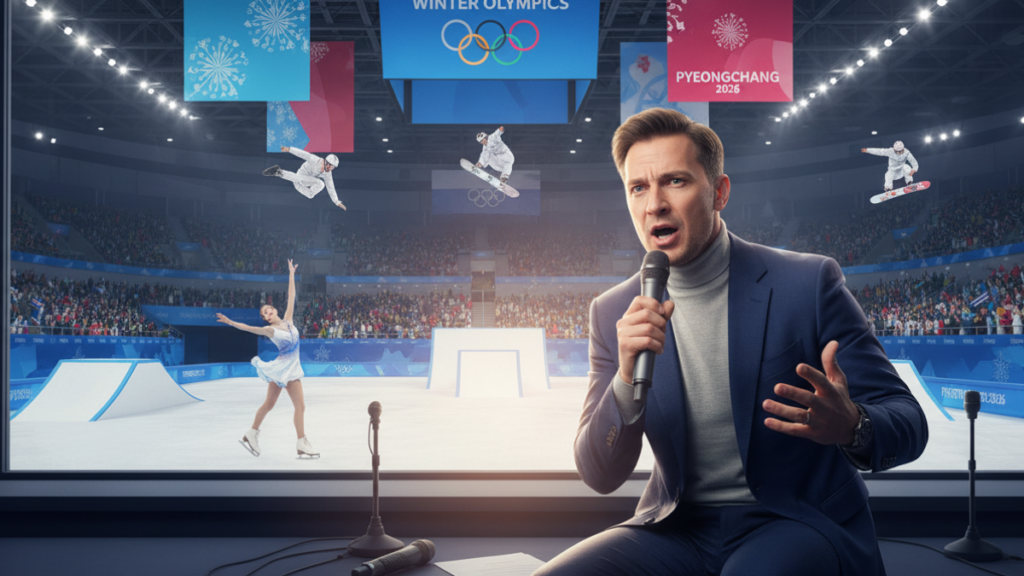
Live narration often uses short sentences and clear verbs. The present simple tense is preferred because it makes the action immediate. Learners learn how a single verb can make a big difference, like “lands” or “clips”.
Sequencing language is key to keeping the story straight. Learners practice using time signals to order events, especially when many things happen at once. They also learn to use discourse markers to smoothly move between ideas.
| Feature in live coverage | Typical language choices | Why it supports B2 C1 speaking performance | Quick class focus |
|---|---|---|---|
| Rapid description | Present simple, short verb-led clauses, minimal fillers | Builds accuracy at speed while keeping sentences stable | One-sentence calls for each key moment, then replay with improved clarity |
| Selective detail | Concrete nouns, measured adjectives, specific adverbs for pace | Trains prioritising information and avoiding overloaded speech | Choose three “must-say” details per moment; remove the rest |
| Uncertainty vs confirmation | “It looks like…”, “seems to…”, “appears to…”, then “confirmed” phrasing | Improves precision and protects credibility when outcomes change | Two-pass narration: first impression, then confirmed update |
| Transitions and structure | Sequencing language and discourse markers for speaking | Supports coherence and listener tracking during complex sequences | Mark every shift: start, change, contrast, and result |
| Evaluative vs neutral tone | Neutral description compared with mild appraisal (“clean”, “risky”, “solid”) | Develops register control and reduces overstatement | Rewrite a line twice: neutral report, then restrained evaluation |
Short clips or transcripts from the BBC can help learners compare. They can see the difference between neutral and evaluative language. This helps them understand how to choose the right words for different situations.
For groups in Brazil, comparing with Portuguese can be enlightening. They can notice differences in metaphors, adjectives, and formality. This comparison helps learners make better choices for different audiences and settings.
Activity spotlight: opinion-led debate on sport, funding, and fairness
This task views elite sport as a debate, not a competition to win. In a debate lesson B2 C1, learners can examine evidence, question assumptions, and see how language affects credibility in public talks.
For Brazilian classes, this topic is relevant because it connects global events to local issues. It helps with argumentation English by setting clear roles, timed turns, and a record of claims and sources.
Debate motions inspired by elite sport and Olympic policy
Choosing the right Olympic policy debate motions keeps the discussion focused. They work best when each side must define key terms and separate verified information from interpretation.
- Public funding for high-performance sport should focus on medal potential over broad participation.
- Private sponsorship should face tighter limits to ensure equal access to coaching or equipment.
- Judging in scored events should publish clear criteria and detailed breakdowns of decisions.
- Technology and equipment advantages should be capped to protect fair competition.
- Athlete eligibility rules should balance inclusion, safety, and consistency across events.
- Anti-doping governance should be more independent from national sporting bodies.
To support fairness in sport English, learners should cite at least one example, one reported figure, and one counterexample. This makes claims testable, even when opinions vary.
Language for hedging, rebuttals, and concession
Advanced performance often requires control, not force. Hedging and rebuttal phrases help speakers sound measured, especially when evidence is incomplete or contested.
- Hedging: “This tends to…”, “It is likely that…”, “In many cases…”, “The evidence suggests…”
- Rebuttal: “That does not follow because…”, “A stronger explanation is…”, “The key point is being missed…”
- Concession: “That is a fair concern; however…”, “Even if that is true, it does not mean…”
Evidence language should be straightforward: “According to reported figures…”, “This example shows…”, and “That is a claim, not a fact.” These moves strengthen argumentation English by making reasoning clear.
Assessment ideas for B2–C1 speaking performance
Speaking assessment criteria can be clear and consistent across groups. The focus is on clarity, development, and interaction, rather than the “right” view.
| Speaking focus | What to listen for in debate | B2 signal | C1 signal |
|---|---|---|---|
| Clarity of position | A clear stance, defined terms, and a stable line of reasoning | States a view and gives main reasons with some repetition | States a precise claim, defines terms, and maintains a consistent frame |
| Logical development | Links between points, cause–effect, and weighed trade-offs | Uses basic sequencing and examples, with occasional jumps | Builds layered points, anticipates implications, and weighs priorities |
| Interaction management | Turn-taking, signalling, and responding to interruptions | Responds to others but may lose the thread under pressure | Steers the exchange, summarises accurately, and keeps focus |
| Responsiveness to counterarguments | Direct engagement with opposing reasons and evidence | Answers some points but may sidestep stronger challenges | Addresses the strongest objection, concedes limits, then reframes |
| Accuracy with complex grammar | Control of conditionals, relative clauses, and modality | Meaning stays clear despite some errors in complex forms | High control of complex structures with few slips |
| Range of topic vocabulary | Precise lexis for policy, funding, eligibility, and governance | Uses common terms with some repetition and occasional misuse | Uses varied, precise vocabulary and reformulates when needed |
Sharing these criteria before speaking helps learners track their progress. The same framework also supports a debate lesson B2 C1 by keeping feedback specific, fair, and comparable.
Activity spotlight: advanced vocabulary and collocations from Winter Olympic sports
This activity helps improve Winter sports vocabulary English. It uses short clips and reports from major broadcasters. Learners focus on understanding the language in context.
This method supports clear listening and note-taking skills. It’s especially useful for Brazilian classrooms.
Sport-specific lexis, word families, and precise verbs
Strong reporting uses specific verb choices. Learners track verbs like accelerate and recover. They sort them by race moment.
This helps with word families B2 C1. For example, qualify is linked to qualification.
Terms are paired with clear explanations and examples. This helps learners use result language like advance and eliminate.
Collocations and idiomatic patterns used in sports journalism
Reports use predictable pairings. Students notice these differ from casual speech. A short extract can reveal collocations like set the pace.
Each collocation is paired with its typical grammar and a neutral substitute. This helps learners adjust their language.
| Match-report phrase | Core meaning | Useful grammar pattern | Plain alternative for clarity |
|---|---|---|---|
| set the pace | lead early and control tempo | set the pace + in/through + stage | lead from the start |
| edge out | win by a very small amount | edge out + opponent + by + figure | beat by a little |
| claim a medal | secure a top-three result | claim + a medal + in + event | win a medal |
| mount a comeback | recover after a setback | mount a comeback + after + issue | come back well |
| narrow margin | small time or point gap | by/with a narrow margin | by a small gap |
Pronunciation focus: stress, consonant clusters, and tricky names
Accurate delivery is key when reading reports aloud. Work on stress patterns English starts with longer terms. Then, move to sentence stress for clarity.
Drills on consonant clusters help with common combinations. This includes /str/ and /sk/ in words like strategy and ski.
International reporting requires proper nouns pronunciation. Learners check how names are said on-air. They rehearse in short scripts to improve rhythm and stress.
Activity spotlight: reading authentic news and analysing bias
Learners use Winter Olympics news from big outlets as language data. They focus on form, logic, and register, not political views. This makes learning about media bias useful for better reading and class discussions.
Choosing the right text is key for advanced reading. A simple report can be next to an analysis or editorial on the same event. This helps learners see how different styles handle certainty and evaluation.
Headline analysis is a good start. It shows how headlines can shape our expectations. Learners can compare what headlines promise with what the first paragraph delivers.
Then, learners focus on fact vs opinion. Reports mix numbers with interpretation. They learn to separate what is observed from what is inferred.
| Feature in Winter Olympics news coverage | Common wording pattern | Likely effect on meaning | Reading focus for critical reading skills |
|---|---|---|---|
| Headline framing | “X faces questions after…” | Suggests doubt before evidence appears | Check whether the lead supports the implied claim |
| Lead paragraph scope | “In a dramatic turn…” | Signals interpretation early | Identify which details are facts and which are tone-setting |
| Quotation balance | One side quoted directly; the other paraphrased | Gives one voice more authority | Count direct quotes and note who is named |
| Attribution clarity | “Sources say” or “it is believed” | Reduces traceable responsibility | Mark anonymous claims and look for corroboration |
| Statistics and comparison | Single figure without baseline or timeframe | Can mislead by omission | Ask what context would make the number interpretable |
To improve critical reading, learners can compare English and Portuguese reports. This bilingual approach helps track lexical choices and background information for international readers.
Learners keep a record of what is stated, suggested, and unsaid. This routine helps with media bias analysis and advanced comprehension. It keeps the focus on headline analysis and fact vs opinion language.
Activity spotlight: writing an editorial or long-form blog post
This task links Winter Olympic issues to policy, athlete welfare, media stories, and funding. It meets editorial writing B2 C1 goals. It also makes ideas clear and testable against evidence.

For many Brazilian learners, this topic is current. It mirrors debates in football, volleyball, and public sport. This familiarity helps keep the blog focused and clear.
Structuring an argument with clear paragraphing and signposting
A strong draft starts with a clear thesis. It then builds in steps. Each paragraph has a topic sentence, a claim, and support.
Signposting helps readers follow the logic. Phrases like however, in contrast, and as a result show how evidence connects. They are especially useful when facing a counterargument.
| Argument move | What it does in the text | Typical signposting | Winter Olympic angle for examples |
|---|---|---|---|
| Thesis | Sets the central position in one sentence | This piece argues that… | Investment in athlete welfare versus medal targets |
| Reason + evidence | Explains why the thesis is credible | For example, in practice | Training access, travel costs, and medical support |
| Counterargument | Shows awareness of a competing view | Some may argue that… | Public funding priorities and “elite sport first” logic |
| Rebuttal | Limits the counterargument with reasoning | Yet, even so | Long-term participation, safety, and credibility in sport |
| Implication | Links the argument to wider outcomes | Therefore, this suggests | Media framing, trust, and fair selection systems |
Register and tone: from persuasive to analytical
Editorial writing often uses firmer claims and carefully chosen evaluation. Long-form blogging can sound more analytical. It uses measured certainty and a clear split between fact, inference, and opinion.
Formal register writing keeps tone steady across both styles. It avoids slang, controls humour, and uses precise verbs. This keeps the text focused, whether discussing results data or ethical questions.
Editing checklist: cohesion, accuracy, and style
An advanced writing editing checklist starts with cohesion devices. These include reference words, consistent key terms, and links that match the argument. Paragraph unity is key, so each paragraph should do one job and avoid side themes.
Accuracy checks focus on complex sentences that stay clear. They ensure reliable punctuation and stable verb forms. Style checks look for abrupt shifts in formality, repeated phrasing, and overconfident claims that lack support.
Activity spotlight: listening to interviews and producing athlete profiles
Winter Olympic coverage clips are great for advanced classes in Brazil. They help learners improve their listening skills. This is done by focusing on real-world media language and public answers.
Short clips also help with note-taking and understanding what is said versus what is guessed. This skill is crucial when moving to writing athlete profiles.
Extracting stance, motivation, and implied meaning
Elite sport interviews often use guarded language. Learners can spot this by looking for modal verbs and softeners. These words show how committed the athlete is.
Implied meaning can be inferred from changes in tone or repeated phrases. The goal is to understand what is meant without guessing too much.
- Explicit content: the exact claim, time frame, and responsibility.
- Implied layer: what the speaker avoids, narrows, or reframes.
- Accountability: where the words suggest uncertainty, pressure, or control.
Follow-up speaking: interview role-plays with challenging questions
Simulations can turn listening into speaking. They keep the conversation brief and professional. Questions should cover common topics like preparation and public scrutiny.
For B2–C1, the focus is on asking follow-up questions and staying calm. This rewards learners for being clear and composed under pressure.
| Press question type | What it tests | Useful stance and motivation language | Evidence expected |
|---|---|---|---|
| Performance pressure after a mistake | Composure, hedging, and precision | It would be unfair to… / What mattered was… | One concrete moment from the event and one training detail |
| Preparation changes before competition | Sequencing and causality | We adjusted because… / The priority was… | Timeline language and one measurable change |
| Controversy about judging or rules | Diplomatic disagreement | From my perspective… / I cannot speak for… | Rule-based wording and careful attribution to officials |
| Team dynamics and responsibility | Attribution and balance | Credit belongs to… / We were focused on… | Named roles (coach, support staff) without unfounded claims |
Writing extension: profile bios and feature-style intros
After listening, learners can write short bios. They should focus on verified facts and include a quoted line to capture the athlete’s voice.
Feature writing intros should be crisp and journalistic. They should include a scene, statistic, and a clear nut line. This shows why the athlete is important now. Listening interviews B2 C1 help make the writing feel authentic.
Activity spotlight: data, statistics, and describing trends in results tables
This activity helps learners report Winter Olympic results calmly and accurately. It focuses on spotting trends without guessing why. They learn to turn numbers into clear sentences, using phrases like rose, fell, and levelled off.
When analysing medals tables, learners aim to report what the table shows and what it doesn’t. A small change in gold medals can change a team’s rank, even if total medals are similar. This skill is crucial for B2 C1 statistics, where precision is key.
Comparative structures help learners explain small differences and big outliers. Phrases like slightly higher than and far lower than are useful for quick summaries. They also learn to be cautious in data commentary, using phrases like may be linked to instead of is caused by.
When interpreting charts and tables, learners notice how they are framed. Some headlines focus on gold medals, while others look at totals or medals per capita. For Brazilian audiences, it’s important to stay neutral by focusing on evidence and avoiding stereotypes.
| Focus in results reporting | Useful language feature | Example sentence for Winter Olympic data | Common pitfall to avoid |
|---|---|---|---|
| Describing direction over time | Trend verbs and adverbs | “The points total rose steadily across the final three heats.” | Using dramatic verbs that overstate small changes |
| Comparing teams or countries | Comparative structures | “Canada finished slightly ahead of Germany on total points, but Germany had more wins.” | Mixing measures (points vs medals) in one claim |
| Explaining ranks in a medals table | Precise quantifiers | “Norway placed first with more golds, although the total medal gap was narrow.” | Treating rank as the only measure of performance |
| Highlighting exceptions | Outlier and contrast language | “One event produced an outlier result, unlike the rest of the series.” | Assuming an outlier proves a wider pattern |
| Responsible interpretation | Hedging and cautious stance | “The improvement may reflect better preparation, but the data alone cannot confirm why.” | Claiming causation from one dataset |
- Short oral summaries: 30 seconds to report one key change, one comparison, and one caution.
- Mini reports: 120–150 words that combine medals table analysis with one paragraph of trend language.
- Media check: identify what a headline highlights, then rewrite it in neutral statistics language B2 C1.
If you want to expand your academic vocabulary, check out our complete guide on Word Formation Exercises for B1–C1 Learners.
Conclusion
These Winter Olympic Games English activities combine eight formats into one plan. They help with controlled speaking, careful turn-taking, and precise phrasing. They also boost confidence in using specific words and improving pronunciation.
The activities are based on stable templates from elite sports. This structure helps learners use B2 C1 integrated skills across tasks. It also makes learning more authentic by using real reporting and analysis.
For advanced English practice in Brazil, the theme is still accessible. The tasks focus on explaining, providing evidence, and making logical comparisons. This means learners can improve their clarity and accuracy without needing to know a lot about winter sports.
Throughout speaking, listening, reading, and writing, the focus is on inference, evaluation, and organised expression. Learners get to work with different registers, from formal journalism to analytical argument. Used together, these activities offer a practical way to improve English skills at upper levels.
FAQ
Who are these Winter Olympics English activities designed for?
These activities are designed for B2–C1 learners, including upper-intermediate and advanced students. They are particularly suitable for private lessons and small-group classes where learners are ready to analyse authentic media, sustain longer discussions, and produce structured written responses.
What language skills can learners develop through the Winter Olympic Games theme?
Learners can develop speaking, listening, reading, and writing skills in an integrated way. The theme also supports advanced abilities such as expressing nuanced opinions, analysing evidence, summarising data, and responding critically to authentic media sources.
Why is Olympic media coverage effective for advanced English learners?
Olympic media coverage exposes learners to formal, analytical, and journalistic language. It includes headlines, quotations, commentary, and structured reporting, helping students become familiar with different registers, tone variation, and evidence-based argumentation.
Are these activities suitable for private English lessons?
Yes. The activities are highly adaptable for one-to-one teaching. They encourage sustained fluency, structured debate, interview simulation, and analytical discussion — all of which work particularly well in personalised, high-level lessons.
Which authentic sources can be used with this topic?
Reliable sources include BBC Sport, Eurosport, Reuters, and the official IOC website. These platforms provide interviews, match reports, statistics, and commentary that are ideal for listening practice, reading analysis, and vocabulary expansion at advanced levels.