
Introduction
English demonstratives might seem easy, but they’re crucial for clear communication. This guide helps Brazilian learners of English (A1–C1) use This That These Those correctly. It includes examples from school, travel, and work in British English.
It covers the basics: singular vs plural, and near vs far. You’ll also learn how demonstratives act as pronouns and adjectives. A practice section and answer key are provided for self-checking.
This article is divided into 11 sections for easy reading on mobile devices. It starts with rules, then examples, common errors, dialogues, tips, and practice with answers. It concludes briefly.
Demonstrative words like this, that, these, and those are part of a broader group of English pronouns used to refer to people, objects, or ideas. If you would like to understand how demonstratives connect with other types of pronouns, explore our complete guide, English Pronouns: Complete Guide from Basic to Advanced, where you can learn about all pronoun categories with clear explanations and examples.

Key takeaways
- Choose This That These Those by checking number (one vs many) and distance (near vs far).
- English demonstratives can point to objects, people, places, time, and ideas in a conversation.
- Brazilian learners English often need extra practice with “that” for natural, everyday reference.
- Demonstratives work in two roles: pronoun (no noun) and adjective (before a noun).
- This demonstratives guide uses British English usage suited to real-life situations in Brazil.
- Short exercises and later answers help learners check accuracy and build speed.
Understanding demonstratives in English for Brazilian learners
In everyday talk, people use small words to point and keep things clear. Demonstratives in English are key, often used in just one word. For Brazilian learners, the big challenge is speed. They need to pick the right form for the moment, not just what feels familiar.
What “demonstratives” mean in everyday English
Demonstratives are short words that point to things, people, or ideas. The main ones are this, that, these, those. They help listeners know what is being talked about, whether it’s on a table or in a chat.
These words have two main roles. As adjectives, they go before a noun: this watch, those shoes. As pronouns, they can stand alone when the noun is clear: This is nice, Those are mine.
Why demonstratives are tricky for Portuguese speakers
Brazilian Portuguese learners often map their language too closely onto English. In Brazilian Portuguese, esse/essa is used where English would say this. Aquele/aquela is often used for that. Knowing the Portuguese system can help, but English has a simpler rule at Portuguese demonstratives.
Grammar can also be tricky. Learners might focus too much on near versus far, missing the singular versus plural. In real talk, this can lead to using this even when it’s not right.
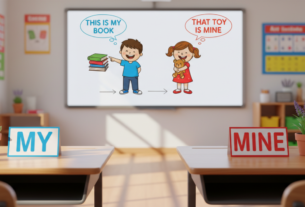
While demonstratives help us identify specific objects or people, English also uses other structures to show relationships such as ownership. To learn how possession works in English with forms like my and mine, you can explore the article Possessive Pronouns and Adjectives: My or Mine Explained Clearly.
| English choice | Core idea in speech | Common BR-PT pull | Quick example |
|---|---|---|---|
| this | near the speaker; singular | overuse because esse/essa feels like “this” in many Brazilian contexts | This t-shirt is expensive. |
| these | near the speaker; plural | singular/plural gets missed under speed | These shoes go well with your suit. |
| that | far from the speaker; singular | may be avoided in favour of this when unsure | That watch is nice. |
| those | far from the speaker; plural | plural form is often delayed while speaking | Those trainers are new. |
How to choose the right word quickly when speaking
Use a simple decision guide for fast speech. First, decide if it’s one or many. Then, is it near or far? This keeps your English clear and easy to follow.
- One + near → this
- Many + near → these
- One + far → that
- Many + far → those
To sound natural, add a clear reference. A small gesture or eye gaze helps. It also makes switching between adjectives and pronouns easier, especially when Brazilian Portuguese patterns differ.
This That These Those
In everyday speech, choosing the right demonstratives is easy and practical. The words “this,” “that,” “these,” and “those” point to things, people, or ideas. They also show how many and how close or far they are.
Brazilian learners often do well by checking two things first: one or more than one, and near or far. The rest is just pattern practice, not guessing.
Singular vs plural: the core difference
First, think about number. Singular forms are this and that. Plural forms are these and those.
This vs these is about counting: one item versus more than one. That vs those is similar, but often used when the item is not nearby.
| Form | Number | Quick verb cue | Example sentence |
|---|---|---|---|
| this | Singular | This is… | This is my notebook. |
| that | Singular | That is… | That is the whiteboard. |
| these | Plural | These are… | These are my keys. |
| those | Plural | Those are… | Those are your bags. |
When speaking, the verb cue helps the ear. “This/That is …” and “These/Those are …”. If the verb sounds wrong, the demonstrative is likely wrong too.
Near vs far: distance in real life and in conversation
Next, think about distance. “Near” means close to the speaker. “Far” means not close, like across the room or street.
Distance can also be about conversation. “Near” can point to the current topic. “Far” can point back to something earlier.
- Near: this, these (on the desk, in the hand, in the current moment)
- Far: that, those (over there, not in the immediate space)
Common classroom and travel examples
In class, learners can practice with real objects. Point to a phone and say, “This is my phone.” Point to bags on the floor and say, “Those are our bags.” Gestures make the meaning clear and reduce hesitation.
In cafés, shops, and stations, demonstratives help with polite, quick questions. “Excuse me, is that the right platform?” and “How much are those?” are natural choices when the sign or item is not close.
For structured revision, exercises can focus on short cues: one/many, near/far, is/are. The goal is to build a reliable habit for classroom talk and travel speech.
Demonstrative pronouns: when the word replaces the noun
Demonstrative pronouns help us point to things without repeating the noun. Often, the noun is clear from the context, a gesture, or the last sentence. This is where the choice between pronoun and adjective becomes clear: the same word can either replace the noun or sit before it.
In quick conversations, using this/that as pronouns sounds more natural than repeating the noun. For Brazilian learners, understanding the context is key. If the listener can’t see or recall the item, the message becomes unclear.
Using “this/that/these/those” alone (without a noun)
Use this, that, these, and those alone when the noun is understood. They can identify an object, choose between options, react to information, or refer back to a point just made. These/those pronouns are especially common when several items are visible or being compared.
Clarity is important. If a speaker says “This is good” without a cue, the listener might ask “This what?”. Add the noun once to set the topic, then switch back to the pronoun in the next line.
Examples with questions and short answers
Reuse these patterns for travel, class, and daily errands. Notice the verb agreement: this/that + is and these/those + are.
- “What’s this?” / “This is my passport.”
- “What are those?” / “Those are my keys.”
- “Is that yours?” / “Yes, that is mine.”
- “Are these ready?” / “Yes, these are ready.”
| Pattern | Correct short answer | Why it works |
|---|---|---|
| What’s this? | This is my passport. | Singular item; this/that as pronouns take is. |
| What are those? | Those are my keys. | Plural items; these/those pronouns take are. |
| Is that yours? | Yes, that is mine. | Single item at a distance; reply keeps the same demonstrative pronoun. |
| Are these correct? | No, these are wrong. | Plural set near the speaker; the adjective is not needed because the noun is implied. |
Typical mistakes and how to fix them
- Mistake: “This are my keys.” Fix: “These are my keys.” Match plural with are.
- Mistake: Using those for one far item: “Those is my bag.” Fix: “That is my bag.” Keep singular far with that.
- Mistake: Unclear reference: “This is good.” Fix: Set the noun once: “This idea is good.” Then later: “This is good.” This keeps pronoun vs adjective clear and avoids confusion.
Demonstrative adjectives: when the word modifies a noun
Demonstrative adjectives help us point out specific things. They act like a quick guide, making sure we understand quickly, like at a station or shop.
It’s important to remember that choosing between demonstrative pronouns and adjectives depends on clarity. If it’s not clear, include the noun. This is why we often use this/that/these/those + noun in travel English.
Placing demonstratives before nouns correctly
Always put demonstratives before nouns. For example, say this phone, not phone this. This rule applies to questions, statements, and short answers.
- Where is that passport?
- I can’t find these documents.
- Are those train tickets valid today?
Choosing the right noun form (singular/plural)
Always match the noun form correctly. Use this and that with singular nouns, and these and those with plural nouns. This helps avoid grammar mistakes when speaking.
| Form | Correct pattern | Travel-ready examples (Brazil-focused) | Common mix-up to avoid |
|---|---|---|---|
| This | this + singular noun | this phone; this bag; this passport | this documents |
| That | that + singular noun | that photo; that shoe; that ticket | that shoes |
| These | these + plural noun | these photos; these shoes; these documents | these passport |
| Those | those + plural noun | those buildings; those train tickets; those bags | those bag |
Contrast examples: pronoun vs adjective usage
Use a noun after demonstrative adjectives when you need to label something. Look at the difference between demonstrative pronouns and adjectives in minimal pairs. Notice how the noun changes.
- Adjective: I like this film. / Pronoun: I like this.
- Adjective: Can you see those buildings? / Pronoun: Can you see those?
If it’s not clear, keep the noun. For example, those buildings is clearer than those. This choice helps with clear speech, especially when discussing many things.
Practice
- Fill the gaps with this/that/these/those: “Can I put ______ bag here?”
- Choose the correct option: “______ documents are mine.” (this / these)
- Rewrite with a noun: “I prefer those.” (use: train tickets)
- Rewrite without a noun: “I can’t find that passport.” (remove the noun)
Near vs far meanings beyond physical distance
In spoken English, demonstratives do more than point to objects. They also mark what feels “near” or “far” in the mind. This matters for fluency because listeners track meaning through context, not just distance.
For Brazilian learners, it helps to treat this as a choice of perspective. The pragmatic use of demonstratives often reflects how connected the speaker feels to a moment, an idea, or a tone.
Talking about time: “this week” vs “that day”
With demonstratives time reference, “near time” links to now or the current period. Speakers say this morning, this week that day, or these days when the time still feels active in the conversation.
“Far time” creates space from the present. That day, that year, and those days often signal that the moment is finished, distant, or already framed as a past story.
When choosing, learners can ask one question: does the time feel close to the speaker’s current frame, or does it feel separate? That judgement is often more useful than the calendar itself.
| Time frame in speech | Typical demonstrative choice | What it suggests to the listener |
|---|---|---|
| Current period the speaker is living through | this / these | Ongoing, relevant now, connected to the present |
| Past moment told as a finished event | that / those | Completed, set apart, viewed from a distance |
| Time mentioned earlier in the same chat | that (very common in speech) | Shared reference, “you know the one I mean” |
Referring to ideas in a conversation: “this” point vs “that” argument
Demonstratives also organise talk. For discourse reference this/that, “this” often introduces or highlights what comes next: This is the key point. It can sound focused and guiding.
“That” often points back to what was already said: That’s what I mean. In spoken British English, this backward reference is natural and frequent, especially when agreeing, summarising, or correcting.
Teachers can encourage listening practice by noticing how “that” works as a quick label for a whole sentence, not just one noun. It helps learners follow arguments without translating word by word.
Emotional distance and emphasis in polite speech
Beyond grammar, demonstratives can signal attitude. “This” may sound more engaged: This is really helpful. “That” can sound more detached or evaluative: That’s interesting.
These effects are not fixed rules, but patterns. The pragmatic use of demonstratives depends on tone, relationship, and setting, such as classrooms, meetings, and customer service.
For Brazilian learners aiming for natural politeness, the safest habit is to notice what trusted speakers do in films, podcasts, and lessons. Over time, demonstratives time reference and discourse reference this/that start to feel automatic in real speech.
Practice
- Choose the best option: “I’m very busy ____ week.” (this / that)
- Complete the sentence: “I remember ____ day clearly; it changed my plan.” (this / that)
- Reply with a natural spoken phrase: A: “So we need clearer goals.” B: “____’s what I mean.” (This / That)
- Pick the more polite, neutral response in a meeting: “____’s interesting.” (This / That) Explain your choice in one short sentence.
Common errors Brazilians make with this/that/these/those
Many Brazilian learners make mistakes with demonstratives, especially in fast speech. They often choose a safe option instead of the precise one. Checking distance and number helps more than memorising long rules.

Overusing “this” and “these” in spoken English
In fast speech, learners might use this or these too much. This can sound odd if the object is far away or already mentioned.
Try a simple routine: pause, check distance, check number, then pick the right form. A helpful trick is to listen for the verb. If it’s is, choose singular; if it’s are, choose plural.
Mixing singular and plural forms
Another mistake is mixing number with the verb. This often happens in spontaneous talk. It’s especially common when the noun comes later and the speaker changes direction.
| Error form | What it breaks | Correct pairing to learn as one unit | Quick self-check |
|---|---|---|---|
| This are my keys. | Singular demonstrative with plural verb | These + are: These are my keys. | Hear are → choose these/those |
| These is my bag. | Plural demonstrative with singular verb | This + is: This is my bag. | Hear is → choose this/that |
| That are the tickets. | Singular demonstrative with plural noun and verb | Those + are: Those are the tickets. | Count items → one or many? |
| Those is a problem. | Plural demonstrative with singular verb and idea | That + is: That is a problem. | If it is one idea → singular |
To avoid these mistakes, many teachers teach this/that + is and these/those + are as fixed pairs. Practice them until they become second nature.
Confusing “that” with “it” in natural conversation
In conversations, it points to a specific thing, while that refers to a situation or idea.
- I lost my phone. It is gone. (the phone)
- I lost my phone. — That is annoying. (the situation)
In British English, using that to react is common: That’s great, That’s a problem, That’s interesting. Practice these reactions as set phrases. Use it only when the noun is clear and specific.
Real-life examples and mini dialogues (British English)
These British English dialogues show how people talk in everyday life. Each example is set in a real-life situation, making travel English UK easy to understand. They also help learners spot patterns quickly.
Café
Customer: Excuse me, is that available?
Server: Yes, and these pastries are fresh today.
Customer: Cheers. I’ll take this coffee, please.
- that = far, singular (pronoun: replaces the item)
- these = near, plural (adjective: describes pastries)
- this = near, singular (adjective: describes coffee)
Shop
Customer: Sorry, how much are those?
Assistant: They’re £12. And what about this one?
Customer: Is that jacket on sale?
- those = far, plural (pronoun: replaces the items)
- this = near, singular (pronoun: replaces the item)
- that = far, singular (adjective: describes jacket)
Station
Traveller: Pardon, is this the train to Manchester?
Staff: No, that one is. This is for Leeds.
Traveller: All right, thanks.
- this = near, singular (adjective: describes train)
- that = far, singular (pronoun: replaces train)
- this = near, singular (pronoun: replaces train/service)
Class
Teacher: Open these pages, please.
Learner: Is this correct?
Teacher: Yes. Now check those answers on the board.
- these = near, plural (adjective: describes pages)
- this = near, singular (pronoun: replaces an answer)
- those = far, plural (adjective: describes answers)
For learners in Brazil, this mix of café, shop, station, and class contexts keeps the focus on meaning, distance, and number. It also keeps travel English UK practical, while reinforcing real-life examples demonstratives across both pronoun and adjective use.
Quick rules and memory tips to choose correctly
In fast speech, demonstratives are best checked quickly. The aim is to keep meaning clear while speaking fast. Use quick rules like “this that these those” as a guide, then check with context.

The “near me / far from me” shortcut
Start with distance. Near far demonstratives help place and time: here/now is near, and there/then is far. This works for real objects and ideas too.
Use this and these for things close to you. Use that and those for things far away or in the past.
The “one / many” shortcut
If distance is tricky, check the number first. Use this/that for one item. Use these/those for many items.
A quick self-check is the verb. Is fits with singular, and are with plural. This helps avoid mistakes, especially when switching languages.
| Fast check | Singular choice | Plural choice | Micro-example (British English) |
|---|---|---|---|
| Near (here/now) | this | these | This is my phone. These are my notes. |
| Far (there/then) | that | those | That is your bag. Those are your books. |
| Verb agreement check | is | are | This is correct. Those are correct. |
| Conversation link | this idea | those points | This idea makes sense. Those points need detail. |
Pairing with gestures and pointing for fluency
Fluency comes from gestures. Pointing helps carry meaning. It makes understanding faster and reduces word search time.
In class, use a phone, pen, and notebook at different distances. Say a sentence while pointing, then change positions and repeat. This makes the choice automatic.
Practice Section (4 exercises)
- Look at two objects near you. Say two sentences: one with this, one with these, while pointing.
- Pick two objects across the room. Say two sentences: one with that, one with those, and check is/are.
- Say a time phrase aloud: “this week”, then “that day”. Explain in one short sentence why each feels near or far.
- Do a 20-second drill: alternate quick rules this that these those while pointing near, then far, without stopping.
This that these those exercises to practise and self-check
Practice Section: Use these exercises to improve your speed and accuracy. Each task helps with demonstrative pronouns and adjectives. You can check your English grammar quickly after each task.
Fill-in-the-gaps: choose this/that/these/those
Choose one word for each gap.
- 1) ____ passport here is mine.
- 2) ____ keys over there are yours.
- 3) ____ ticket in my hand is for the train.
- 4) ____ tickets on the table are for the match.
- 5) ____ week is busy for me.
- 6) ____ day last month was unforgettable.
- 7) ____ days are easier when you revise.
- 8) ____ messages on your phone look urgent.
- 9) Can you move ____ chair near you?
- 10) Please read ____ sign on the wall.
Optional extension (B2–C1): After each answer, add a time or discourse link: “this week, in this email, in that argument”.
Rewrite: change adjectives to pronouns (and vice versa)
Rewrite each sentence so it switches type. Keep meaning clear.
- 1) This passport is new. → Rewrite with a pronoun.
- 2) Those keys are on the sofa. → Rewrite with an adjective + noun.
- 3) These tickets are for São Paulo. → Rewrite with a pronoun.
- 4) That is my message. → Rewrite with an adjective + noun.
- 5) This is expensive. → Rewrite with an adjective + noun.
- 6) Those messages are confusing. → Rewrite with a pronoun.
Optional extension (B2–C1): Add a second sentence that refers back to the same item: “That is the issue. This is why…”.
Speaking drill: describe objects near and far
Speak for 10–15 seconds per prompt. Point if possible, or imagine the scene.
- 1) Point to something in your hand and say what it is using this.
- 2) Point to two items near you and describe them with these.
- 3) Point to an object across the room and describe it with that.
- 4) Point to several things far away and describe them with those.
- 5) Hold up your phone and refer to one text: use an adjective + noun.
- 6) Refer to an idea: say, “____ is the problem,” then give one reason.
Optional extension (B2–C1): Repeat prompts 3–6 using a time reference: “that day”, “those weeks”, “this afternoon”.
Answer key and brief explanations
Exercise 4: Error correction (Correct each sentence.)
- 1) This are my keys.
- 2) These passport is mine.
- 3) That tickets are cheap.
- 4) Those message is from the bank.
- 5) I like this days.
- 6) This is the tickets for the match.
Answers + quick rules for self-check English grammar
- Exercise 1 answers: 1) this 2) those 3) this 4) these 5) this 6) that 7) these 8) those 9) this 10) that. Rule: near vs far + singular vs plural.
- Exercise 2 sample answers: 1) This is new. Rule: pronoun replaces the noun. 2) Those keys are on the sofa. Rule: adjective stays before the noun. 3) These are for São Paulo. Rule: pronoun + plural verb. 4) That message is mine. Rule: adjective modifies a noun. 5) This price is expensive. Rule: add a concrete noun. 6) Those are confusing. Rule: pronoun stands alone.
- Exercise 3 check: Use this/these for near; that/those for far. Rule: distance choice first, then number.
- Exercise 4 answers: 1) These are my keys. Rule: plural needs are. 2) This passport is mine. Rule: singular noun needs this. 3) Those tickets are cheap. Rule: plural noun needs those. 4) That message is from the bank. Rule: singular noun needs that. 5) I like these days. Rule: plural needs these. 6) These are the tickets for the match. Rule: plural subject + are; demonstrative pronouns practice.
To review later, repeat the this that these those exercises aloud and re-check the answers. Keep one minute for demonstrative adjectives practice, then one minute for demonstrative pronouns practice.
Conclusion
This That These Those summary: it’s easy when you stick to one rule. First, check the number: this/that for one thing, and these/those for many. Next, think about distance: this/these for things close, and that/those for things far away.
Finally, check how the demonstrative is used: as a pronoun alone, or as an adjective before a noun.
For a quick guide, remember: one or many, near or far, pronoun or adjective. This rule helps with correct use in speaking and writing. It also aids in verb agreement, like is/are, which changes with the demonstrative.
Next, practice by reading dialogues out loud and listening to the rhythm. Use real objects to practice, making distance feel real. Then, check your answers to spot common mistakes, especially with is/are and that versus it.
In English grammar for Brazilians, progress comes from noticing patterns in real input. This includes short videos, podcasts, and graded readers. Regular, short practice sessions help build accuracy without stress. This guide works best when learners use it often, as a reliable tool for everyday choices.
Understanding demonstratives becomes easier when learners are familiar with other pronoun forms used in sentence structure. If you want to review how subject and object pronouns work in English, the article Subject and Object Pronouns: I or Me? Common Mistakes Explained provides a clear explanation of these essential grammar forms.
FAQ
What is the difference between this and that?
“This” refers to something near the speaker, while “that” refers to something farther away. Both are singular demonstratives used to identify a specific person or object.
When should I use these and those?
“These” and “those” are plural forms. Use “these” for things that are near and “those” for things that are farther away.
Are this, that, these, and those pronouns or adjectives?
They can function as both. When they replace a noun, they are demonstrative pronouns. When they describe a noun, they are demonstrative adjectives.
Why do English learners confuse these demonstratives?
Learners often confuse them because they must consider distance and number at the same time. For example, “this” is singular and near, while “those” is plural and far.
How can I practise using this, that, these, and those?
The best way is to practise with visual examples, short dialogues, and sentence exercises that help you recognise when each form is appropriate.


2 thoughts on “This That These Those? A Complete Guide with Exercises A1-C1”