Introduction
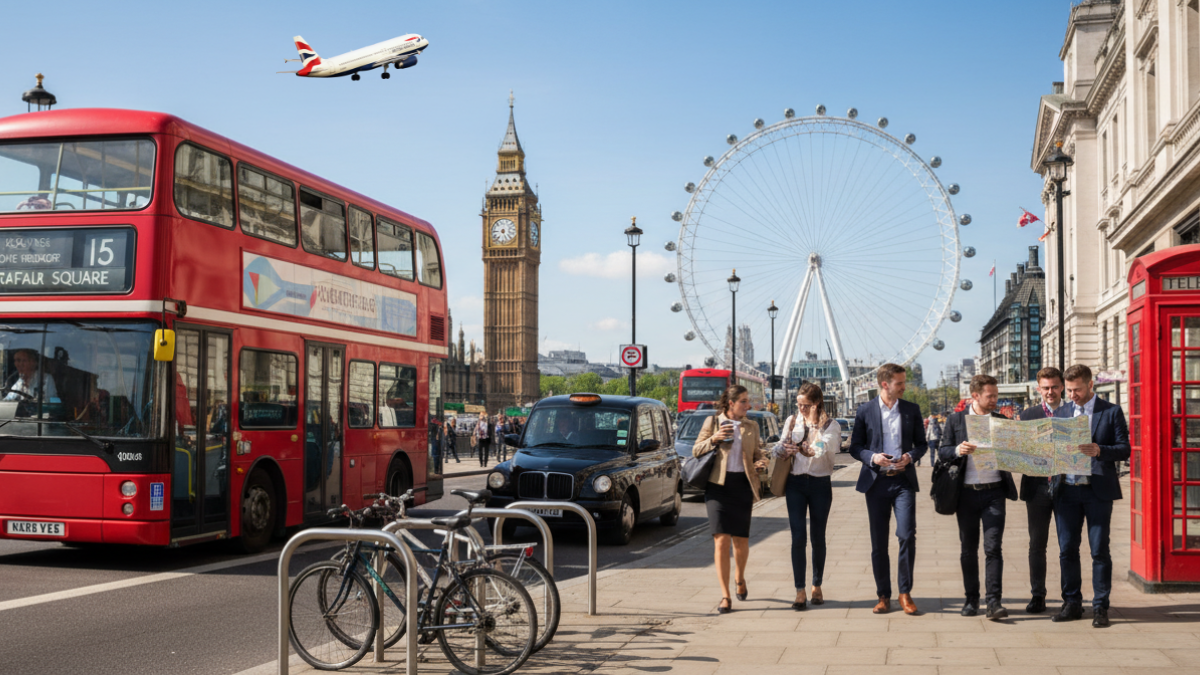
Traveling in England might seem similar to the US, but there are key language differences. This section covers UK transport vocabulary and British English travel terms found on signs, tickets, and apps. It’s designed for B1–B2 English practice for everyday trips and simple problems with transportation in England.
It focuses on common travel English UK, like using trains, buses, and taxis. Words can have different meanings in the UK compared to the US. So, we highlight UK–US differences, like saying “queue” instead of “line”.
Each section has clear topic blocks: key terms, usage notes, and short dialogues for real travel situations. The aim is to help you understand and use the language in practical ways, from hearing platform changes to dealing with delays.

Key takeaways
- The article focuses on UK transport vocabulary for trains, buses, and city travel.
- British English travel terms are explained with short notes for accurate use in common settings.
- The language level is B1–B2 English practice for questions, announcements, and routine issues.
- US readers get clear UK–US comparisons that affect travel English UK in stations and on vehicles.
- Mini-dialogues and prompts support listening and speaking when getting around England.
- Key phrases cover typical disruption language, including delays, cancellations, and platform updates.
Why learn UK transport English for B1–B2 learners?
For many travellers, transport is where plans meet real life. UK transport English covers quick, repeatable exchanges: buying a ticket, checking a platform, or confirming a stop. For intermediate English travel, these moments matter because they happen often and move fast.
England public transport English also helps with understanding what is written and what is said. Signs, app updates, and recorded announcements can be brief, clipped, and full of set phrases. Learning the core patterns supports clearer travel communication skills when a member of staff gives an instruction or when a passenger needs to ask for help.
A key feature is the polite, efficient style often heard in England. Indirect questions and softeners reduce pressure in busy spaces. Phrases such as Could you tell me…? and I was wondering… sit alongside routine markers like please and thank you.
- Predictable question forms for directions and connections
- Short confirmations for stops, times, and ticket rules
- Useful language for disruptions, refunds, and rebooking
US learners often notice British English vs American English transport differences in both words and systems. Announcements may sound faster, accents vary by region, and abbreviations appear on screens. Terms like off-peak can affect price and timing, so meaning needs to be recognised quickly.
| Where the language appears | What learners usually need to understand | Typical wording in England | Why it matters for intermediate English travel |
|---|---|---|---|
| Stations and ticket halls | Barriers, ticket gates, and where to tap or scan | Use the barriers, insert ticket, tap in | Reduces delays and avoids entering the wrong area |
| Timetables and mobile apps | Service status, platform moves, short notice changes | Platform alteration, delayed, cancelled | Supports quick decisions when plans shift |
| On trains, buses, and coaches | Stops, connections, and how to get off at the right point | Next stop, change at, alight here | Improves listening accuracy in crowded, noisy settings |
| Roadside parking and car parks | Payment rules and restrictions | pay and display, permit holders | Prevents misunderstandings about time limits and zones |
| Ticket offers and pricing | Discounts and eligibility rules | railcard, off-peak, return | Helps compare fares and choose the correct ticket type |
In this article, vocabulary is treated as context, not a word list. UK transport English is shown with where it appears—stations, apps, vehicles—and what problem it solves, from finding the right platform to paying correctly. That approach keeps British English vs American English transport contrasts clear, while strengthening travel communication skills in real conditions.
- Which transport messages are easier to understand: signs, apps, or announcements, and why?
- How does indirect phrasing change the tone of a question in a busy station?
- Which words in England public transport English could be confusing at first: off-peak, barriers, or railcard?
- What listening problems are most common for intermediate English travel: speed, accent, or background noise?
Transportation in England: essential vocabulary for getting around
For many travellers, England transport vocabulary starts with simple choices. You might wonder how to move, where to buy a ticket, and what to listen for at a busy station. In public transport England, everyday words appear on timetables, map boards, and screens above the platform. In private transport UK, the language shifts towards roads, costs, and access.
Public transport vs private transport: key contrasts
Public transport England is organised around a service (a scheduled train or bus), a route (the path it follows), and a timetable (planned times). A fare is the price paid to travel, and a connection is the next train or bus that links the journey. In some cities, trams and local rail services add more options, with the same core terms.
Private transport UK often brings different words into focus: fuel, traffic, and parking. In London, the congestion charge is a key term that affects some drivers. Learners also meet UK-specific items, such as coach for a long-distance bus, carriageway for part of a road, and queue for a line of people waiting.
| Topic | Public transport England | Private transport UK |
|---|---|---|
| Typical cost words | fare, ticket, refund, peak, off-peak | fuel, parking fee, congestion charge, insurance excess |
| Planning language | timetable, service, route, connection, platform | sat nav, traffic, diversion, junction, motorway |
| Common places | station, stop, interchange, platform, terminus | car park, kerb, drop-off point, taxi rank, cycle lane |
| Typical problems | delay, cancellation, platform alteration, missed connection | congestion, no spaces, roadworks, breakdown |
Useful verbs and phrases: catch, change, get off, board, miss
High-frequency travel verbs in English help learners follow fast conversations and ask clear questions. Catch is used with scheduled transport: “catch a train” or “catch the bus”. Board is the moment of getting on, often after the platform is confirmed.
Change marks an interchange point, as in “change at Reading”. Get off is used for leaving a vehicle: “get off at the next stop”. Miss often refers to timing, such as “miss the last train”, which can affect onward connections.
- Where do I change?
- Is this stop for Oxford Street?
- Does this train call at Gatwick Airport?
- What time does it arrive?
Common signs and announcements: delays, platform changes, cancellations
UK station announcements and electronic boards use set phrases that repeat across the network. “On time” means the service is running as planned, while “delayed” signals a later departure or arrival. “Cancelled” means the service will not run, and the next listed service may become more crowded.
“Platform alteration” or “platform change” indicates a move to a different platform, sometimes at short notice. “Shortly arriving” is common when a train is close, and “due to” introduces a reason, such as signalling faults or staff shortages. Many messages end with “apologise for the inconvenience”, which is a standard formula in UK station announcements rather than personal language.
As learners build England transport vocabulary, these repeated words and patterns support quicker reading of signs and more accurate listening in busy stations. This is especially useful when travel verbs in English appear in real time, spoken quickly over a tannoy or displayed for only a moment.
- Which words clearly separate public transport England from private transport UK in everyday planning?
- How does the meaning of “service” in transport differ from “service” in a shop or restaurant?
- In what situations do “change” and “connection” describe the same event, and when do they differ?
- Which UK station announcements are easiest to misunderstand, and why?
- How do travel verbs in English affect the tone of a question at a ticket office or on a platform?
Getting around by train in England: stations, tickets and platforms
Many visitors find trains the easiest way to travel between cities and towns. This guide covers the basics: entering the station, buying a ticket, finding your platform, and leaving. It also helps you understand signs and screens, especially when plans change.
Station vocabulary: concourse, ticket office, barriers, platform
The concourse is the main hall where you find the departure board and maps. There’s usually a staffed ticket office and an information desk for questions.
Entry and exit often involve barriers (or ticket gates). Signs like “To trains”, “Tickets”, and “Way out” often show these barriers.
Once through the gates, you reach the platform, where the train stops. Announcements might say “Customers are advised…” if the platform changes.
Ticket types: single, return, peak, off-peak, railcard
A single ticket is one-way, while a return is for a round trip. Screens show “Anytime” and “Advance” tickets, along with “validity” and “restrictions”.
Peak times are busier, with tighter rules, while off-peak offers more flexibility. This is key to understanding peak off-peak meaning.
Railcards offer discounts. Ticket machines and apps ask if you have one before showing the price.
| Word on screen or sign | What it usually means | Where it appears |
|---|---|---|
| Single / Return | One-way or round trip, often the first choice in UK rail tickets single return menus | Ticket office, ticket machine, mobile ticketing apps |
| Peak / Off-peak | Time-based rules linked to demand; key to peak off-peak meaning | Fare options, restriction notes, journey planners |
| Railcard | Discount category selection; common railcard English on purchase screens | Ticket machine prompts and checkout pages |
| Way out / To trains | Directional signage for leaving the station or reaching platforms | Concourse walls, overhead signs near barriers |
| Platform alteration | The departure platform has changed, sometimes close to departure time | Departure boards and public address announcements |
On-board language: carriage, seat reservation, luggage rack, buffet car
A carriage is one coach on the train. Some trains show coach letters, others numbers. Seat reservations are above seats, and “aisle seat” or “window seat” describe the position.
Luggage racks are for bags, often above seats or near doors. Some trains have a quiet carriage and a buffet car for longer journeys.
Staff roles vary, but announcements might mention the train manager or guard. Common phrases include “next station”, “this train terminates here”, and reminders to keep tickets ready for checks.
Mini-dialogue practice: asking about platforms and changes
Passenger: Sorry, could you repeat that? Is the London train leaving from Platform 7?
Staff: Yes, Platform 7. Please check the departure board in case of a platform alteration.
Passenger: So it’s Platform 7, is that right? And does it stop at Reading?
Staff: It does. If a change is needed, the announcement will say where to change and which platform to use.
- Which station signs are most useful for navigating a new concourse quickly?
- How does peak off-peak meaning affect the way travellers plan departure times?
- What details should be checked before choosing UK rail tickets single return on a ticket screen?
- Why might railcard English be confusing for learners, and which words help clarify it?
- In what situations does station vocabulary platform barriers become important during a disruption?
Buses and coaches: British English words and real-life situations
Local buses stop often and travel short distances. Coaches, on the other hand, go further with fewer stops. This section helps you learn bus vocabulary UK and coach travel England terms. You’ll understand signs, screens, and brief questions in daily travel.
Bus stop language: timetable, route, stand, request stop
At the stop, a timetable shows when a service is due. But, busy roads can affect times. A route is the path the bus takes, shown with a service number and a destination on the front display.
A stand is the bay where a service departs, similar to a gate. At bus and coach stations, you’ll find this information.
A request stop is not automatic. The passenger signals the driver, often by pressing the bell. The bus pulls in only if someone requests it. In some places, people may also hail the bus or flag it down when the stop is quiet.
Paying and tickets: contactless, fare, day ticket, Oyster vs bank card (London note)
On many services, the fare is the price for one trip. The contactless fare UK bus prompt usually means a bank card or phone tap on a reader. Other common words include single, return, and day ticket, which can cover multiple trips within set rules.
The day ticket meaning varies by operator and area. So, posters may specify zones, dates, and time limits. In London, travellers often see Oyster card vs bank card London wording on Transport for London readers and notices. Oyster is a smartcard, while many bank cards can also be used in similar ways on TfL services.
| Word or prompt | Where it appears | What it usually means in practice |
|---|---|---|
| Service number / Destination | Front display, stop flag, app listings | Confirms the correct vehicle and the end point of the route |
| Stand | Bus or coach station boards | The exact departure bay; may change, so boards matter |
| Request stop | On-board screen, stop sign, local notices | The driver stops only if the bell is pressed or someone signals |
| Contactless | Card reader, driver cab stickers | Tap a card or device to pay; receipts are not always printed |
| Day ticket | Fare charts, apps, ticket machines | Unlimited or capped travel under stated limits, often for one day |
Polite questions to the driver: “Does this bus go to…?”
Drivers often answer quickly, so clear questions help. Useful patterns include: “Does this bus go to…?”, “Does it stop at…?”, and “How many stops is it?” Another common question is “Can you tell me when to get off?”, especially when the area is unfamiliar.
Replies may use landmarks and road names, such as “after the High Street” or “the next stop after the station”. On coaches, staff may use coach travel England terms like “luggage hold” and “seat reservation”, depending on the operator and route.
Mini-dialogue practice: checking the right bus and where to get off
Passenger: Does this bus go to the city centre?
Driver: Yes, it does. It’s showing on the front.
Passenger: Does it stop at the railway station?
Driver: It stops there. About ten minutes, traffic depending.
Passenger: Could you tell me when to get off for the station, please?
Driver: No problem. Press the bell after the museum stop.
Passenger: Sorry, is this the right service for the High Street?
Driver: Not this one. Get off at the next stop and change to the 12.
Passenger: Thanks. Does the 12 leave from the same stop?
Driver: It’s across the road, by the shelter.
- Which words in bus vocabulary UK would be easiest to spot on a stop sign, and why?
- How does a request stop change the way a passenger plans when to press the bell?
- In what situations is contactless fare UK bus wording clearer than a printed ticket?
- What details should be checked to understand day ticket meaning on a new route?
- When seeing Oyster card vs bank card London notices, what travel questions remain unanswered?
London transport vocabulary: Tube, Overground and city travel
London’s transport network is unique in the UK. It has the Tube for underground lines and the Overground for above-ground routes. You’ll also see the DLR, Elizabeth line, buses, and river services on maps and apps.
Learning London Tube vocabulary means getting to know lines and direction. Signs might say a train is bound for somewhere, or list routes as north or south. At busy spots, look out for words like interchange, step-free access, lift, and escalator to help plan your journey.
London Overground terms might seem familiar, but the language is consistent. Platform screens show the next train’s details and whether it’s fast or stopping. In London, “Way out” is used for exits, and “Entrance” and “Exit” are often separate to manage crowds.
Transport for London English is seen at gates and card readers. You might see “tap in” and “tap out” near barriers, linked to Oyster and contactless payment. The area also shows fare zones on maps, with words like zone and fare zone to explain prices.
| Where it appears | Common wording | Meaning in context | Typical use in city travel |
|---|---|---|---|
| Platform signs and apps | bound for, northbound, southbound | Shows direction and end destination | Choosing the right side of the platform and avoiding the wrong direction |
| Station corridors | interchange, Way out, exit | Points to changes and leaving the station | Following signs through large stations such as King’s Cross St Pancras |
| Accessibility signs | step-free access, lift, escalator | Explains whether stairs can be avoided | Planning routes with luggage, pushchairs, or mobility needs |
| Ticket gates | tap in, tap out, Oyster, contactless | Confirms how to start and finish a paid journey | Passing through barriers without delays at peak times |
UK underground announcements are short and repeated. Recognising key phrases helps you understand. “Mind the gap” is a safety message near the platform edge. Another common line is “This train is terminating at…”, which signals that everyone must get off and continue another way.
During disruptions, announcements might say “Change here for…”, “Service is suspended”, or “Severe delays”. These phrases appear on screens too, which helps when audio is hard to hear. In Transport for London English, the language is direct, often naming lines and stations rather than giving long explanations.
Crowded stations add another layer of London English. People may follow a queueing system, or see signs marked “closed” and “diverted” near an entrance. Simple courtesy language is used: “Sorry”, “Excuse me”, and “Can I get past, please?” are common when moving through narrow passages.
- Which words in London Tube vocabulary are most useful for understanding direction on a platform?
- How do London Overground terms compare with the language used on the Tube and the DLR?
- Why might Transport for London English prefer short phrases on signs and screens?
- Which UK underground announcements could cause a passenger to change plans immediately?
- What expressions help people stay polite during city travel London English in crowded stations?
Taxis and ride-hailing in England: what to say and what to expect
In cities and towns, taxis are easy to spot. But, the rules change based on the vehicle type. Knowing taxi vocabulary in England helps travellers understand signs, payment options, and short questions on the street. It also helps with clear, polite talk in ride-hailing English UK when booking through an app.

Key terms: black cab, minicab, rank, fare, tip, receipt
When comparing black cabs and minicabs, the main difference is how you start your ride. A black cab can be hailed on the street or found in a marked queue. On the other hand, a minicab (also called a private hire vehicle) is usually pre-booked by phone or app. Many visitors first see the taxi rank meaning UK when they spot a signed area where taxis wait and passengers line up.
The price language is also useful. A meter calculates the trip cost as the car moves and time passes. The total is the fare. Some journeys add a surcharge, such as late-night travel, extra passengers, or airport pick-ups, depending on local rules.
Payment questions are short and direct. For example, “Do you take card?” or “Can I pay contactless?” A receipt is common for expenses. The fare receipt tip UK topic can cause confusion: a tip is optional, and many people round up the amount if service is smooth. Asking “Could I have a receipt, please?” is standard, whether paying by card or cash.
| Term | What it means in England | Common phrase heard or used |
|---|---|---|
| Taxi rank | A signed area where licensed taxis wait; passengers join an informal queue | “Is this the taxi rank?” |
| Meter | The fare calculator used in many black cabs; it runs by time and distance | “Is it on the meter?” |
| Surcharge | An extra charge added to the base fare in certain conditions | “Is there a surcharge for the airport?” |
| Receipt | A record of payment, often needed for business expenses | “Could I get a receipt, please?” |
Making requests politely: route preferences and accessibility needs
Clear requests keep the trip calm and efficient. A destination can be given as a full address, a postcode, or a well-known landmark. It helps to say the borough or area if a street name is common. In ride-hailing English UK, the same detail matters because the driver may follow the app’s route unless a preference is stated.
Route preferences are usually phrased as simple options. For example, “Could we take a quieter route?” or “Could we avoid motorways if possible?” A passenger may also ask for a small pause: “Could you stop here for a moment, please?” These forms tend to sound polite without being indirect.
Accessibility language should be specific and brief. “Step-free” is used for easier entry, while “folding wheelchair” signals a chair that can fit in the boot. Some licensed vehicles offer a “hearing loop”, and asking “Do you have a hearing loop?” is a clear way to check before travel.
Mini-dialogue practice: booking, confirming pick-up, paying
Booking and pick-up
“Could I book a minicab for 6.30 pm?”
“What’s the pick-up address and postcode?”
“It’s King Street, SW1A 1AA. That’s SW1A, one A, one A.”
Confirming the vehicle
“Are you here for the King Street pick-up?”
“Yes. Could you confirm the destination, please?”
“It’s Paddington Station. P-A-D-D-I-N-G-T-O-N.”
Paying and checking details
“How much is the fare?”
“It’s £18.50.”
“Do you take card, and could I have a receipt, please?”
These short exchanges cover the main points that cause errors: repeating an address, spelling a street name, and confirming the final stop. They also support quick comparisons in black cab vs minicab situations, especially where the taxi rank meaning UK affects how the ride begins and how the fare is calculated.
- Which words in taxi vocabulary England are easiest to confuse, and why?
- In what situations might a traveller prefer a pre-booked option instead of a rank?
- How does the idea of fare receipt tip UK differ from tipping customs in the United States?
- What details make an address clearer when spelling it aloud in ride-hailing English UK?
- Which accessibility terms are most useful for communicating needs without extra explanation?
Driving in England: road rules vocabulary and practical phrases
For many visitors from the United States, the first surprise is that traffic keeps left. This short guide builds driving in England vocabulary for signs, navigation, and everyday questions at the wheel.
British road language can feel compact on signs, so it helps to recognise patterns. Terms may differ from American usage, even when the layout looks familiar.
Road and direction words: roundabout, junction, dual carriageway, motorway
A roundabout is a circular intersection where traffic flows clockwise. On signs and in speech, drivers often combine locations with exits, such as “take the first exit” or “take the third exit”.
A junction is a numbered connection point, often shown on larger roads. The phrase roundabout junction dual carriageway is common in spoken directions because these features link together on many routes.
A dual carriageway usually has two directions separated by a central barrier, with faster traffic and fewer crossings. A slip road is the short lane used to join or leave a larger road, where “merge” is a frequent instruction.
On major routes, motorway terms UK include motorway, services (rest area), and hard shoulder (emergency lane). An A road is a primary route, while a B road is typically smaller and more local.
- One-way street: traffic flows in a single direction
- Diversion: a signed alternative route, often during works
- Turn right/left and turning: common phrasing on sat nav and road signs
Car hire language: insurance, excess, fuel policy, automatic vs manual
At the rental desk, paperwork often focuses on risk and responsibility. The phrase car hire excess insurance UK refers to cover linked to the excess, which is the amount a driver may pay towards damage before insurance applies.
Other frequent terms include deposit (a held amount on a card), damage (harm to the vehicle), and mileage (distance allowed). A fuel policy may be described as “full-to-full”, meaning the car is collected with a full tank and returned full.
Transmission wording matters: automatic is available but manual is still common. Documents may also list a driving licence, an additional driver, and a sat nav as optional extras.
Parking and enforcement: pay and display, permit, fine, clamped
City centres often use pay and display parking England, where payment is made at a machine and a ticket is shown in the windscreen. The sign may also name the parking bay rules and the restricted hours.
A permit holder area limits spaces to authorised vehicles, often marked “Residents only”. In controlled zones, common wording includes “No stopping”, “No waiting”, and “Loading only”, each with a different meaning on the street.
Enforcement language is direct: a fine may appear as a penalty charge, and clamped refers to a wheel clamp that prevents the car from moving. Reading the full sign, including times and arrows, helps avoid confusion.
| Term on signs or in speech | Plain meaning | Typical context in England | Useful phrase for comprehension |
|---|---|---|---|
| Roundabout | Traffic circle; give way to traffic from the right | Urban and rural intersections | “Take the second exit.” |
| Junction (J1, J2, etc.) | Numbered connection point to enter or leave a major road | Motorways and major A roads | “Leave at Junction 6.” |
| Dual carriageway | Divided road with two directions separated by a barrier | Fast routes between towns | “Stay in the left lane.” |
| Slip road | Short lane for joining or exiting a larger road | Near junctions and interchanges | “Merge in 200 yards.” |
| Motorway / Services | High-speed road / rest stop with fuel, food, toilets | Long-distance travel; limited access points | “Services in 1 mile.” |
| Pay and display | Pay at a machine and show a ticket | Town centres, shopping streets | “Display ticket on dashboard.” |
| Permit holders only | Parking limited to vehicles with a local permit | Residential streets and controlled zones | “Residents only Mon–Fri.” |
| Penalty charge / Clamped | Official parking fine / wheel immobilised | Restricted bays and enforcement areas | “Penalty charge notice issued.” |
- Which UK road term is most likely to cause confusion for US drivers, and why?
- How do the words no stopping and no waiting suggest different restrictions?
- What details on a parking sign matter most: times, arrows, or zone names?
- Why might a traveller prefer an automatic car when learning to drive on the left?
- When hearing motorway terms UK on a sat nav, which words help predict what comes next?
Cycling and walking: travel vocabulary for towns and countryside
In many English towns, bikes and walking are common for short trips. Clear terms are key for signs and quick chats. The cycling vocabulary UK includes cycle lane, shared path, pedestrian crossing, zebra crossing, and traffic lights. Busy streets may also have advanced stop line near junctions and cycle hire on local maps.

For walking directions in England, location words are simple and exact. Phrases like straight ahead, at the junction, opposite, next to, and behind are common. Distance is often given as a short walk or about ten minutes on foot, which is easier for visitors.
In rural areas, signs and guideposts introduce specific public footpath vocabulary. A public footpath is a protected right of way for walkers. A bridleway is open to horses and cyclists too. Walkers may find a stile, a gate, or a waymarker on their route across fields and lanes.
| Term on signs or maps | Plain meaning | Typical place | Useful context phrase |
|---|---|---|---|
| Cycle lane | Marked space for cyclists beside the road | Towns and city roads | Stay in the cycle lane at the junction. |
| Shared path | Route used by pedestrians and cyclists | Parks, riversides, seafronts | Keep to the left on the shared path. |
| Public footpath | Legal walking route across land | Villages, fields, coastal routes | The public footpath goes through the gate. |
| Bridleway | Route for horses, walkers, and often bikes | Countryside tracks | The bridleway runs behind the farm. |
| Waymarker | Post or sign showing the correct line | Hills, woodland, open fields | Follow the waymarker straight ahead. |
Shared routes have short safety messages and polite phrases. Notices may say cyclists dismount near narrow bridges, or keep left and keep right where space is tight. On paths, a brief Excuse me or Coming past on your right helps smooth passing and reduces surprises.
When using walking directions England with outdoor maps, the same words are used in different places. The best approach is to link a direction to a landmark: on the left by the shop, opposite the station, or next to the post box. This pattern works for cycling vocabulary UK in towns and public footpath vocabulary in rural areas, where turns may be marked by a gate rather than a street name.
- Which road or path words seem closest to American usage, and which feel unfamiliar?
- How does a right of way change expectations about access in rural areas?
- What details make walking directions England easier to follow: landmarks, time, or distance?
- On a shared path, which phrases support safe passing without sounding rude?
- How do cycle lane UK terms affect where a cyclist should stop at a junction?
Travel planning English: timetables, apps, delays and customer service
Good UK travel planning English involves three key skills. These are reading schedules, handling disruptions, and speaking clearly to staff. For those in the United States, learning a few key words from timetables can help a lot. This is especially true when using these words in real-life situations.
Travel apps can be very helpful. They show live updates and alternative routes all in one place. For example, real-time travel options can help learners match what they see on signs with the words they need to say at the counter.
Time and frequency language: every, hourly, last train, running late
In timetables, “every” and “hourly” talk about how often a service runs, not how fast. You might see “every ten minutes” or “once an hour”. Important words include “departure”, “arrival”, “due”, and “estimated”, which are often together when services change.
The term “running late” means the service is behind schedule. Notices might say “delayed by 10 minutes” or “expected at 18:42”. The word “due” still shows the original time. In busy stations, listening for “platform alteration” is as important as checking the clock.
| Term on a sign or app | What it usually refers to | Helpful phrase in customer service English |
|---|---|---|
| Due | The planned time on the timetable | Is that still the due time, or has it changed? |
| Estimated | A live forecast based on current running | What is the estimated arrival now? |
| Every ten minutes | Frequency (a repeating interval) | Does it run every ten minutes all day? |
| Last train | The final service of the day on that route | What time is the last train, and does it stop at my station? |
| Running late | A delay, often with no exact minutes stated | How late is it running, roughly? |
Disruption vocabulary: engineering works, replacement bus, strike action
Disruption notices often use fixed wording, making them easier to learn. “Engineering works” usually means planned maintenance. It might be called “planned works” on posters or in alerts. A message like “part suspended” means one section is not running, but other parts still operate.
When trains stop, an engineering works replacement bus may appear. This can affect journey time, stop order, and luggage space. Words like “reduced service” and “service disruption” are important to know. “Strike action” refers to industrial action that limits or cancels services, sometimes at short notice.
Problem-solving phrases: refunds, compensation, rebooking, alternative routes
When plans change, calm phrasing helps conversations stay clear. Staff may ask if the ticket is “valid”, if the service was “cancelled”, and if the passenger can “travel later” or “take a different route”. It’s helpful to ask one question at a time, using the same terms shown on the board.
For refunds compensation UK transport queries, people often need to confirm both eligibility and the next step. Useful wording includes “Can this ticket be rebooked?”, “Is there compensation for this delay?”, and “Where do I request a refund?” These phrases keep refunds compensation UK transport conversations focused on the delay, the ticket type, and the available options.
- Could you confirm the alternative routes to get there today?
- Is my valid ticket accepted on a different operator?
- Can I rebook for a later service without paying extra?
- Where can I check refunds compensation UK transport rules for this delay?
- Which timetable vocabulary terms are easiest to confuse: due, estimated, or expected?
- How does the running late meaning change the way a traveller asks about arrival time?
- What information is missing when a notice only says “service disruption”?
- In an engineering works replacement bus situation, what questions reduce mistakes at the stop?
- When discussing refunds compensation UK transport, which details matter most: ticket type, delay length, or route?
Conversation practice pack: dialogues for common travel scenarios (B1–B2)
These short scripts make useful language easy to find and keep the UK’s everyday speech rhythm. They’re great for B1–B2 travel dialogues because the questions are simple, the answers are brief, and clarity is key.
At the ticket office: requesting the best fare and travel times
Talking at the ticket office often starts with neutral language, not pushing for anything. It’s also important to confirm the date, time, and if the ticket is good for a specific service.
Traveller: “Hello. Could I have the cheapest return to Manchester Piccadilly for today, please?”
Staff: “Of course. Are you travelling off-peak, and do you have a Railcard?”
Traveller: “Off-peak, please. No Railcard. What time is the next train, and which platform does it usually leave from?”
Staff: “The next off-peak is at 14:42. It’s often platform 6, but check the screens in case it changes.”
Traveller: “Sorry, did you say 14:42? And is this ticket valid on that train?”
Staff: “Yes, 14:42, and yes, it’s valid. Here’s your ticket.”
When air travel is part of your trip, the checks at the airport are similar. The airport check-in dialogue shows the same pattern of short requests, confirmation, and polite repeats.
Asking for directions: landmarks, distances, and polite follow-up questions
Asking for directions in British English often uses landmarks and simple time estimates. It also includes quick follow-ups to avoid mistakes, especially around crossings and turns.
Traveller: “Excuse me, how do I get to the Science Museum from South Kensington station?”
Local: “Take the subway tunnel from the station. It’s signposted. It’s about five minutes.”
Traveller: “Is it quicker to walk, or should I take the bus?”
Local: “Walking is quickest. Stay underground until you see the museum signs, then follow them to the entrance.”
Traveller: “Thanks. So I should follow the tunnel signs, not go outside first?”
Local: “That’s right.”
Handling issues: lost property, missed connections, service cancellations
Dealing with problems is easier with calm details: the service time, destination, and what happened. For lost property, UK English usually includes a clear item description and where it was last seen.
Traveller: “Hello. I think I left a navy backpack on the 09:18 to Cambridge. It was in the luggage rack above my seat.”
Staff: “Right. Do you remember which carriage, and where you got off?”
Traveller: “Carriage C. I got off at Tottenham Hale.”
Staff: “Thank you. I’ll log it with the lost property team. What’s inside that could help identify it?”
Traveller: “A water bottle and a small notebook.”
Traveller: “My train was cancelled at the last minute. I’ve missed my connection at Birmingham New Street.”
Staff: “Understood. The next option is the 16:10. Your ticket will be accepted, and you may be able to claim compensation.”
Traveller: “Thank you. Is there a replacement bus, or is it rail only?”
Staff: “Rail only at the moment. Please check the departure boards for platform details.”
Small talk while travelling: weather, queues, and sharing space politely
Light chat in England is often brief and practical, especially in crowded places. In travel dialogues B1–B2, this kind of talk builds comfort with tone and pacing without needing complex grammar.
Traveller: “Looks like it’s going to rain again.”
Passenger: “Yes, typical. At least it’s mild today.”
Traveller: “Sorry, is this seat taken?”
Passenger: “No, go ahead.”
Traveller: “Is this the queue for the bus to Oxford?”
Passenger: “Yes, it starts back there. It moves once the coach arrives.”
Across these scripts, UK transport conversation practice stays consistent. It uses short questions, clear checks, and polite repairs when something is missed. This approach supports ticket office English, asking for directions British English, and lost property UK English in busy, real settings.
| Scenario | Useful question form | Polite follow-up | Key detail to include |
|---|---|---|---|
| Ticket purchase | “Could I have the cheapest return for today?” | “Sorry, could you repeat the time?” | Date, peak/off-peak, Railcard, validity |
| Directions near a station | “How do I get to the nearest hospital?” | “Is it far on foot?” | Landmark, walking minutes, turns, crossings |
| Missed connection | “What are my options if I’ve missed the connection?” | “Will my ticket be accepted on the next train?” | Service time, destination, cancellation reason |
| Lost item report | “I’d like to report lost property.” | “Where should I check for updates?” | Item colour, time, route, carriage, last seen place |
- Which lines in the ticket office exchange show a clear request, and which lines show confirmation?
- In the directions dialogue, what words signal distance and time, and how could they be rephrased?
- What details make the lost property report easy to process, and what is missing for a complete record?
- How does the language change between a service cancellation and a missed connection?
- Which small talk examples feel safe in a crowded carriage, and which topics should be avoided?
If you’re planning to explore the capital, understanding how transport works will make your experience much smoother. To expand your practical language for travelling around the city, explore our Visit London: English Vocabulary and Travel Conversation Guide, where you’ll find essential phrases, useful expressions and real-life dialogues to help you navigate stations, book tickets and discuss transport confidently in British English.
Conclusion
This recap covers essential words and short dialogues for real travel. It connects language to places like train stations and bus stops. It also shows how people use apps and live timetables to plan trips.
As a British English travel review, it focuses on key words and phrases. These include travel verbs, clear signs, and announcements about delays. Ticketing terms and polite questions are also highlighted.
This summary covers various transport modes, from rail to driving. It includes vocabulary for cycling and walking too. The list-based approach makes it easy to scan and remember.
For learners, this recap shows the importance of vocabulary and conversation practice. Recognising words in announcements and short exchanges is crucial. This helps learners understand different cities and travel conditions.
FAQ
What does “return” mean on train and bus tickets in England?
“Return” means a ticket for a journey there and back. In the US, it’s called a “round trip”. In England, you’ll see “single” and “return” on ticket screens and offices.
What is the difference between a bus and a coach in England?
Buses are local services with many stops. Coaches go longer distances with fewer stops. Coach stations use the word “stand” for departure.
What do “platform alteration”, “delayed”, and “cancelled” usually mean in station announcements?
These words are common on departure boards and over the tannoy. “Platform alteration” means the train leaves from a different platform. “Delayed” means the train is late, often with an “estimated” time. “Cancelled” means the service won’t run.
What does “This train is terminating at…” mean?
It means the train ends its journey at that station. You might need to “change” to another service. Announcements also say the train “calls at” certain stations.
Why do travellers in England talk about “ticket barriers” or “ticket gates”?
Many stations have barriers that control entry and exit. Travel cards and bank cards are used on readers, often called “tap in” and “tap out”. Signs say “Way out” for exits.
What is a “black cab”, and how is it different from a minicab in England?
A black cab is a licensed taxi that can be hailed in the street or found at a taxi rank. A minicab is a private hire vehicle that must be pre-booked. Terms include “meter”, “fare”, “surcharge”, and “receipt” when discussing payment.
What does “queue” mean, and why is it important for travel in England?
“Queue” means a line of people waiting. It’s used in ticket offices, boarding areas, and busy stations. You might hear “queueing system” and polite requests like “Excuse me, are you in the queue?”
Which UK road terms often confuse US learners: roundabout, dual carriageway, and motorway?
These terms are common in UK driving. A “roundabout” is a circular junction. A “dual carriageway” is a major road with separated directions. A “motorway” is a high-speed road like a US interstate. UK navigation also uses terms like “slip road”, “junction”, “one-way street”, and “diversion”.
What does “pay and display” mean for parking in England?
“Pay and display” means paying for parking and showing a ticket in the car. Signs may include terms like “permit holder”, “restricted hours”, “penalty charge”, “loading only”, “No waiting”, and “clamped” (wheel clamp).
What is a “request stop” on a bus route?
A request stop is a stop where the bus may only stop if someone signals. Signs and on-board displays mention this. People might say they need to “get off” at the next stop or ask if the bus “stops at” a certain place.
2 thoughts on “Transportation in England: English Vocabulary and Conversation Practice (B1–B2)”