
Introduction
Have you ever wondered how maths and English can be learned together? Learning mathematical concepts in English helps students develop both numerical reasoning and language skills at the same time. Through engaging math exercises, learners can improve their vocabulary, practise reading comprehension, strengthen listening skills, and solve real-world problems confidently.
In this lesson, A1–B1 learners will explore basic maths symbols, arithmetic operations, shapes, and problem-solving strategies through interactive activities. Teachers can use these tasks in the classroom, while parents and homeschool educators can use them for independent practice.
By the end of this lesson, students will be able to recognise common maths vocabulary, understand basic operations, identify 2D shapes, and apply mathematical thinking in everyday situations.
Table of Contents
- Essential Maths Vocabulary
- Listening Activity: Basic Math Operations
- Interactive Activity 1: Maths Symbols
- Interactive Activity 2: Fill in the Blanks
- Reading: Understanding Basic Maths Operations
- Reading Comprehension Questions
- Shapes and Geometry (Part 2)
- Problem Solving Activities (Part 2)
- Speaking Practice (Part 2)
- Answer Key
- FAQs
Essential Maths Vocabulary
Before starting the activities, learn these useful maths words.
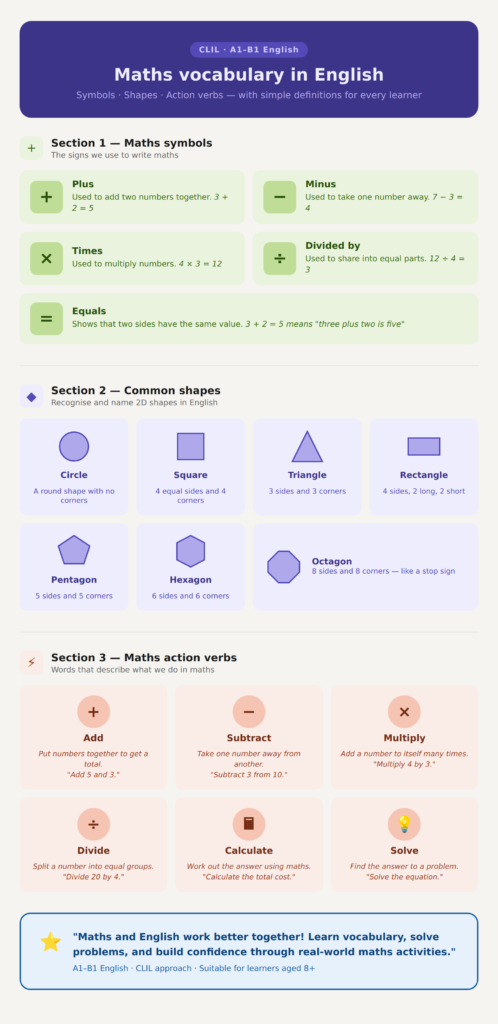
Useful Maths Verbs
| Verb | Meaning |
| add | put together |
| subtract | take away |
| multiply | find the total of equal groups |
| divide | share equally |
| calculate | work out the answer |
| solve | find the solution |
Listening Activity: Basic Math Operations
Watch the video and complete the activities below.
Pre-Listening Vocabulary
ACTIVITY 1 – DRAG AND DROP
Excellent! You can identify the most common maths symbols in English.
ACTIVITY 2 – FILL IN THE BLANKS
Complete the Maths Sentences
Reading: Understanding Basic Maths Operations
Maths operations help us solve everyday problems. We use addition when we put numbers together. For example, if you have two apples and receive three more, you now have five apples.
Subtraction helps us find out how many items remain after taking some away. If you have five pencils and lose two, you still have three pencils.
Multiplication is useful when working with equal groups. If there are four bags with three sweets in each bag, multiplication helps us quickly find the total.
Division is used when sharing equally. If twelve biscuits are shared among four children, each child receives three biscuits.
These operations are used every day when shopping, cooking, travelling, and solving practical problems.
Reading Comprehension
ACTIVITY 3 – MULTIPLE CHOICE
Basic maths operations vocabulary in English for A1–B1 learners
Shapes and Geometry
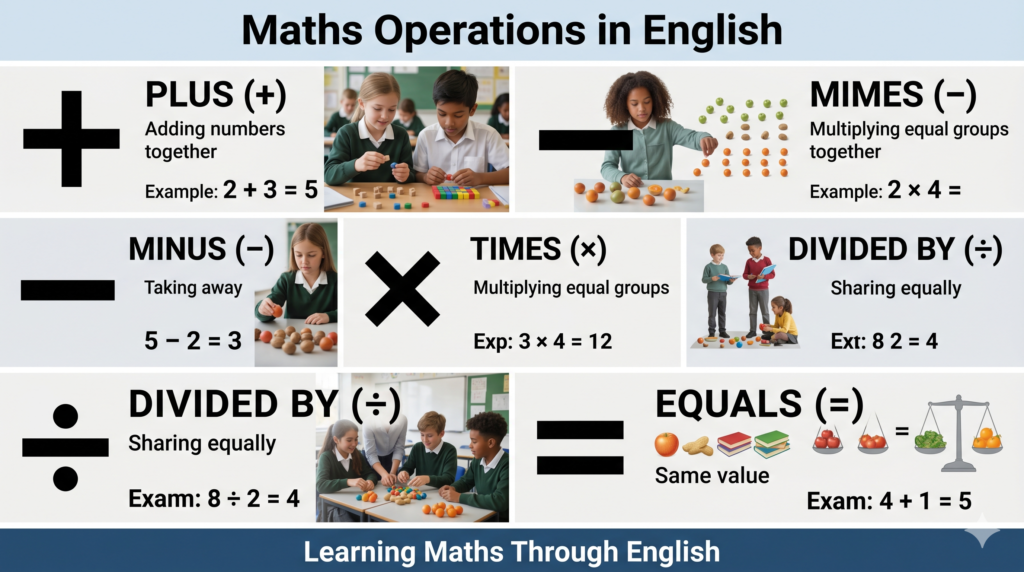
Shapes are everywhere around us. We can find circles in clocks, triangles in road signs, rectangles in doors, and hexagons in honeycombs. Learning the names of shapes in English helps students describe objects, understand geometry, and communicate mathematical ideas more effectively.
Before completing the activities, review the shapes below:
| Shape | Number of Sides |
|---|---|
| Circle | 1 curved side |
| Triangle | 3 sides |
| Square | 4 equal sides |
| Rectangle | 4 sides |
| Pentagon | 5 sides |
| Hexagon | 6 sides |
| Heptagon | 7 sides |
| Octagon | 8 sides |
| Nonagon | 9 sides |
| Decagon | 10 sides |
Listening Activity 2: 2D Shapes Around Us
Watch the video and answer the questions below.
ACTIVITY 4 – FILL IN THE BLANKS
2D Shapes Vocabulary
ACTIVITY 5 – MULTIPLE CHOICE
Listening Comprehension: 2D Shapes
Question 1
How many sides does a pentagon have?
A) Four
B) Five ✅
C) Six
D) Seven
Question 2
Which shape is commonly found in a honeycomb?
A) Triangle
B) Circle
C) Hexagon ✅
D) Rectangle
Question 3
How many sides does an octagon have?
A) Six
B) Seven
C) Eight ✅
D) Nine
Question 4
Which shape is often seen on a football?
A) Pentagon ✅
B) Hexagon
C) Triangle
D) Circle
Question 5
How many sides does a decagon have?
A) Eight
B) Nine
C) Ten ✅
D) Eleven
H5P ACTIVITY 6 – DRAG THE WORDS
TITLE:
Complete the Shape Sentences
WORDS TO USE:
circle
triangle
square
hexagon
octagon
pentagon
SENTENCES:
- A road sign is often shaped like a *triangle*.
- A clock is usually a *circle*.
- A dice has the shape of a *square* on each face.
- Honeycomb cells are usually *hexagon* shaped.
- A stop sign is shaped like an *octagon*.
- A football contains *pentagon* patterns.
[IMAGE PLACEHOLDER]
Insert an image showing:
- circle
- triangle
- square
- pentagon
- hexagon
- octagon
Suggested Alt Text:
“2D shapes vocabulary in English including circle, triangle, square, pentagon, hexagon and octagon”
Problem-Solving Strategies with Math Exercises
Maths is not only about numbers. It is also about finding solutions to everyday situations. Good problem-solvers read carefully, identify important information, choose the correct operation, and check their answers.
Read the situations below and decide which operation you should use.
H5P ACTIVITY 7 – DRAG AND DROP
TITLE:
Choose the Correct Operation
DRAG ITEMS:
Addition
Subtraction
Multiplication
Division
SCENARIOS:
- Emma has 7 apples and buys 5 more. *Addition*
- Lucas has 15 sweets and gives 4 away. *Subtraction*
- There are 4 boxes with 6 pencils in each box. *Multiplication*
- Twenty biscuits are shared equally among 5 children. *Division*
- A shop sells 3 packs with 8 stickers in each pack. *Multiplication*
- Sarah had 18 balloons and 7 popped. *Subtraction*
Speaking Practice
Work with a partner and discuss the questions below.
- Which maths operation do you use most often?
- What is your favourite shape?
- Can you name three shapes with more than four sides?
- Where can you find circles in everyday life?
- Why is maths important?
- Can you create a simple maths problem for your partner?
- Which shape do you think is the most interesting?
- How do you use maths outside school?
Real-Life Maths Challenge
Maths is part of our daily lives. We use it when shopping, cooking, travelling, budgeting, and playing sports. Understanding maths vocabulary in English helps learners apply their language skills in practical situations.
Read the situations below and complete the activities.
H5P ACTIVITY 8 – FILL IN THE BLANKS
TITLE:
Everyday Maths Problems
INSTRUCTIONS:
Complete each sentence with the correct answer.
- Anna buys 3 apples and then buys 4 more. She has *7 apples*.
- A teacher has 20 pencils and gives 5 away. There are *15 pencils* left.
- There are 4 bags with 3 sweets in each bag. There are *12 sweets* altogether.
- Twelve biscuits are shared equally among 3 children. Each child gets *4 biscuits*.
- A football team scores 2 goals in the first half and 3 in the second half. They score *5 goals* in total.
- A shop sells 5 packs with 2 stickers in each pack. The shop sells *10 stickers*.
- Mia has 18 balloons and 6 pop. She has *12 balloons* left.
- Eight children share 24 cookies equally. Each child receives *3 cookies*.
H5P ACTIVITY 9 – TRUE OR FALSE
TITLE:
Maths Facts
INSTRUCTIONS:
Read each statement and decide whether it is true or false.
- A triangle has three sides. True
- Division means sharing equally. True
- A square has five sides. False
- Multiplication helps us find the total of equal groups. True
- An octagon has eight sides. True
- Subtraction means putting numbers together. False
- A hexagon has six sides. True
- The symbol “+” means plus. True
Download the Printable Worksheet
📄 Download the printable PDF worksheet to practise maths vocabulary, shapes, and problem-solving skills offline.
[INSERT PDF DOWNLOAD BUTTON HERE]
Suggested button text:
Download the Math Exercises Worksheet PDF
Internal Learning Resource
To continue improving your English through educational topics, explore our article:
[INSERT INTERNAL LINK HERE]
Suggested anchor text:
Transportation in England: Essential Vocabulary and Activities
External Learning Resource
For additional maths practice and educational resources, visit:
Answer Key
Activity 2
- plus
- minus
- times
- divided by
- equals
- divide
- multiply
- subtract
Activity 4
- triangle
- square
- pentagon
- hexagon
- octagon
- decagon
- circle
- heptagon
Activity 8
- 7
- 15
- 12
- 4
- 5
- 10
- 12
- 3
Activity 9
- True
- True
- False
- True
- True
- False
- True
- True
Conclusion
Learning maths in English is an excellent way to develop both language and problem-solving skills. Through these math exercises, students have practised essential vocabulary, explored mathematical operations, identified common 2D shapes, and applied maths to everyday situations.
Regular practice with maths vocabulary and interactive activities can help learners become more confident using English in academic subjects. Keep exploring, practising, and challenging yourself with new maths concepts in English.
FAQ
What are math exercises in English?
Math exercises in English are activities that help learners practise mathematical concepts while developing English vocabulary and communication skills.
Why is learning maths vocabulary in English important?
It helps students understand school subjects taught in English and improves their ability to communicate mathematical ideas.
Are real-life scenarios useful for learning maths?
Absolutely! Applying concepts to everyday situations, like budgeting or measuring, helps solidify understanding and boosts confidence.
Where can I find math worksheets tailored to different skill levels?
Many educational websites provide free, downloadable math materials sorted by difficulty, from beginner to intermediate levels.
What’s the best way to tackle word problems?
Break them into smaller steps – identify key terms, translate them into equations, and solve systematically.


4 thoughts on “Math Exercises in English A1–B1: Symbols, Shapes, and Problem Solving”