Introduction
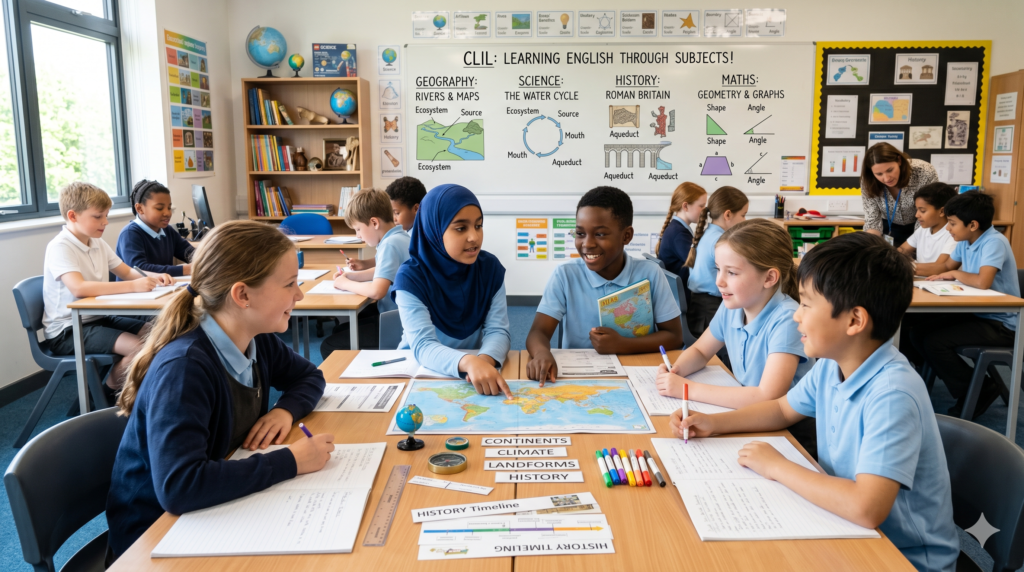
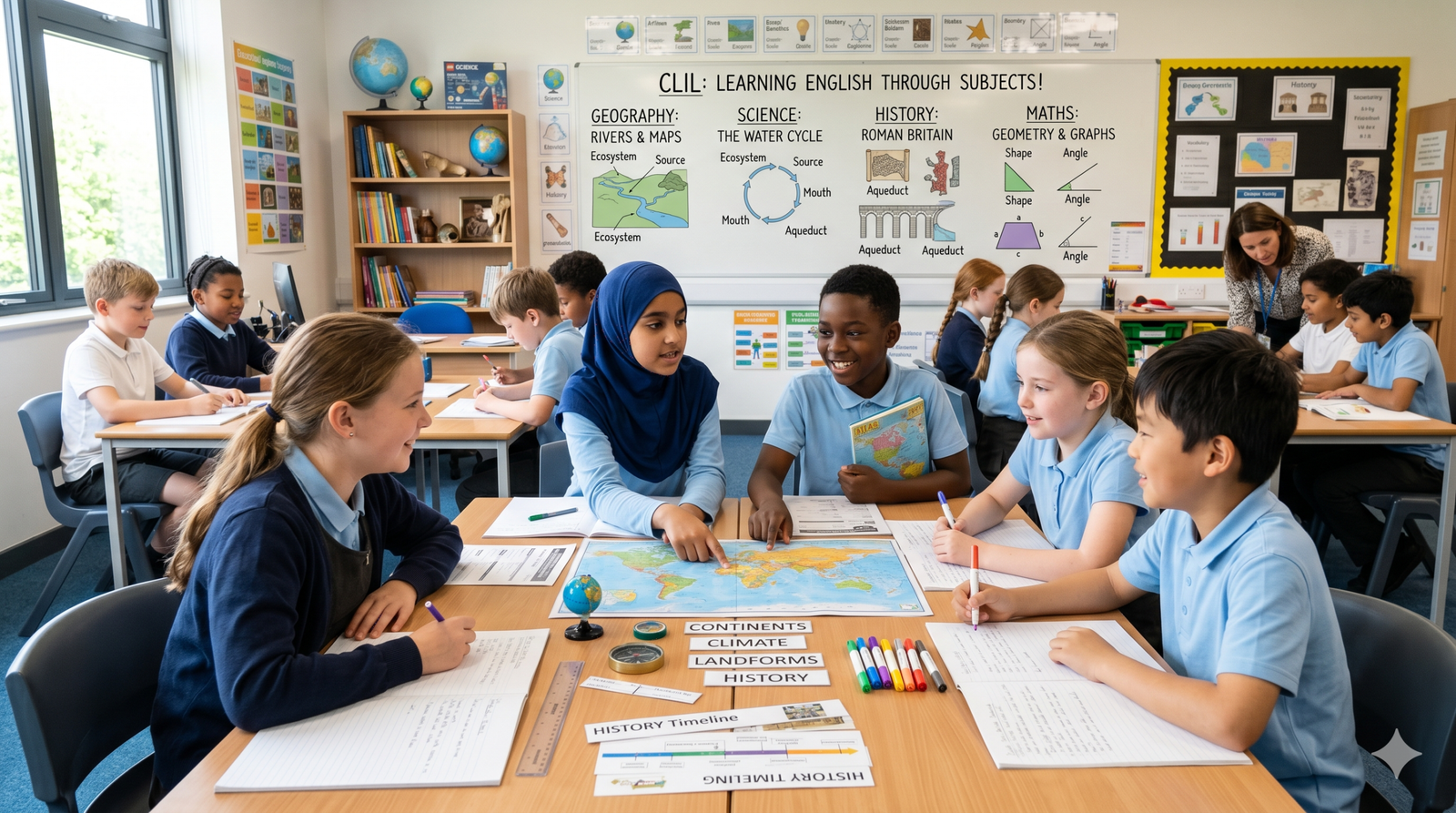
Teaching English is no longer limited to grammar exercises and vocabulary lists. Today, many educators are looking for ways to make language learning more meaningful, engaging, and connected to the real world.
One of the most effective approaches is CLIL, which stands for Content and Language Integrated Learning. Instead of teaching English as an isolated subject, it combines language learning with academic content such as maths, science, geography, history, and physical education.
This approach allows students to learn a subject and a language at the same time, creating a more natural and purposeful learning experience.
What Does CLIL Mean?
It stands for Content and Language Integrated Learning. The method was developed to help students acquire a foreign language while studying meaningful academic content.
In a CLIL lesson, the focus is not only on learning English but also on understanding concepts from another subject area.
For example:
- Students learn maths vocabulary while solving problems.
- Students learn geography vocabulary while studying maps.
- Students learn science vocabulary while conducting experiments.
- Students learn history vocabulary while exploring historical events.
As a result, language becomes a tool for learning rather than the final objective.
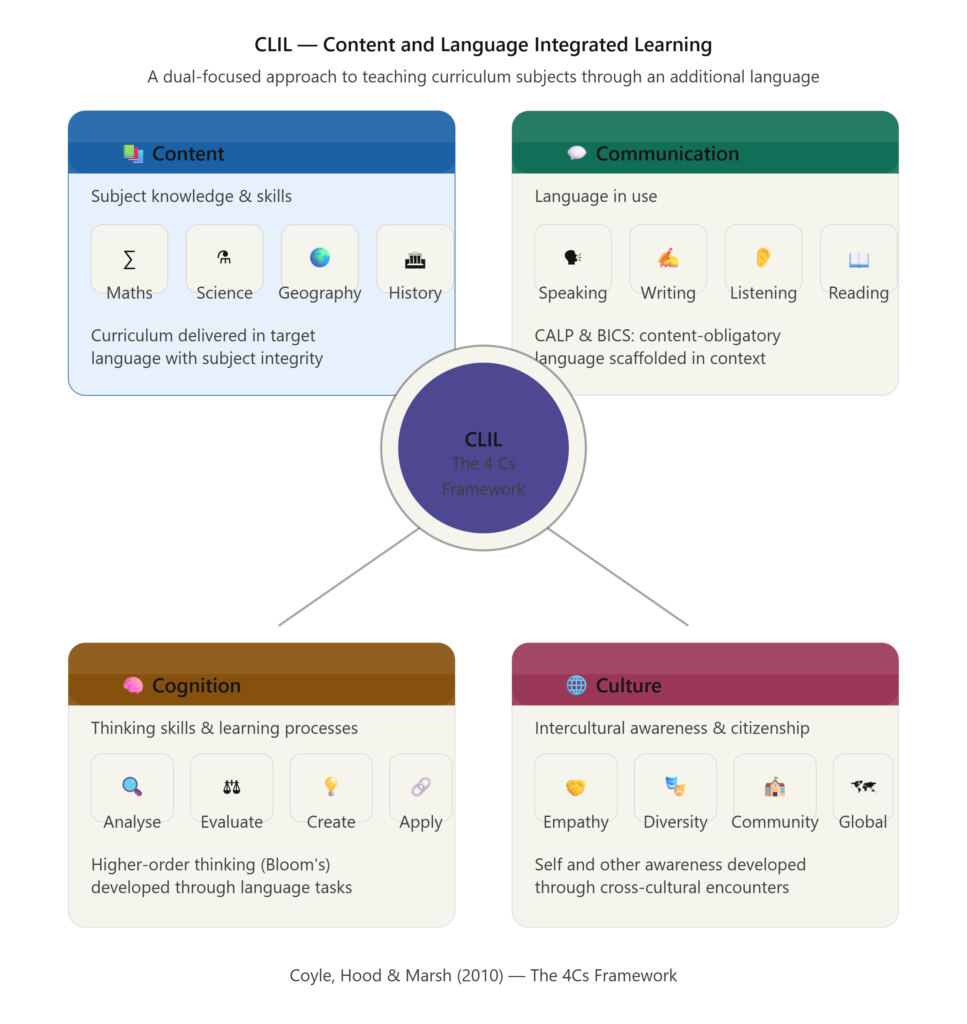
A simple explanation of Content and Language Integrated Learning
CLIL lessons start with a clear goal, like sorting materials or comparing climates. English is the tool to share and explain what you’ve learned.
Language goals are specific and teachable. You might focus on vocabulary, connectors, and classroom talk. This helps students to agree, challenge, and ask for evidence.
How CLIL differs from ESL/EFL and bilingual education
When comparing CLIL vs EFL, the main difference is the lesson’s focus. In EFL, language is the main subject. In Content and Language Integrated Learning, it helps you understand and complete real tasks.
CLIL vs bilingual education is another comparison. Bilingual education is a whole-school approach with decisions on curriculum and language use. It can be part of this, but it can also be used in a single unit without changing the whole programme.
| Feature | CLIL | EFL lessons | Bilingual education |
| Main purpose | Learn subject content and English together, with planned language support | Build English skills as the main focus of the lesson | Deliver parts of the curriculum through two languages over time |
| Typical classroom tasks | Investigations, problem-solving, reports, presentations, debates | Grammar practice, role plays, controlled speaking, skills work | Full subject learning, projects, and assessment across languages |
| Success looks like | Pupils explain ideas clearly and use target language to show thinking | Pupils improve accuracy, fluency, and confidence in general English | Pupils meet curriculum standards while developing bilingual competence |
| Where it can happen | In English lessons or subject-linked modules, including mini-units | In language classes across levels and schooltypes | As a school model with policy, staffing, and a planned timetable |
CLIL in Brazil: where it fits in bilingual schools and mainstream contexts
In Brazil, CLIL is often used in bilingual schools. It fits with Science and Maths themes, inquiry projects, and units that need language to describe results.
In non-bilingual schools, CLIL can be used in short, content-rich sequences in English lessons. This is great for mixed-level classes and limited contact hours. Each task has a clear reason to read, speak, and write, and the outcomes are easier to show and measure.
Why CLIL works in English teaching
Teachers in Brazil often wonder why it works so well. It’s because English becomes a tool, not just a goal. This makes learning meaningful and easier to remember.
One of the benefits of CLIL is its pace. Students move between ideas, images, and talk in one lesson. This helps them focus on meaning first, then shape clearer language.
Learning Through Meaningful Contexts
Students learn language more effectively when they use it to understand and discuss real topics.
Instead of memorising isolated vocabulary lists, learners encounter new words in authentic contexts.
Developing Academic Vocabulary
It helps students acquire subject-specific vocabulary that is often required in bilingual schools and international educational settings.
Encouraging Critical Thinking
Students analyse information, solve problems, and make connections between ideas while using English.
Increasing Motivation
Many learners find Content and Language Integrated Learning lessons more engaging because they focus on interesting topics rather than language rules alone.
CLIL vs Traditional English Teaching
Traditional English lessons often focus primarily on grammar, pronunciation, and vocabulary practice.
Content and Language Integrated Learning takes a different approach by integrating language learning into meaningful subject content.
For example:
Traditional lesson:
Students learn vocabulary related to shapes.
CLIL lesson:
Students learn vocabulary related to shapes while exploring mathematical concepts and solving problems.
In Content and Language Integrated Learning, language becomes a practical tool for communication and learning.
School Subjects That Work Well with CLIL
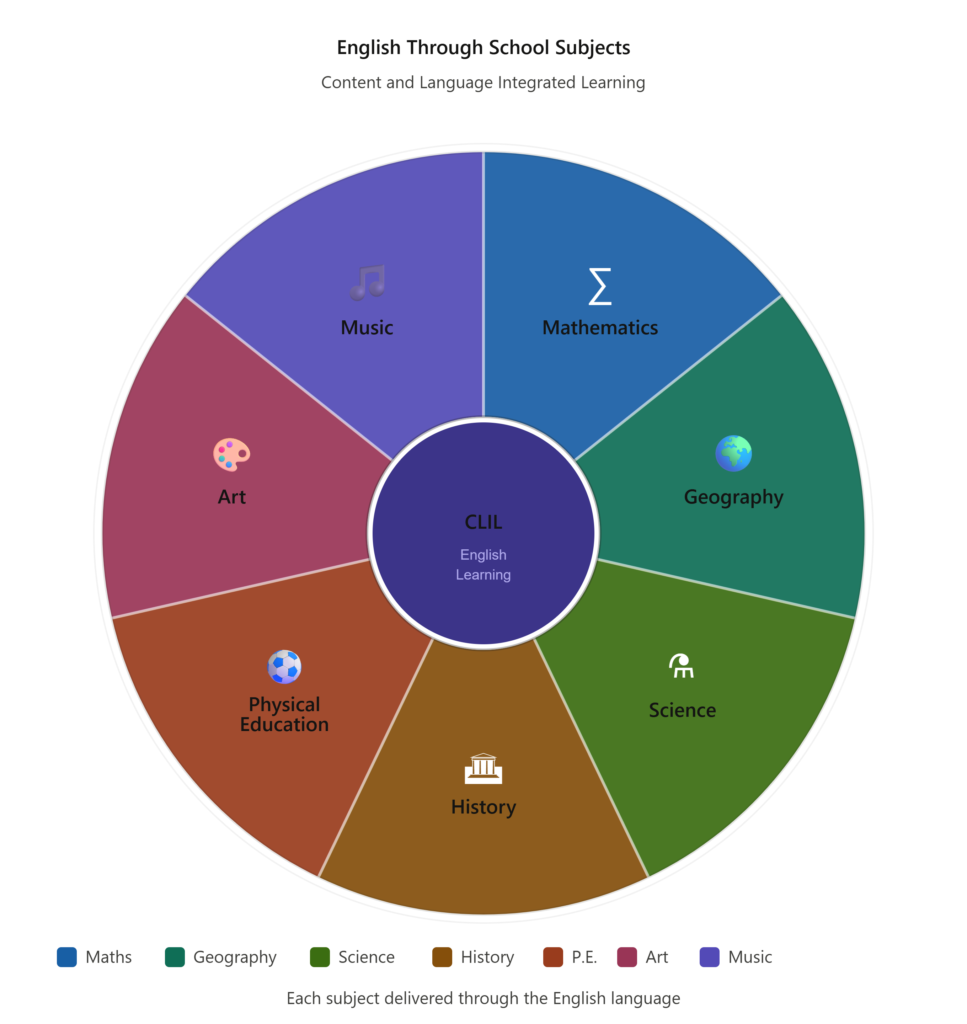
One of the greatest strengths of CLIL is its flexibility. Almost any school subject can be integrated into language learning.
Mathematics
Mathematics provides excellent opportunities for learning numbers, shapes, operations, and problem-solving vocabulary. See more in our article Math Exercises in English A1–B1: Symbols, Shapes, and Problem Solving
Geography
Geography lessons naturally introduce vocabulary related to countries, maps, climates, continents, and natural features.
Science
Science topics encourage observation, experimentation, and the use of academic language.
History
History helps students develop reading comprehension and critical thinking while exploring important events and cultures.
Physical Education
Physical education provides opportunities for movement-based learning and practical communication.
Simple CLIL Activities for Teachers
Teachers do not need complex lesson plans to start using Content and Language Integrated Learning.
Here are a few simple ideas:
Maths
Ask students to describe shapes and solve basic problems in English.
Geography
Use maps to practise directions, countries, and geographical features.
Science
Conduct simple experiments and encourage students to explain their observations in English.
History
Explore historical figures and events through reading and discussion activities.
Physical Education
Use English instructions during games, sports, and movement activities.
Small changes can transform traditional lessons into meaningful Content and Language Integrated Learning experiences.
How to Start Using CLIL
If you are new to Content and Language Integrated Learning, start small.
Choose a familiar topic and introduce a few key vocabulary items before beginning the lesson.
Use visuals, real-world examples, and opportunities for communication. The goal is not perfect language production but meaningful interaction.
As students become more confident, you can gradually increase the amount of English used during lessons.
External Resource for Teachers
Teachers interested in learning more about Content and Language Integrated Learning can explore resources from the British Council. Visit: British Council CLIL Resources
Conclusion
Content and Language Integrated Learning is a powerful educational approach that combines language learning with meaningful academic content. By teaching subjects such as maths, geography, science, history, and physical education through English, educators can create more engaging and authentic learning experiences.
Whether you teach in a traditional classroom, a bilingual programme, or a homeschooling environment, Content and Language Integrated Learning offers practical ways to develop language skills while exploring real-world topics.
As the English Through School Subjects category grows, you will find more activities, lesson ideas, and resources designed to help you bring Content and Language Integrated Learning into your teaching practice.
🎓 Join Our Free English Teaching Community
Would you like more ready-to-use classroom resources?
Join our free WhatsApp community to receive:
- ✅ Answer Keys
- ✅ Printable classroom materials
- ✅ New listening and dictation lessons
- ✅ Teaching ideas for B2–C2 learners
- ✅ Updates from MyEnglandBlog
👉 Join our free WhatsApp Community here: https://chat.whatsapp.com/Kfpriy6R30qDRntLEDsqH5?
Frequently Asked Questions
What is CLIL in simple terms?
Content and Language Integrated Learning is a teaching approach that combines subject content and language learning at the same time.
Is CLIL suitable for beginner learners?
Yes. Teachers can adapt language and content to match different proficiency levels.
Which school subjects work best with CLIL?
Mathematics, geography, science, history, physical education, art, and many other subjects can be taught using Content and Language Integrated Learning principles.
What are the main benefits of CLIL?
Content and Language Integrated Learning helps learners develop language skills, academic vocabulary, critical thinking, and confidence.
How can teachers start using CLIL?
Teachers can begin by introducing simple subject-related vocabulary and gradually increasing the use of English during lessons.


1 thought on “What Is CLIL? A Practical Guide for English Teachers”