Introduction
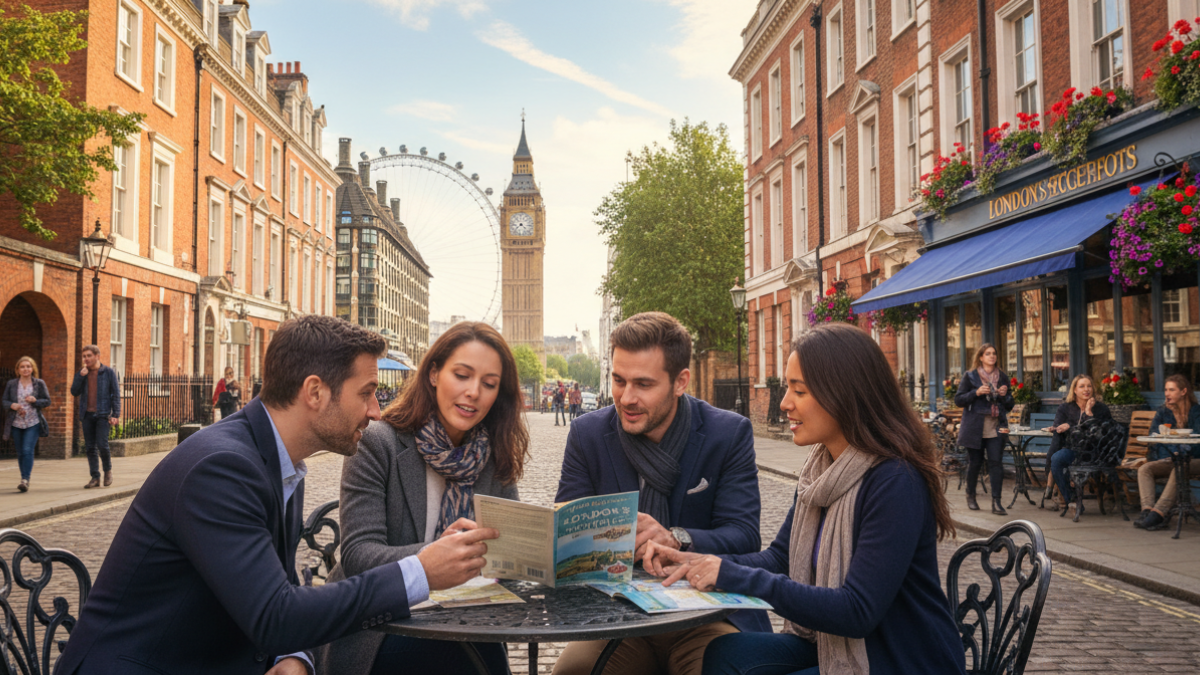
This text is a reading practice for English learners, set in London. It focuses on eight hidden places to explore London. It aims to improve reading skills with clear, short descriptions.
This section is designed for those learning British English. It uses British spelling and phrases. This helps learners notice patterns in London texts.
For English learners from Brazil, this text is practical. It helps expand vocabulary and improve reading confidence. It explains cultural references in simple terms.
The text is structured consistently. It starts with descriptions of London’s hidden gems. Then, it covers key vocabulary, comprehension questions, and speaking prompts. Finally, it asks readers to describe a hidden place in their city.
Key takeaways
- This piece is a London travel reading text designed as reading practice English, not a full travel guide.
- It presents London hidden gems using short descriptions to support steady comprehension.
- The language model follows British English reading norms, including spelling choices.
- It is written for learners who learn English Brazil and want London-based context.
- The article moves from descriptions to vocabulary, then questions, speaking prompts, and a city description task.
- Each section is structured to help readers skim, scan, and then read more closely.
Why this reading practice is perfect for Brazilian learners of English
This reading practice uses London’s lesser-known places to build meaning from context. For Brazilian learners of English, this mix of real settings and clear descriptions supports steady progress. It also keeps the focus on British English for Brazilians, where local terms and place references often matter.
What you will learn: culture, context, and everyday language
The text centres on neighbourhoods, markets, parks, canals, and creative spaces, so vocabulary repeats in a natural way. Readers meet travel language used for directions, transport, short descriptions, and atmosphere. Words such as lane, courtyard, and borough become easier to follow when they appear across several entries.
Cultural context adds meaning without slowing the pace. Markets, memorials, and local boroughs are part of how London works day to day, and that background helps readers infer purpose and tone. This supports an English reading strategy that goes beyond single-word translation and relies more on sense-making.
- Everyday travel topics: routes, stops, walks, and timings
- City detail: architecture, green spaces, and small venues
- Useful description language: quiet, lively, tucked away, atmospheric
How to use the text: skim, scan, then read for detail
The approach follows skim scan read, a simple routine that suits short place descriptions. Skim means reading quickly to catch the topic and overall meaning. It helps readers notice the structure, such as where each location sits and what it is known for.
Scan means looking for specific details, such as names, standout features, access limits, and typical activities. This is useful when a reader needs one fact fast, like whether a place is best for a walk, a photo, or a quiet break.
Read for detail means slower reading to confirm facts and interpret descriptive clues. That careful pass supports later comprehension work, because it checks what the text states and what it implies.
| Stage | What the reader looks for | Typical output |
|---|---|---|
| Skim | Main topic, tone, and broad categories (market, park, canal, gallery) | A one-sentence summary of each place |
| Scan | Names, key features, limits on entry, and suggested activities | A short list of facts for quick reference |
| Read for detail | Exact meaning, relationships between ideas, and descriptive evidence | Clear answers that cite wording from the text |
Tips for pronunciation and spelling differences in British English
The reading includes forms that signal British spelling, such as colour and neighbourhood. Seeing these patterns in context helps Brazilian learners of English recognise variants without confusion. It also builds familiarity with British English for Brazilians, where the written form may differ from what learners have seen in American materials.
Place names can add a second layer, because pronunciation does not always match spelling. Names like Leadenhall and Twickenham may look unfamiliar at first, so awareness matters before speaking tasks. Short pronunciation tips, tied to the text, help readers notice stress, weak sounds, and linking in natural speech.
Explore London through hidden gems: how to read like a local
This text is like how locals talk about places in London. It focuses on where things are, what they feel like, and how they work every day. In London, it’s often the hidden spots that matter more than famous places.
To read like a local, it’s all about context, not just finding one big attraction. Good descriptions quickly move from where something is to how it feels. They might mention a lane or a market, then add a small detail that changes everything.
Local language also hints at the mood and pace of a place. Words like tucked away or quiet suggest calm spots. On the other hand, buzzy or packed means it’s lively and busy.
- Setting: street, courtyard, canal edge, garden path, or covered market.
- Sensory detail: light on brick, bright paint, echo under an arcade, or sudden calm.
- Access and timing: limited opening, weekend crowds, sheltered corners, or short walks from a station.
These details help us understand what’s public and what’s hidden. A simple phrase like “behind the shops” can mean the entrance is hard to find. Saying “best on a weekday morning” can change how we expect to experience a place.
| Descriptive signal in a descriptive text London | What it often means in reading for context | Likely impact on timing and access |
|---|---|---|
| Sheltered, under cover, arcade | Protection from wind and rain; sound may echo; light can be softer | Useful in wet weather; can feel busier at peak hours |
| Open-air, waterside, hilltop | More space and views; weather shapes comfort and visibility | Better in clear conditions; quieter off-peak and early in the day |
| Down a lane, behind a gate, through an arch | Entrance is less obvious; the place may feel removed from main roads | May require slower navigation; some entrances close outside set hours |
| Limited access, open days, private | Not always available; rules may apply even if it looks public | Needs attention to dates and opening times; queues can form quickly |
| Buzzing, popular, tour groups | High footfall; noise and movement; fast-changing space | Expect peak-time crowding; calmer early mornings and weekdays |
This approach helps Brazilian readers understand local London language without slang. It keeps the text grounded in real observations. When descriptions mix place, mood, and access, it’s easier to see how London works in real time.
- Which words in the text most clearly separate calm spaces from lively ones?
- How do “access and timing” notes change the meaning of a place description, even without extra detail?
- What clues suggest that an entrance might be easy to miss?
- In reading for context, what matters more: exact facts, or the signals that shape expectations?
- Which type of setting (market, garden, lane, canal) seems easiest to imagine from descriptive text London, and why?
Hidden gem descriptions: untapped places to visit in London
This part of the London hidden gems list gives eight short descriptions for reading practice. Each place is presented with location, atmosphere, typical activities, and any limits on access. The focus stays on clear details and practical language.
Neal’s Yard: colourful courtyards and independent shops
Neal’s Yard sits just off Seven Dials in Covent Garden, hidden behind narrow passages. The small courtyard feels bright, with painted walls, signs, and plants close together.
People often pause for photos, then browse independent shops and cafés nearby. At busy times the space can feel tight, so slower visits tend to happen early in the day.
Little Venice: canals, houseboats, and waterside walks
Little Venice London is near Warwick Avenue, where canals meet in a calm basin. The view is soft and open, with houseboats, moored barges, and tree-lined towpaths.
Walkers follow the water, watch passing boats, or sit near a waterside pub. The towpath can narrow in places, so shared space with cyclists is common.
Leadenhall Market: Victorian architecture and sheltered lanes
Leadenhall Market is in the City of London, close to Bank and Monument stations. Inside, the roofed passages create a sheltered feel, with Victorian ironwork and patterned flooring.
Office workers pass through at lunchtime, while visitors look up at the ceiling and shopfronts. Opening hours vary by business, and evenings can become quieter when the area clears.
Postman’s Park: a quiet memorial with moving stories
Postman’s Park lies near St Paul’s Cathedral, set back from busy streets. The green space is small and calm, with benches, shade, and a steady flow of local workers.
The Postman’s Park memorial records acts of everyday bravery on ceramic plaques. Readers often slow down here to scan names, dates, and short descriptions in simple English.
St Dunstan in the East: a ruined church turned secret garden
St Dunstan in the East garden is between Monument and Tower Hill. Stone walls and arches remain from the church, with climbing plants and tall trees filling the gaps.
Visitors sit quietly, listen to city sounds, and take photos of the ruined structure against the sky. It is a compact space, so it can feel crowded at peak tourist hours.
Hampstead Pergola and Hill Garden: romantic paths and viewpoints
Hampstead Pergola is in Hampstead Heath, near the Hill Garden. The long walkway has columns, vines, and shaded sections that change with the seasons.
People stroll, read, and look out from nearby viewpoints across north London. Paths can be slippery after rain, so sturdy shoes help on damp days.
God’s Own Junkyard: neon art in a surprising setting
God’s Own Junkyard is in Walthamstow, set inside an industrial area. The interior is bright and busy, filled with neon signs, film props, and reflective surfaces.
Many visitors take photos and study the lettering, colours, and shapes. Opening times are limited compared with central attractions, so checking hours before travel matters.
Eel Pie Island (Twickenham): creative studios with limited access
Eel Pie Island Twickenham sits on the River Thames near Twickenham, reached by a narrow footbridge. The island feels separate from the town, with workshops, studios, and riverside buildings.
Artists work here, and some open their doors during specific events. Access is limited most of the year, so entry often depends on open studio dates.
| Place | Where it is | What it looks/feels like | What people do there | Access or practical constraint |
|---|---|---|---|---|
| Neal’s Yard | Near Covent Garden, by Seven Dials | Small, colourful courtyard with close walls and plants | Take photos, browse independent shops, stop for a drink | Can feel crowded; best at quieter times |
| Little Venice London | By Warwick Avenue, canal junction | Calm water, houseboats, towpaths and trees | Walk by the canal, watch boats, sit waterside | Towpaths narrow; shared use with cyclists |
| Leadenhall Market | City of London, near Bank/Monument | Roofed lanes, Victorian ironwork, sheltered feel | Pass through, shop, look up at the architecture | Area quietens after work hours |
| Postman’s Park memorial | Near St Paul’s Cathedral | Quiet garden with plaques and benches | Read short stories on plaques, rest in the shade | Small space; lunchtime can be busy |
| St Dunstan in the East garden | Between Monument and Tower Hill | Ruined arches with greenery and trees | Sit quietly, take photos, notice contrasts with the City | Compact site; peak times reduce space |
| Hampstead Pergola | Hampstead Heath, near Hill Garden | Long pergola with vines, shaded paths | Stroll, read, take in nearby viewpoints | Paths can be slippery after rain |
| God’s Own Junkyard | Walthamstow, industrial setting | Dense neon displays, bright colours, reflections | Photograph signs, study design and lettering | Limited opening times compared with museums |
| Eel Pie Island Twickenham | River Thames, near Twickenham | Riverside studios, quiet island atmosphere | Visit studios during events, explore the riverside | Limited access outside open days |
- Which place shows the clearest contrast between a busy area and a quiet interior space?
- How do opening times and access limits change the way visitors plan a day out?
- Which description uses the most visual detail, and what words create that effect?
- What clues suggest that some locations are better in the morning than at midday?
- How does the text signal respect and calm when describing memorial spaces?
How to get around London smoothly and cheaply
In many city texts, movement matters as much as the place itself. London transport is often described in short, practical phrases. This helps learners understand how areas connect and why a route feels fast, quiet, or crowded.
Using the Tube, buses, and walking routes between neighbourhoods
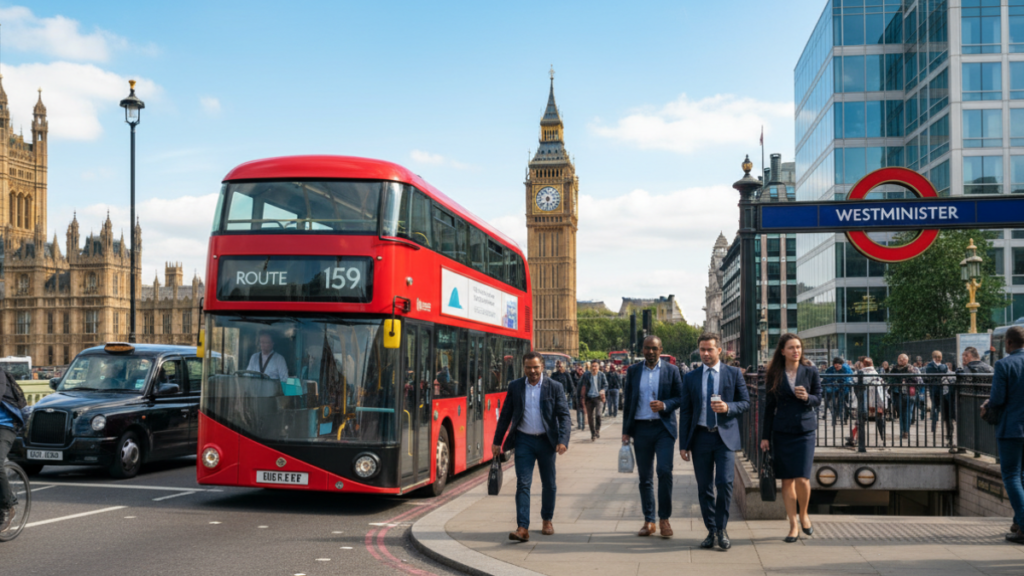
Writers in London guidebooks often mention Tube and buses as a quick way to cross the city. Useful terms include “line”, “platform”, “change”, and “bus stop”. These terms appear in signs and travel notes.
At street level, walking routes London can be easier to follow than a map suggests. Short walks between nearby areas are often written as “ten minutes on foot” or “a pleasant stroll”. This helps readers picture distance and pace.
For budget travel London, mixed journeys are common in visitor advice. A short walk can replace one stop on the Underground. Meanwhile, a bus can keep the route simple when stations are less convenient.
Oyster vs contactless: what visitors should know
Visitor information often uses the phrase Oyster card vs contactless because both are ways to pay for public transport. Oyster is a stored-value travel card, while contactless uses a bank card or a phone payment. Fares are calculated from tap-in and tap-out.
| Term seen in travel texts | What it means in practice | Why it appears in reading |
|---|---|---|
| Oyster card | A reusable card topped up with credit for trips across the network | Often mentioned in budget travel London tips and station instructions |
| Contactless | A bank card or phone used to pay by tapping at gates and readers | Common in arrival guides and short “how to pay” notices |
| Daily cap | A limit on what is charged in one day, after several journeys | Explains why costs stop rising, which supports price comparisons |
| Zones | Numbered areas used to set fares across the city | Helps readers interpret prices and plan trips between neighbourhoods |
Timing your visit: weekdays, weekends, and off-peak hours
Many descriptions include time clues, because atmosphere changes across the week. Weekday rush hours can mean fuller platforms and slower exits. Some weekends bring crowds to markets, parks, and riverside paths.
Off-peak is a plain term for quieter hours, outside the busiest commuting times. In off-peak travel London notes, the same journey may be described as calmer. This means more space to read signs, follow announcements, and notice details.
Timing language also supports comprehension. When a paragraph says “early morning”, “late evening”, or “after lunch”, it often signals what to expect from London transport and from the streets nearby.
- Which phrases in a paragraph show that a place is near enough for walking routes London?
- How can “change at” or “one stop” help a reader follow a story that moves across Tube and buses?
- What details in a text usually explain Oyster card vs contactless without giving a full price list?
- How does off-peak travel London affect words linked to noise, space, and pace?
- Why might budget travel London advice include both a short walk and a bus ride in the same route?
Mini cultural notes to enrich comprehension
These London culture notes give quick background info. They help readers understand place descriptions without needing to do extra research. They also show how British culture mixes history, leisure, and daily life in public spaces.
In London, a market is more than just stalls. It includes food counters, small shops, and covered walkways. These are often found in older buildings with ironwork and glass roofs.
This is important for understanding UK city life. A market can offer shelter from rain, quick meals, and narrow lanes. It shows how London’s neighbourhood culture keeps shopping close to work and homes.
Memorials in parks are common too. In Britain, parks with plaques, sculptures, or memorials are still used for breaks and walks. This mix might seem unusual at first but is typical of London.
The calm and practical atmosphere of these settings means the writing is respectful but not dramatic. This reflects London’s neighbourhood culture well.
Canals and houseboats are also mentioned. London kept parts of its old transport network, even after roads and rail took over. Today, towpaths are great for walking, jogging, and slow travel through quieter streets.
For UK city life vocabulary, words like towpath, mooring, and lock signal a walk by water. In London, canals suggest a slower pace and local leisure, not swimming.
Boroughs and neighbourhood names are key in London. A borough is an official area with its own council. A neighbourhood is a smaller area used in daily speech.
This helps understand British cultural context in travel and reading. It also helps grasp London’s neighbourhood culture, where nearby areas can feel different in architecture, noise, and street life.
| Reference in descriptions | What it usually signals | Helpful UK city life vocabulary |
|---|---|---|
| Market in a covered lane | Food and shopping mixed with historic design; easy shelter in bad weather | arcade, stall, covered, passageway |
| Memorial inside a park | Everyday leisure beside remembrance; quiet tone and simple signage | plaque, tribute, memorial, grounds |
| Canal with houseboats | A walking route shaped by water; slow movement and local routines | towpath, mooring, lock, footbridge |
| Borough and neighbourhood labels | Administrative area versus local identity; clues about transport and character | borough, ward, neighbourhood, postcode |
- How does the meaning of a market change when it is described as “covered” or “Victorian”?
- What tone do park memorial references create, and how is it kept neutral?
- Which canal words suggest movement and direction, and which suggest stopping?
- Why might a writer choose a borough name rather than a neighbourhood name in a short description?
- What details best capture London neighbourhood culture without adding long explanations?
Key British Vocabulary
This list of British English words is packed with terms you’ll find in London signs and everyday talk. It helps you read better by linking words to examples and showing how they differ internationally.
These words are key for UK travel, helping you navigate and understand places. They also improve your grasp of British transport, food, and descriptive adjectives.

Transport and directions: pavement, queue, return ticket, carriage
| Word | British English definition | London example sentence | Contrast with common international usage |
|---|---|---|---|
| pavement | The footpath beside the road, used by pedestrians. | Visitors kept to the pavement near Covent Garden to avoid cyclists. | Often called sidewalk in American English. |
| queue | A line of people waiting their turn. | There was a short queue for the bus at Bank, even in light rain. | Often called a line in American English. |
| return ticket | A ticket for travel to a place and back again. | A return ticket to Twickenham can be cheaper than two singles on some routes. | Also known as a round-trip ticket in American English. |
| carriage | A single coach on a train, with its own doors and seating area. | The carriage was quiet on the Overground after the morning rush. | Sometimes called a car or coach, depending on the country. |
Food and drink: takeaway, crisps, fizzy drink, pudding
| Word | British English definition | London example sentence | Contrast with common international usage |
|---|---|---|---|
| takeaway | Hot food bought to eat elsewhere. | A simple takeaway near Camden is useful before an evening walk by the canal. | Often called takeout in American English. |
| crisps | Thin, crunchy slices of potato sold in packets. | Crisps are a common snack from a corner shop on the way to a park. | Called chips in American English; in the UK, chips are thicker and hot. |
| fizzy drink | A sweet, carbonated soft drink. | A fizzy drink from a kiosk can feel welcome after climbing a steep hill. | Often called soda or pop elsewhere. |
| pudding | Dessert in general, or a specific sweet dish served after a meal. | Many pubs list pudding on the menu alongside tea and coffee. | In some countries, pudding mainly means a creamy custard-style dessert. |
Places and sightseeing: courtyard, alleyway, borough, landmark
| Word | British English definition | London example sentence | Contrast with common international usage |
|---|---|---|---|
| courtyard | An open space enclosed by buildings, often calm and sheltered. | A small courtyard in Soho can hide cafés and quiet benches. | Meaning is similar internationally, but it is common in London retail and historic sites. |
| alleyway | A narrow passage between buildings. | An alleyway near a market can lead to a tucked-away entrance. | Sometimes shortened to alley, which may sound more informal. |
| borough | An official district of London with its own local council. | Richmond upon Thames is a borough known for riverside paths. | Outside the UK, the word may be used differently or not at all. |
| landmark | A well-known place that helps people recognise an area. | St Paul’s Cathedral is a landmark that makes orientation easier across the city. | Meaning is broadly shared, but London uses it often for navigation and tourism. |
Useful adjectives for descriptions: quaint, lively, tucked away, atmospheric
| Word | Clear meaning | London example sentence | Common nuance |
|---|---|---|---|
| quaint | Attractively old-fashioned, small, and charming. | A quaint lane near a station can feel far from the main road. | Often positive, but it can suggest something is slightly out of date. |
| lively | Full of activity, noise, or social energy. | The street felt lively when the galleries opened for the evening. | Can be positive, yet it may also mean busy for some readers. |
| tucked away | Hidden or placed where it is not easy to notice. | A tucked away garden behind office blocks can surprise first-time visitors. | Often hints at a quiet location, not a famous address. |
| atmospheric | Having a strong mood created by light, sound, or setting. | An atmospheric arcade feels different on a grey afternoon. | Used for places with a distinct sense of character, not only for scenery. |
This set of UK travel vocabulary shows that meaning stays the same, but usage changes with context. Learning British transport, food, and descriptive adjectives with real London examples is key.
This list focuses on practical reading skills, like understanding signs and menus. It helps you grasp British English without needing long explanations.
Reading comprehension questions
These English reading questions focus on eight hidden gems. They use British spelling and clear prompts. They are perfect for Brazilian learners who want to improve their reading skills in London.
The tasks mix scan for details with short interpretation. This helps learners check facts and practice inference. Answers should only use the wording from the descriptions, without adding extra information.
Find the details: matching places to descriptions
Match each description to one place (Neal’s Yard, Little Venice, Leadenhall Market, Postman’s Park, St Dunstan in the East, Hampstead Pergola and Hill Garden, God’s Own Junkyard, Eel Pie Island).
- A sheltered Victorian setting with lanes and striking architecture.
- A canal area with houseboats and waterside walks.
True or false: check your understanding
- True or false: Postman’s Park is presented as a quiet memorial with moving stories.
Short answers: explain your choices using evidence from the text
- Which place sounds tucked away because of its access limits? Give the place name and quote a short phrase from the description that supports the choice.
Inference: what can you guess about local life from each place?
- Choose one of these places: Neal’s Yard or God’s Own Junkyard. What can be inferred about the local scene there (for example, shopping habits or creative culture)? Give one inference and point to specific wording as evidence.
Speaking discussion prompts for classes or self-study
These speaking prompts English focus on the eight hidden-gem descriptions. They are perfect for pair work or solo practice. They help learners speak clearly and calmly.
For ESL speaking practice, learners can share or rephrase important points. These include access limits, transport tips, and the mood of each place. The goal is to compare places based on the text, not to add new information.
- Which place seems calmest based on setting and typical noise level, and what words in the description support that view?
- Which location appears most visually distinctive (colour, light, architecture, or art), and which two details best justify the choice?
- Which hidden gem looks easiest to reach using common London transport, and which sounds less convenient due to access rules or location?
- Which site seems best for a short visit between other stops, and which seems to reward a longer, slower walk?
- Which pair of places contrasts most in atmosphere (for example, quiet memorial vs lively market), and how does the text signal that difference?
To extend British English speaking topics without changing the facts, learners can focus on language choices. For example, they can evaluate how adjectives shape tone, or how place features guide expectations.
| Focus for discussion questions London | Evidence to extract from the reading | Useful language for British English speaking topics | Quality check for ESL speaking practice |
|---|---|---|---|
| Atmosphere and pace | Clues about quiet corners, sheltered lanes, memorial spaces, gardens, or waterside walks | seems, suggests, implies, “based on the description…” | Gives two text details and avoids extra claims |
| Access and ease of visiting | Notes on limited access, opening patterns, central vs residential areas, and walkable routes | “more accessible than…”, “less straightforward because…”, “the text indicates…” | Compares at least two places with clear reasons |
| Visual impact | References to colour, neon, Victorian design, courtyards, canals, ruins, and viewpoints | “most striking”, “stands out due to…”, “has a stronger visual contrast” | Uses specific nouns (arches, lanes, boats, ruins) not vague praise |
| Best match for a purpose | Signals of shelter, short stops, reflective spaces, photo-friendly spots, or browsing areas | “better suited to…”, “fits a brief visit”, “supports a slower route” | States a purpose, then links it to evidence |
When repeating speaking prompts English, the same prompt can be answered twice with different choices. This keeps discussion questions London fresh while maintaining tight links to the original text.
Describe a place in your city activity
This activity is based on the London model but set in Brazil. It focuses on a hidden spot in your city. The goal is to describe it clearly, naturally, and with details that listeners can imagine.
Planning: choose a hidden gem and list sensory details
Start by picking a local spot, not a famous one. It could be a small square, a street market, or a quiet spot. Note what you see, hear, smell, taste, and touch. Use specific words instead of general ones like “nice” or “good”.
- Sound: buskers, street vendors, birds, distant traffic
- Smell: fresh coffee, rain on warm pavement, grilled cheese bread
- Texture: cobblestones, painted walls, cool shade under trees
Writing frame: opening, location, atmosphere, top tips
A writing frame helps keep your ideas in order. It’s great for drafting and then speaking. The frame is simple but mirrors travel writing.
| Part | What to include | Useful sentence starters |
|---|---|---|
| Opening | One clear reason the place stands out; keep it factual | This place is known for… / It feels different because… |
| Location | Neighbourhood, nearby landmark, and an easy reference point | It is near… / It is a short walk from… |
| Atmosphere | Light, colour, movement, and two or three strong sensory details | The air smells of… / The street sounds like… |
| Top tips | Best time of day, what to bring, and one local etiquette note | Go in the morning if… / Bring… |
Speaking task: present your place in one minute
For the speaking task, you have one minute. Use the same structure as the writing frame but make sentences clear. End with a strong image and a practical tip.
Peer feedback checklist: clarity, vocabulary range, pronunciation
A checklist for feedback makes it easy and consistent. It focuses on meaning, then language, and finally how you deliver it. It also helps track progress in describing different places in Brazil.
- Clarity: Could the listener picture the route and the setting?
- Vocabulary range: Did the speaker use sensory details vocabulary with precise nouns and verbs?
- Pronunciation: Were key place words and stress patterns easy to understand?
- Structure: Did the talk follow the describe a place activity order without drifting?
Discussion questions
- Which details made the place feel real: sounds, smells, or textures, and why?
- What is the strongest sentence in the one-minute talk, based on clarity?
- How did the writing frame English shape the order of information?
- Which word choices improved the atmosphere most, and what could replace vague adjectives?
- What would the peer feedback checklist highlight as the next priority: vocabulary, structure, or pronunciation?
Study tips: turning a London listicle into daily English practice
A short London list can help with a daily English routine. Each description is brief and easy to go back to. It’s great for Brazilian learners because it’s about transport, food, and street life.
Using the same text for a week is key. This way, you can read, mark up, and use it again and again.
The same idea applies to education debates. London’s BETT show is a big event in education tech. It has over 600 vendors and 30,000 visitors from 120 countries.
BETT has made changes to be more eco-friendly. They use QR codes, don’t give out bags, and recycle banners. This shows how learning materials can also be green.
But, digital tools still have environmental costs. Streaming uses more energy than DVDs, and AI training can harm the planet. For more on this, check out this Cambridge University Press tag archive.
Build a vocabulary notebook with collocations and example sentences
A vocabulary notebook works best with chunks, not single words. Use phrases like “tucked away courtyard” and “quiet memorial”. Add one example sentence from the listicle and then a new one with the same pattern.
Collocations help with translation and spelling. They make British English easier to learn, like favour and colour.
Shadow reading: copy rhythm and linking in British pronunciation
Shadow reading focuses on timing and linking, not speed. Repeat what you hear, keeping the same pauses and stress. Pay attention to weak forms in function words.
This method is great for short descriptions. You can repeat sentences without getting tired. It helps you notice reductions in spoken English.
Rewrite for fluency: paraphrase each place in simpler English
Start small with paraphrasing. Break one sentence into two, using simpler words. For example, “atmospheric lanes” could become “lanes that feel old and calm”. This helps with tense and word order.
Check if your rewritten text still names the place and gives a clear detail. Keep the tone neutral, like travel reporting.
| Method | What it uses from the London text | Language focus | Low-effort way to repeat it |
|---|---|---|---|
| English study tips | Short place summaries and transport notes | Reading for gist, then detail | Re-read one place each day and highlight one key detail |
| vocabulary notebook collocations | Adjective + noun pairs and set phrases | Chunking, spelling patterns, natural phrasing | Add three collocations and write two example sentences |
| shadow reading British English | Sentence rhythm in descriptions and directions | Stress, linking, weak forms | Repeat one paragraph twice, aiming for the same pauses |
| paraphrasing practice | Core facts about each hidden gem | Sentence control, synonyms, clarity | Rewrite one description in simpler English in 60–80 words |
| daily English routine | One place per day across a week | Consistency and recall | Rotate: read, note collocations, shadow, then paraphrase |
- How does a vocabulary notebook change when it records collocations instead of single words?
- Which parts of British pronunciation are hardest to notice during shadow reading British English: stress, linking, or weak forms?
- When does paraphrasing practice improve clarity, and when can it remove useful detail?
- How might a daily English routine balance paper notes with low-print digital options like QR codes?
- What environmental costs of edtech should learners keep in mind when choosing apps and devices?
After exploring these hidden gems, you can extend the lesson with structured discussion prompts. These ready-to-use B1–B2 conversation topics help students talk about travel experiences, city life and cultural discoveries in greater depth.
Conclusion
This Explore London reading practice takes you on a short, clear journey to eight hidden spots. From Neal’s Yard to Eel Pie Island, it’s a guide to London’s secret gems. It uses real places and everyday details to help you feel comfortable with how London is described.
The article also includes mini cultural notes to explain UK habits and travel norms. It groups British vocabulary by theme, making it easier to understand in context. This helps with learning British English, including words like “colour” and “organise”.
To check your understanding, there’s a comprehension section with different tasks. These tasks help you describe places more clearly. You can even apply this to describing a city in Brazil, using local spots and landmarks.
This material aims to improve your ability to understand descriptive writing. It helps you discuss places more organised and accurately. So, Explore London reading practice can be part of your regular British English learning, focusing on independent understanding and language growth.
FAQ
FAQ
Which eight London “hidden gems” are included in the descriptions?
You’ll find eight places in the text. These include Neal’s Yard, Little Venice, and Leadenhall Market. Each spot is described with details on location, atmosphere, and what to do there.
How do the cultural notes support understanding of the text?
The cultural notes explain local references. They help you understand London markets, memorials in parks, and how canals shape walks. They also talk about neighbourhood identity in London writing.
What British English transport terms might appear, and why do they matter?
You might see terms like Tube and pavement. These are common in London. Knowing them helps you follow directions and understand descriptions better.
What is the difference between Oyster and contactless in London transport reading?
Oyster is a travel card, while contactless is for tap-in payments. These terms are often used in London. Knowing them helps you understand fares and travel options.
What does “off-peak” mean, and how is it used in place descriptions?
“Off-peak” means quieter times. In the text, it helps describe the atmosphere. Words like lively and calm make more sense when you know the time.
How can learners handle difficult London place names in reading and speaking tasks?
Seeing names like Leadenhall in context helps. It links the name to its setting. This makes it easier to pronounce and discuss later.



2 thoughts on “Explore London: Reading Practice About 8 Hidden Gems in the UK”