Introduction
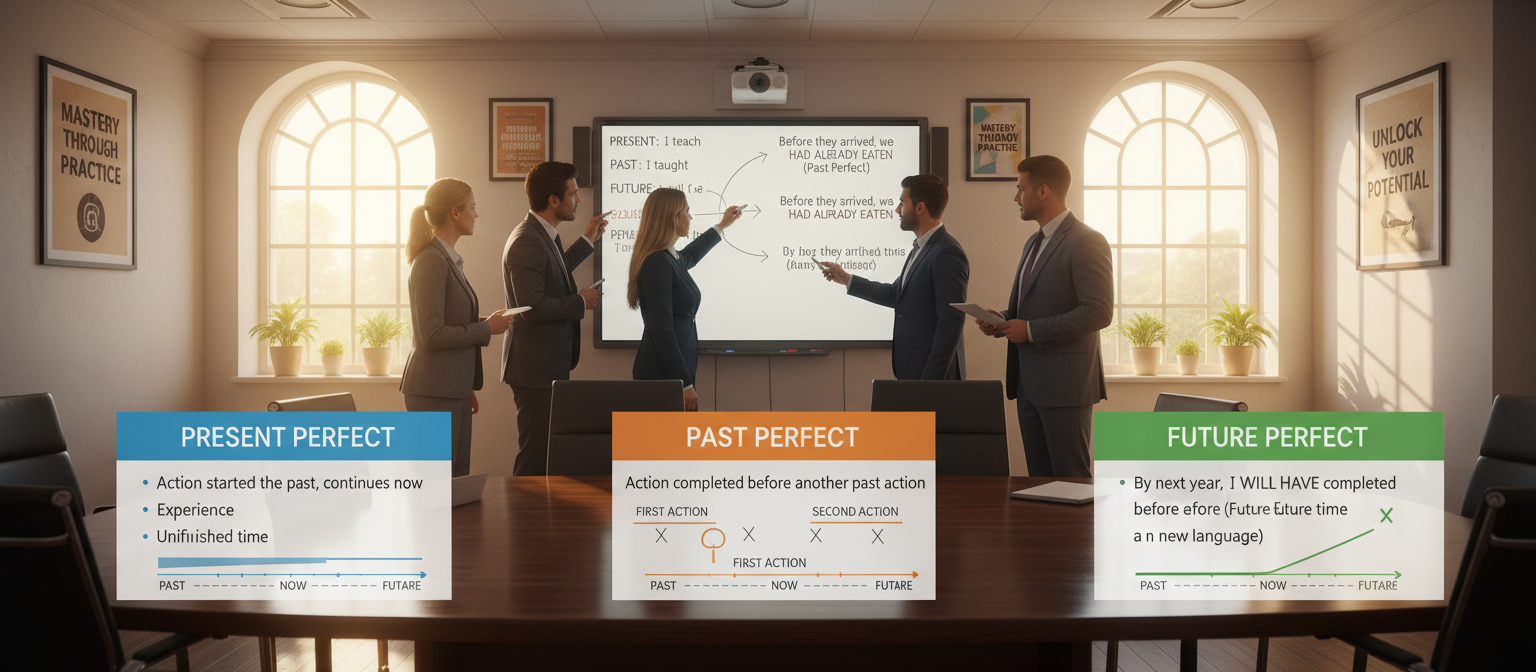
This guide focuses on English Verb Tenses. It aims to make the perfect tenses clear in real writing. It shows how the perfect aspect links two times, making it clear what happened first and what matters now.
The key skill is choosing the right tense. Writers use present perfect for actions before now, past perfect for actions before a past point, and future perfect for actions before a future point. In advanced English grammar, the time relationship is often more important than the action itself.
A1–B1 readers will find quick form reminders and common time markers. These include already, yet, by, and so far. B2–C1 readers will focus on nuance, sentence-to-sentence consistency, and editing choices that affect tone.
This tutorial is written in British English but targets the United States. A dedicated section explains US usage preferences and how to stay consistent when switching between varieties.
It’s designed like a modern digital workbook. It has short blocks, bullet rules, and contrast pairs that show meaning fast. Continuous perfect forms appear briefly when they change meaning, especially for duration and emphasis.
Key Takeaways
- Perfect tenses show a time link, not just an action.
- Present perfect connects a past event to now; it keeps the time focus open.
- Past perfect sets a clear “past-before-past” order for stories and reports.
- Future perfect marks completion before a future deadline or point.
- Advanced English grammar often depends on consistent tense choices across a paragraph.
- English Verb Tenses vary by region, so US preferences need careful handling.
Why Perfect Tenses Matter in Advanced English Grammar
In real writing, tense is more than a rule. It’s a tool for meaning. When learners master English Verb Tenses, they help the reader follow time, cause, and relevance easily.
The perfect aspect in English is crucial for this control. It shows how an event relates to a reference point, not just what happened. This is why it’s so important in advanced English grammar.
What the perfect aspect in English really signals
The perfect aspect in English shows a connection between two times. It focuses on the concept, not just the formula. The verb choice answers a timing question the reader might not ask out loud but still needs to know.
Present perfect links a past event to now. Past perfect shows one past event before another. Future perfect shows completion before a future time. These are key in English Verb Tenses for mature writing.
Choosing the right tense for clarity, precision, and style
In reports and workplace updates, perfect forms clear up confusion. They show what was true before, what has changed, and what will be done by a certain time. This control is a hallmark of advanced English grammar.
Style also changes with tense choice. Perfect forms often sound like reporting and synthesis. Past simple tends to feel more like storytelling. With English Verb Tenses, the writer can show distance or immediacy, depending on the style.
| Writing goal | Preferred tense choice | Effect on tone | Typical context |
|---|---|---|---|
| Emphasise current relevance | Present perfect | Summary-like, focused on outcome | Status updates, reviews, CV statements |
| Show clear sequence in a past narrative | Past simple with selective past perfect | Story-driven, easy to follow | Case studies, incident reports, memoir-style writing |
| Explain “past before past” cause | Past perfect | Analytical, clarifying background | Investigations, academic argument, legal-style accounts |
| State completion before a future deadline | Future perfect | Planned, deadline-aware | Project plans, forecasts, operational targets |
Common advanced learner pitfalls with perfect tenses
Many learners misuse present perfect with finished-time markers, like “I have seen it yesterday.” This messes up how time is shown and weakens clarity, even when the meaning seems clear.
Another problem is not using past perfect when it’s needed. Without it, the reader might get the order of events wrong, especially in long paragraphs.
Another issue is mixing timelines in one paragraph without a clear reference point. This makes the reader have to piece together the timeline, which is avoidable with careful English Verb Tenses choices.
Finally, learners often confuse perfect simple and perfect continuous. Perfect simple highlights result or completion, while perfect continuous shows duration or ongoing activity. This contrast is key in advanced English grammar and helps with more precise meaning.
Present Perfect: Advanced Meanings Beyond “Have Done”
The present perfect is a key tense in modern English. It links past actions to the present moment. This connection can turn a simple fact into something more meaningful.
Its form is straightforward: have/has + past participle. Quick checks help in writing: I haven’t finished; Have you sent it?; She’s already replied. These patterns help avoid mistakes and speed up editing.
Life experience vs specific time: keeping “when” out of scope
Use the present perfect for experiences without a specific time. It answers ever? and before?, not when?. This is crucial in English Verb Tenses.
For example, I have visited Chicago (a life experience). But I visited Chicago in 2019 (with a specific time, past simple). Many learners mistakenly use the present perfect for times that are clearly past.
Recent past with present relevance (and why it’s not simple past)
Choose the present perfect for recent actions that matter now. It’s common in updates and achievements: The team has fixed the bug (so it works now). Past simple is more about a single event: The team fixed the bug (reporting what happened).
This focus on current relevance is why perfect tenses are used in emails and reports. They highlight the current state without extra time details.
Unfinished time periods: “this week”, “today”, “so far”
Use the present perfect for ongoing periods: We have had three meetings this week. The week is still ongoing, so the count can change. The same logic applies to today, this month, and so far.
Writers can switch to past simple for a closed period: Earlier today, I met the client. Both options are correct; the choice shows how the writer views time in English Verb Tenses.
Strengthen Your Reading Skills Too
Grammar and reading comprehension work closely together, especially at advanced level. Understanding how verb tenses express sequence, duration and relationships between events can make complex texts much easier to interpret. If you would like to put your English skills into practice, explore our guide to Advanced Texts in English: Reading Practice, featuring challenging C1–C2 texts and activities focused on inference, tone, vocabulary in context and critical reading.
| Meaning | Present perfect example | Past simple contrast | Best used for |
|---|---|---|---|
| Life experience (no “when”) | I have tried New York-style pizza. | I tried it last summer. | Background, CV-style facts, general experience |
| Recent change with a current result | The company has updated its privacy policy. | The company updated its privacy policy yesterday. | Announcements, ongoing compliance, present impact |
| Unfinished time period | She has worked from home today. | She worked from home earlier today. | Open time windows vs a closed mini-story |
| Result foregrounded | They have completed the audit. | They completed the audit and celebrated. | Status and outcomes vs event-by-event narration |
Subtle emphasis: result focus vs action focus
Present perfect simple often highlights the outcome: She has written the report. It focuses on the completion and its current relevance. This is a precise choice in advanced English grammar.
If the activity is more important than the result, use continuous forms. The key is to decide what matters most: the finished outcome or the ongoing effort. Then, choose the right perfect tenses for that meaning.
Practice
- Choose the better option: I have seen / I saw that film in 2022.
- Rewrite with present perfect to show a current result: The app crashed twice. Now it is stable.
- Fill the gap with have or has: ____ you checked the figures so far?
- Decide if the time period is open or closed, then choose: We have shipped / We shipped five orders this month.
Present Perfect vs Past Simple: Choosing the Best Option for US Audiences
In US copy, choosing between present perfect and past simple is about meaning and time. It’s a key area for learners to master in English Verb Tenses. The goal is to match the tense to the reader’s time frame, not just follow a rule.
When American usage prefers past simple and how to stay grammatical
American English often uses past simple where British English might use present perfect. This is especially true in informal speech with just, already, and yet. Both can be correct, but the sentence must respect the timeline.
Use this quick check: if the reader can naturally ask When? and the answer is a finished point, past simple is better. If the focus is on the present result, present perfect is usually better.
Time markers that force past simple: “yesterday”, “in 2019”, “last week”
Finished time phrases block the present perfect in standard usage. This includes yesterday, last week, in 2019, and two days ago. These markers lock the action into a closed time window, making past simple the clean choice in both US and UK contexts.
Diagnostic rule: if the sentence already answers When? with a finished-time phrase, avoid present perfect. This is a common accuracy test in advanced English grammar, and it prevents tense-marker clashes that distract US readers.
| Writing goal | Better tense for US audiences | Typical time signal | Model sentence |
|---|---|---|---|
| State a recent action with a clear finished time | Past simple | yesterday / last night / two days ago | We shipped the order yesterday. |
| Report an update without a stated time | Present perfect | no finished-time phrase | We have shipped the order. |
| Give a life experience (time not specified) | Present perfect | ever / never / before | They have visited the Grand Canyon before. |
| Pin an event to a dated period | Past simple | in 2019 / last week | The company opened the Austin office in 2019. |
News, updates, and status reporting in modern writing
In reporting and professional updates, a common pattern is present perfect for the headline update, then past simple for the detail. This keeps the “new information” linked to now, while placing facts on a past timeline. It also mirrors how many newsrooms handle perfect tenses in fast, readable copy.
Example pattern to follow: “The company has announced a new policy.” Then: “It launched the policy on Monday and expanded it last week.” This split helps the reader track the shift from current status to dated facts.
Editing tips: maintaining consistency across a paragraph
Anchor each paragraph to one clear reference point: now, a past narrative moment, or a future target. Then scan for clashes, such as present perfect beside a finished-time marker, or past simple with so far when the period is still open. This habit strengthens English Verb Tenses control without making the prose heavy.
For a fast edit, use a simple checklist:
- Remove finished-time phrases if the meaning needs present perfect.
- Switch to past simple if a finished time is essential to the point.
- Keep one dominant timeline per paragraph unless a shift is clearly signposted.
- In status writing, keep the update in present perfect and the dated detail in past simple.
Practice
- Choose the better option for US audiences: “I’ve sent the email yesterday” or “I sent the email yesterday”.
- Rewrite with a clean timeline: “The team has finished the report last week.”
- Fill the gap with present perfect or past simple: “The company ___ (announce) a recall. It ___ (start) on 3 March.”
- Find and fix the clash: “So far this quarter, sales rose, and we have hired two new managers.”
Past Perfect: Managing Sequence, Cause, and Background
In English, the past perfect is used to show one past event happened before another. This is important because it helps avoid confusion about the order of events. It also shows what was true at a certain point in the past.
Past-before-past timelines
First, find the main past event that sets the scene. Then, put earlier actions in the past perfect. The timeline looks like this: earlier event → later past event → now.
For example, “The server crashed at noon. The team had updated the software that morning.” Here, the crash is the main event, and the update happened before it.
Past perfect for explanation
In stories, the past perfect helps explain why things happened. The main story uses the past simple, while background reasons use the past perfect. This contrast is key in advanced English grammar.
For instance, “The meeting ended early because the client had changed the scope.” The change explains why the meeting ended early, so it’s placed before the event.
Reported speech and backshifting
When we report past statements, we often shift tenses to keep things clear. This means moving from present perfect to past perfect, or past simple to past perfect. It’s not just a rule, but a way to make our writing clearer.
For example, “She said she had finished the draft.” This shows the draft was done before she said it, making the timeline clear.
When past perfect is optional (and when it is essential)
Past perfect is not always needed. If the order is clear with words like before or after, you might use the past simple instead. This is common in some US writing styles. But, English Verb Tenses always need a clear reference point.
However, past perfect is crucial when the order isn’t clear or when precision is key. This is true in reports, legal documents, or academic writing. In these cases, using the perfect aspect in English ensures clarity and helps track events.
Practice
- Rewrite using past perfect to show the earlier action: “The plane took off. The passengers boarded.”
- Choose the better option: “He said he (finished / had finished) the call before the alarm rang.”
- Add one past perfect clause to explain “why”: “The app failed the test. __________________.”
- Decide if past perfect is optional or essential, and state why: “After the judge read the ruling, the room fell silent.”
Past Perfect Continuous: Duration, Emphasis, and Context
The past perfect continuous is great for showing duration before a past moment. It’s formed with had been + verb-ing. It’s perfect for showing the process, not just the end result.
Use it when a later past event is the main point. The earlier action was ongoing up to that point. Its length is important. For more examples, see this article about verb tenses.
In advanced English grammar, this tense often comes with duration signals. These phrases help anchor the timeline and prevent vagueness.
- for + a period: “for two hours”, “for years”
- since + a start point: “since Monday”, “since 2020”
- all day, all week, by the time, until
A big advantage is showing cause and effect. The earlier activity can explain a later past state, like tiredness or stress. This makes the continuous form sound more natural than the simple form, even though they’re in the same family of perfect tenses.
| Focus | Past perfect simple | Past perfect continuous |
|---|---|---|
| What it highlights | Completion or result at a past reference point | Process and length up to a past reference point |
| Best match | Countable outcomes and clear endpoints | Ongoing activities with measurable duration |
| Typical evidence in the later past | A finished task or a confirmed change | Visible signs, mood, energy, or an unfinished feel |
| Example | “They had finished the report before the meeting.” | “They had been working on the report for hours when the meeting began.” |
Quick learner checks help avoid common slips in English Verb Tenses. Choose the continuous form for actions, especially when “how long?” is the real question. Choose the simple form for states or when the endpoint matters more than the effort.
Keep one clear past reference point in view. If too many past time markers compete, the line can blur. In advanced English grammar, clean timelines often sound more confident than complex ones.
Practice
- Complete the sentence with the correct form: “She ___ (work) for three hours when the power went out.”
- Choose one: “They had been living / had lived in Chicago before they moved to Seattle.” Explain which focus fits better.
- Rewrite to emphasise duration: “He had written emails before the call.”
- Spot the time-marker issue and fix it: “By the time the train arrived yesterday, I had been waiting since two hours.”
Future Perfect Usage: Expressing Completion Before a Future Point
The future perfect tense in English Verb Tenses clearly marks the end of a task. It shows that a task will be finished before a future moment. This makes it easier to track deadlines and outcomes without any confusion.
The form of the future perfect tense is consistent: will have + past participle. It’s like looking back from the future and seeing what’s already done. For more examples, see myeslfriends.

Deadlines and milestones: “by”, “before”, and “when” clauses
Deadlines often use by or before to set a clear point. This ensures that the task is completed first, followed by the time point. In English Verb Tenses, this point is crucial for clarity.
- By Friday, the team will have submitted the report.
- Before noon, the courier will have delivered the parcel.
- By the time the meeting starts, the agenda will have been shared.
In when and by the time clauses, use a present form, not will. For example, “By the time the meeting starts”, not “By the time the meeting will start”. This is a common mistake in future perfect usage.
Projections and planning language in professional writing
Professional writing often uses perfect tenses to show planning and control. The future perfect is useful for showing what will be done before a certain point. It’s also good for forecasts, targets, and plans aimed at US schedules.
Use clear phrases like by close of business, by end of day, no later than, by the end of the quarter. These phrases make the English Verb Tenses practical and clear.
| Writing context | Future point (reference) | Sentence using future perfect usage | What the reader understands |
|---|---|---|---|
| Status report | By Monday morning | By Monday morning, we will have resolved the access issue. | The fix is expected to be complete before the week starts. |
| Project plan | By the end of the sprint | By the end of the sprint, the team will have tested the payment flow. | Testing finishes inside the sprint window. |
| Academic schedule | Before the seminar begins | Before the seminar begins, students will have read the assigned article. | Reading is done in advance, ready for discussion. |
| Operations handover | By the time the shift changes | By the time the shift changes, the site will have been secured. | Security tasks are completed before responsibility moves. |
Future perfect vs future simple: certainty, intention, and evidence
The future simple tense often states a plan or prediction: “The team will finish the report.” It doesn’t guarantee completion before a certain time. The future perfect tense adds this guarantee: “By 3 p.m., the team will have finished the report.”
This difference is important in perfect tenses. It shows the future perfect is more evidence-based because it aligns with a schedule or deadline.
Common errors with time clauses and how to avoid them
A common error is adding will inside time clauses. Keep the main clause in future perfect, and the time clause in the present: “By the time it starts, we will have checked the figures.”
Another issue is using vague timing with no clear reference point. If the sentence feels loose, add a marker like by next week or by the end of the day. This makes the future perfect usage precise and keeps perfect tenses consistent.
Practice
- Complete the sentence: “By the end of the week, I __________ (finish) the first draft.”
- Correct the time clause: “By the time the call will begin, we will have sent the slides.”
- Choose the better option for a deadline: “We will ship / We will have shipped the order by Friday.”
- Add a clear reference point: Rewrite “They will have completed the testing” so the timing is explicit.
Future Perfect Continuous: Duration Up to a Future Moment
The future perfect continuous is used to measure time, not just predict actions. It is part of English Verb Tenses that show a timeline with a clear end. It points to a future moment and looks back at the lead-up to it.
The form is will have been + -ing. This structure is common in professional updates, study plans, and project schedules. It clearly answers how long at a future time among perfect tenses.
When to use it for ongoing activity and measurable duration
Use it when the duration is important at a future point. The activity might still be ongoing, but the sentence focuses on the total time. This is key in the perfect aspect in English.
Example: By June, she will have been working at Microsoft for five years. The job may continue, yet the sentence reports a measurable span. This is why it appears often in English Verb Tenses used for progress reports and performance reviews.
Natural-sounding time expressions: “for”, “since”, “by the time”
Time expressions keep the meaning clear. For introduces a length of time, while since marks a starting point. By the time sets the future checkpoint and takes a present-tense clause, which helps prevent tense mix-ups in perfect tenses.
- By the time the meeting starts, the team will have been discussing the issue for an hour.
- In September, he will have been studying English since March.
- By Friday, they will have been testing the release for two weeks.
Comparing future perfect continuous with future continuous
Writers often confuse these two because both point forward. Future continuous (will be doing) shows an action in progress at a time. Future perfect continuous (will have been doing) adds the duration leading up to that time, which is a core use of the perfect aspect in English.
| Form in English Verb Tenses | Main meaning | Best time cues | Example |
|---|---|---|---|
| will be + -ing (future continuous) | Action in progress at a future moment; no duration summary | at 3 pm, this time tomorrow, during the call | At 3 pm, the support team will be handling customer requests. |
| will have been + -ing (future perfect continuous) | Duration accumulated up to a future moment; “how long” focus | by 3 pm, by the time, for, since | By 3 pm, the support team will have been handling customer requests for six hours. |
In practice, the choice is simple: if the sentence needs a duration tally, select the future perfect continuous. If it only needs a snapshot of what will be happening, use the future continuous. This contrast supports precise writing across perfect tenses without forcing a heavier style.
Practice
- Complete the sentence with the correct form: By next May, I ____ (work) in finance for ten years.
- Choose one: At 9 am tomorrow, the nurses (will be preparing / will have been preparing) patients for two hours.
- Fix the time clause: By the time the film will start, we will have been waiting for thirty minutes.
- Write one sentence about study or work using since and the future perfect continuous.
English Verb Tenses in Real Writing: Tone, Register, and Nuance
In real writing, English Verb Tenses shape how a message lands. The same facts can feel brisk, formal, or personal, depending on the tense choices and the register.
In emails and internal updates, the perfect tenses often carry the main news. We have received the signed form keeps the focus on the current result, which suits fast decisions.

In academic prose, advanced English grammar rewards careful framing. Writers use present perfect to show an active research area, then shift to past simple for named studies and dated findings.
In journalism for US readers, a common pattern is a tight update first, then details. A headline-style line may use present perfect, while the body moves to past simple to narrate the sequence.
In narrative storytelling, past simple tends to drive the action. Past perfect appears in controlled bursts for backstory, because too much of it can slow pace and make sentences feel heavy.
Nuance matters: present perfect can feel close to the reader’s “now”, while past simple can feel more detached and scene-based. Past perfect can clarify cause and timing, but it works best when it earns its space.
Paragraph control is a practical skill in advanced English grammar. Choose one dominant tense per paragraph, then shift only for a clear reason, such as a time jump, reported speech, or a brief background explanation.
| Writing context | Typical tense choice | Effect on tone and reader focus | Quick control tip |
|---|---|---|---|
| Email updates and project notes | Present perfect for status; past simple for what happened yesterday | Sounds current and action-ready; keeps attention on outcomes | Open with the result, then add a dated detail line |
| Academic paragraphs | Present perfect for the field; past simple for specific studies | Signals an ongoing debate, then anchors evidence in time | Keep dates, authors, and methods in past simple |
| US business and media writing | Present perfect for the update; past simple for the event chain | Feels efficient; separates “what’s new” from “what occurred” | Match the publication’s house style and stay consistent |
| Narrative and memoir | Past simple for plot; past perfect for earlier causes | Moves the story forward, with clear backstory when needed | Use past perfect once to set the earlier time, then return to past simple |
Practice Section
- Choose the best option: We have shipped / We shipped the replacement, and it should arrive on Friday.
- Rewrite for a formal report: “The team finished the audit, and now the risks are clear.” Use perfect tenses once.
- Spot the heavy line and simplify it: “After the firm had reviewed the file, it had decided it had needed more data.”
- Set one paragraph tense: write two sentences in past simple, then add one past perfect sentence that explains a cause.
Practical Tutorials and Mini Drills for Perfect Tenses
This workbook makes learning grammar easy. It’s designed for use on phones, helping you master English Verb Tenses. It’s great for writing about future plans.
Try the method and then test it. Each drill is short and easy to do. It’s perfect for emails, reports, and class work.
Timeline method: drawing reference points to choose the tense
Step 1: find the reference point: now, a past event, or a future deadline. Mark it with a dot on a simple line.
Step 2: ask if the action is complete before that point, or if it continues up to it. This question helps avoid tense mistakes.
Step 3: pick perfect simple for completion or result; pick perfect continuous for ongoing action. This keeps your grammar consistent.
Error correction practice: fixing tense shifts and time-marker clashes
Watch out for common mistakes. Present perfect doesn’t match with yesterday or in 2019 because those times are closed.
Past perfect is often missing when past actions happen in order. Without it, the order can get mixed up.
In time clauses, avoid will. Instead, use “when it starts” and “by the time she arrives”. This is key for future plans.
Sentence transformation exercises for present, past, and future perfect
Transformations help you control your grammar, not just memorise phrases. To change from past simple to present perfect, remove a time marker and keep the meaning general.
To change from present perfect to past simple, add a time marker and fix the time. To change from future simple to future perfect, add a deadline with by and show it’s done before then.
Self-editing checklist for advanced English grammar accuracy
- Circle explicit time markers (yesterday, this week, by next Friday) and match the tense to the time frame.
- Confirm one clear reference point per sentence; do not let it drift mid-paragraph.
- Check tense consistency across the paragraph, especially in longer explanations.
- Verify participle forms, with extra care for irregular verbs (written, begun, brought).
- In time clauses with when and by the time, use present forms, not will, even in future plans.
Practice Section (4 exercises)
- Choose the correct tense: “I ___ (finish) the report yesterday.” (finish / have finished / had finished)
- Choose the correct tense: “By next Friday, the team ___ (complete) the testing phase.” (will complete / will have completed / has completed)
- Correct the sentence: “She has met the client last week.”
- Transform the sentence (keep meaning): Change to past perfect: “The meeting started. The manager arrived earlier.”
Answers (self-check)
- 1) finish
- 2) will have completed
- 3) She met the client last week. (Finished-time marker: “last week”.)
- 4) The meeting started after the manager had arrived.
Conclusion
Perfect tenses are not just rules to remember. They help us understand time relationships and relevance. The key is knowing the reference point, which guides the reader’s pace and meaning.
When using the present perfect, we link a past action to the present. This avoids the idea of something being finished. The past perfect shows one event before another in the past, helping with sequence and cause.
The future perfect is used for things that will be done before a future time. It’s great for setting deadlines and milestones. To use perfect tenses well, edit with a clear timeline in mind.
Make sure to anchor the reference point and keep tense choices consistent. This is crucial for teachers and learners aiming for clear, consistent writing for US audiences.
After a day, go back to the exercises and add a sentence explaining why each tense fits the time logic. This practice improves your control over English Verb Tenses and enhances your long-term accuracy with the perfect aspect and perfect tenses.
🎓 Join Our Free English Teaching Community
Would you like more ready-to-use classroom resources?
Join our free WhatsApp community to receive:
- ✅ Answer Keys
- ✅ Printable classroom materials
- ✅ New listening and dictation lessons
- ✅ Teaching ideas for B2–C2 learners
- ✅ Updates from MyEnglandBlog
👉 Join our free WhatsApp Community here: https://chat.whatsapp.com/Kfpriy6R30qDRntLEDsqH5?
FAQ
What does the perfect aspect in English actually show?
It shows a time relationship. The present perfect links a past action to now (relevance or result). The past perfect puts one past event before another past reference point. The future perfect places completion before a future moment, often a deadline.
Why can’t the present perfect be used with finished-time markers like “yesterday”?
Finished-time markers answer When? with a closed time period (for example, “yesterday”, “last week”, “in 2019”). In standard British English grammar, that blocks the present perfect. So, “I saw it yesterday” is correct, while “I have seen it yesterday” is not.
When is the past perfect essential, and when is it optional?
It is essential when the reader might not understand which event happened first. This is especially true in incident reports, academic writing, and complex narratives. It is often optional when the order is already clear through time words such as “before” and “after”. Or when the sequence is obvious from context and the writer wants a lighter style.
How is future perfect usage different from future simple?
Future simple (“will do”) predicts or states a future decision, with no built-in idea of completion first. Future perfect usage (“will have done”) looks back from a future point. It highlights that the action will be finished by then, often with “by”, “before”, or “by the time”.
What is the difference between perfect simple and perfect continuous tenses?
Perfect simple focuses on completion or a result (“has finished”, “had written”, “will have completed”). Perfect continuous focuses on duration or the process (“has been working”, “had been waiting”, “will have been studying”), often with “for” and “since”. This contrast is central to advanced English grammar choices in real writing.