
Introduction
At C1–C2 level, Reading Comprehension texts in English is no longer simply about understanding vocabulary or finding information in a text. Advanced readers need to recognise subtle meanings, follow complex arguments, evaluate evidence, identify assumptions and understand how language shapes a writer’s position.
This is why effective reading comprehension practice should go beyond questions such as “What happened?” or “According to the text…?”. At an advanced level, the more important questions are often: What does the writer imply? Why has this example been included? What assumption is being made? How does the language influence the reader?
This guide combines practical strategies with three original C1–C2 reading passages designed to develop these skills.
What Makes a Reading Comprehension texts Suitable for C1–C2 Learners?
A challenging text is not necessarily one that contains the most difficult vocabulary. A genuinely advanced passage requires readers to process ideas, relationships and meanings that may not be stated explicitly.
Editorials, essays, opinion pieces and analytical reports can be particularly useful because they often present a central argument supported by evidence, examples or contrasting perspectives.
When selecting a text, consider three questions:
- Is there a clear but sufficiently complex central idea?
- Does the writer leave some meaning for the reader to infer?
- Can the evidence be questioned, interpreted or evaluated?
A strong C1–C2 text should make learners think about how the writer constructs meaning, not merely what the writer says.
Before Reading: Predict the Direction of the Argument
Prediction becomes more sophisticated at advanced level.
Instead of guessing what the text is “about”, examine its title, opening sentence and any subheadings. Ask yourself:
What position might the writer take?
Write a one-sentence prediction before reading. Then return to it afterwards.
Did the writer confirm your expectation? Did the argument become more nuanced than you anticipated?
A prediction that turns out to be wrong is not a failed exercise. It can reveal how your previous knowledge influenced your interpretation.
During Reading: Look Beyond the Explicit Meaning
Advanced writers frequently communicate ideas indirectly.
Consider this example:
The proposal received enthusiastic support from local business owners, while several residents remained unconvinced.
The sentence does not explicitly say that the proposal will benefit businesses more than residents. However, the contrast may encourage the reader to consider that possibility.
This is inference: reaching a reasonable conclusion from evidence in the text.
A useful question is:
What can I reasonably conclude from this detail, even though the writer does not state it directly?
Be careful, however. An inference must be supported by textual evidence. It should not simply reflect your personal opinion.
Vocabulary in Context: Do Not Stop at Every Unknown Word
At C1–C2 level, encountering unfamiliar vocabulary is normal.
Instead of immediately reaching for a dictionary, examine the surrounding language.
Look for:
- examples;
- contrasts;
- definitions;
- cause-and-effect relationships;
- words with a similar or opposite meaning.
Then ask:
Which meaning makes sense in this particular context?
A word may have several dictionary definitions, but only one may fit the writer’s argument.
This strategy is especially valuable when reading authentic material, where unfamiliar expressions are often part of the challenge.
Tone and the Writer’s Purpose
A sophisticated reading task also requires attention to tone.
Compare:
The government introduced a new transport scheme.
with:
The government finally introduced a much-needed transport scheme.
The second sentence contains language that expresses approval. The phrase much-needed is not neutral.
At C1–C2 level, pay attention to words that suggest:
- approval or criticism;
- certainty or doubt;
- urgency;
- irony;
- caution;
- scepticism.
Then consider the writer’s purpose.
Is the writer primarily trying to:
- inform?
- persuade?
- challenge an assumption?
- warn the reader?
- present a particular interpretation?
Sometimes a text does more than one of these.

Fact, Opinion and Interpretation
Advanced readers should distinguish between what can be verified and what represents a judgement.
For example:
The policy was introduced in 2025.
This is a factual claim that can potentially be checked.
Compare it with:
The policy was a sensible response to the problem.
The second statement is an evaluation. It may be supported by evidence, but the judgement itself is not a simple fact.
A useful reader does not automatically reject an opinion. Instead, ask:
What evidence is being used to support this judgement?
That question leads naturally to critical reading.
Critical Reading: Question the Evidence
A writer can present convincing evidence while still leaving important questions unanswered.
When reading an argument, consider:
- Whose perspective is represented?
- Whose perspective is missing?
- Is the evidence typical or exceptional?
- Does the example actually support the wider claim?
- Could another explanation account for the same evidence?
- What information might change the writer’s conclusion?
Critical reading does not mean disagreeing with everything you read.
It means understanding an argument carefully enough to evaluate it.
Advanced Reading Comprehension Practice
The following three passages are original texts created for English-learning purposes. They are not extracts from published reports.
For each passage, read once for the overall argument. On your second reading, pay attention to language, assumptions, contrasts and evidence.
Text 1: When Green Space Changes a Neighbourhood
Turning an abandoned urban site into a public park is often presented as an uncomplicated improvement. More trees, cleaner paths and a place for residents to meet would appear to benefit everyone. Yet the effects of such projects are rarely distributed so evenly.
A new park can make a neighbourhood more attractive, which may increase demand for nearby housing. For property owners, this can be welcome news. For tenants facing higher rents, however, the same development may create a very different reality. The green space remains public, but the neighbourhood surrounding it may gradually become less accessible to the people who lived there before.
Even access to the park itself deserves closer examination. A map may show that a green space is only a few minutes away, while overlooking whether the route is safe, shaded or suitable for people with limited mobility. Measuring distance alone, therefore, can create a misleading impression of accessibility.
The question is not simply whether a city has created more green space. It is also who can benefit from it, under what conditions, and for how long.
Comprehension and Critical Thinking
1. What underlying assumption about “progress” does the opening paragraph challenge?
2. Why does the writer contrast property owners with tenants?
3. What does the reference to a map suggest about measuring access to public spaces?
4. In the final sentence, what does the phrase “for how long” imply?
5. Which of the following best describes the writer’s approach?
A. The writer argues that urban parks are generally harmful.
B. The writer questions whether the benefits of urban parks are equally distributed.
C. The writer believes cities should stop investing in green spaces.
D. The writer focuses mainly on the environmental benefits of parks.
Answer Key
1. The writer challenges the assumption that a development is automatically positive simply because it appears to improve the physical environment. The benefits may depend on who can actually access and afford the surrounding area.
2. The contrast shows that the same change can produce different outcomes for different groups. Rising property values may benefit owners while creating financial pressure for tenants.
3. It suggests that physical distance alone does not provide a complete picture of accessibility. Safety, shade and mobility also affect whether people can realistically use the space.
4. It implies that access may change over time. A neighbourhood may initially benefit from a new park but later become less affordable for existing residents.
5. B. The writer does not reject urban green spaces. Instead, the passage questions the assumption that their benefits are automatically shared equally.
Text 2: When Convenience Makes the Choice
Consumers often imagine that convenience simply makes life easier. A saved payment card, a familiar website and next-day delivery can remove unnecessary effort from an otherwise routine purchase. Yet reducing effort can also reduce the amount of attention people give to alternatives.
Consider two shoppers making the same purchase. One has plenty of time to compare prices, examine return policies and read independent reviews. The other is trying to place an order between work and collecting a child. Both technically have the same freedom to choose, but the practical conditions surrounding that choice are very different.
This does not necessarily mean that online retailers are deliberately manipulating every customer. A smoother purchasing process may simply reflect an attempt to remove obstacles. Nevertheless, when one option requires several additional steps while another can be completed almost instantly, convenience can influence behaviour without the consumer consciously deciding that it should.
The important issue, then, is not whether consumers have choices. They clearly do. The more interesting question is how much time, effort and attention a person realistically has available when making one.
Comprehension and Critical Thinking
1. What distinction does the writer make between having a choice and being in a position to compare choices?
2. Why does the writer introduce two shoppers with different circumstances?
3. What does the phrase “without the consumer consciously deciding that it should” suggest?
4. Why does the writer qualify the argument by saying that retailers are not necessarily “deliberately manipulating” customers?
5. Which factor does the final paragraph present as particularly important in consumer decision-making?
Answer Key
1. Having several options does not necessarily mean that a person has equal time or opportunity to evaluate them. The writer distinguishes theoretical choice from the practical conditions in which a choice is made.
2. The contrast demonstrates that the same purchasing system can affect people differently depending on their available time and circumstances.
3. It suggests that convenience can influence behaviour indirectly. People may choose the easier option without consciously recognising that the design of the process affected their decision.
4. The qualification prevents the argument from becoming an accusation. The writer acknowledges that convenience may be an unintended consequence of a smoother system rather than evidence of deliberate manipulation.
5. The writer emphasises the amount of time, effort and attention available to the individual when making a decision.
Text 3: What Mistakes Can Teach Us
A missed deadline can reveal a weakness in a working process, but only if people feel able to explain what happened. In environments where every mistake is treated as evidence of incompetence, employees may become more concerned with avoiding blame than identifying problems.
This does not mean that every error should be treated as an opportunity for celebration. A careless shortcut and a reasonable decision made with incomplete information are not necessarily equivalent. Treating them as though they were could create its own problems, particularly if accountability gradually disappears.
The more productive question may therefore be what happened before the mistake occurred. Was the relevant information available? Was the procedure realistic? Did the person recognise the risk but have limited alternatives? Or was an established process ignored simply for the sake of saving time?
Such questions shift attention from the mistake itself to the conditions that produced it. They do not eliminate responsibility. Instead, they can make responsibility more meaningful by distinguishing between errors that reveal a flawed system, decisions made under uncertainty, and behaviour that represents genuine negligence.
Comprehension and Critical Thinking
1. What does the writer imply may happen when employees fear blame?
2. Why does the writer distinguish between a “careless shortcut” and a decision made with “incomplete information”?
3. What is the purpose of the questions in the third paragraph?
4. Does the writer argue that accountability should be removed? Explain your answer using evidence from the text.
5. What broader principle about learning from mistakes can be inferred from the final paragraph?
Answer Key
1. Employees may hide or minimise problems rather than discussing them openly. This can prevent organisations from identifying weaknesses before they become more serious.
2. The distinction shows that not all mistakes have the same cause or degree of responsibility. A person may make a reasonable decision despite uncertainty, whereas a careless shortcut may involve ignoring an established process.
3. The questions encourage readers to investigate the circumstances behind an error rather than judging the outcome alone. They direct attention towards causes and contributing conditions.
4. No. The writer explicitly states that examining the causes of mistakes does not eliminate responsibility. Instead, it can make accountability more meaningful by distinguishing different types of error and behaviour.
5. A useful response to mistakes should examine both individual decisions and the system or circumstances surrounding them. Learning depends on understanding why an error occurred, not simply assigning blame.
A Practical C1–C2 Reading Routine
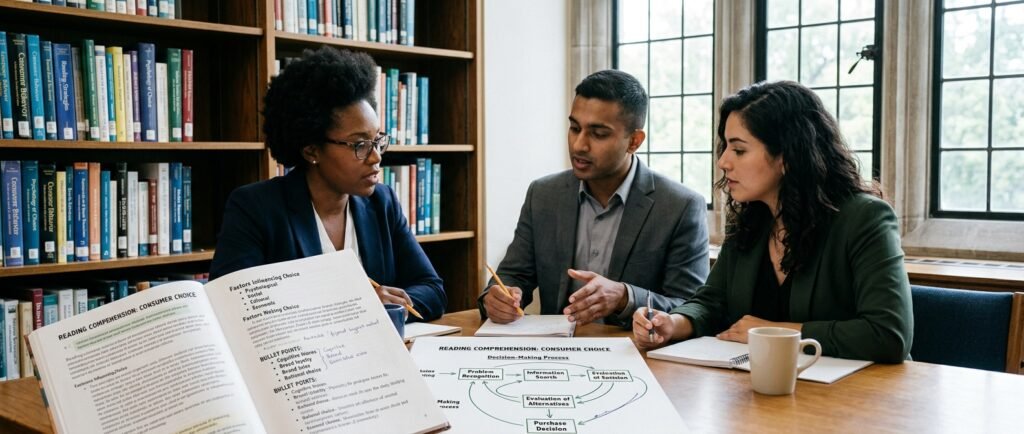
You do not need to read every advanced text slowly from beginning to end. A structured approach can make difficult material more manageable.
First reading: Follow the argument
Read without stopping at every unfamiliar word.
Identify:
- the topic;
- the central argument;
- the writer’s general position.
Do not worry if some details remain unclear.
Second reading: Investigate the language
Return to the text and look more closely at:
- unfamiliar vocabulary;
- contrasts;
- examples;
- words indicating certainty or doubt;
- changes in tone;
- implied meanings.
Ask why the writer chose particular expressions.
Third stage: Test your interpretation
Now move beyond comprehension.
Write two sentences:
What does the writer claim?
What evidence or reasoning supports that claim?
Then identify one point that could reasonably be questioned.
This final step is particularly valuable at C1–C2 because advanced reading is not simply about reaching the “correct” interpretation. It is about developing an interpretation that can be defended with evidence from the text.
How to Make Progress with Reading Comprehension
Continue Your Advanced Reading Practice
For additional practice, learners can explore the British Council’s C1 Reading resources, which include longer, complex texts on a variety of topics, together with preparation activities and comprehension tasks. These materials provide another opportunity to practise reading for detail, understanding unfamiliar vocabulary and developing confidence with advanced English. Explore the British Council’s C1 Reading resources
Regular practice is more effective when you analyse your mistakes rather than simply counting correct answers.
If you misunderstand a vocabulary item, ask whether the surrounding context could have helped you.
If you choose the wrong inference, identify which detail you overlooked.
If you confuse an opinion with a fact, examine how the writer presented the claim.
Teachers can make this process more interactive by asking learners to justify their answers with specific evidence from the passage. Two students may initially have different interpretations, but the important question is whether each interpretation can be supported by the text.
Independent learners can use the same technique by highlighting the sentence or phrase that supports each answer.
Over time, this creates a valuable habit: do not simply ask whether your answer is correct; ask why the text supports it.If you are ready to challenge your reading skills with longer and more demanding texts, explore our collection of Advanced Texts in English: Reading Practice. You will find additional reading materials designed to help advanced learners develop vocabulary, comprehension, inference and critical reading skills through engaging topics and authentic-style texts.
Final Thoughts
Mastering advanced reading requires more than a large vocabulary.
C1–C2 readers need to follow arguments, recognise implied meanings, evaluate evidence and notice how language influences interpretation. They also need to become comfortable with uncertainty: sometimes a sophisticated text deliberately leaves room for more than one reasonable interpretation.
The most effective practice combines careful reading with active questioning.
Predict the direction of an argument. Use context before reaching for a dictionary. Distinguish what the writer states from what the reader infers. Examine tone, evidence and assumptions. Most importantly, support your interpretation with the text itself.
When these habits become part of your regular reading routine, challenging English texts become not only more accessible, but also more intellectually rewarding.
Frequently Asked Questions
What makes a reading comprehension text suitable for C1–C2 learners?
A suitable text presents ideas that require interpretation rather than simple information retrieval. It may contain sophisticated vocabulary, but the real challenge comes from following arguments, recognising implicit meaning, evaluating evidence and understanding the writer’s purpose.
How can I improve my reading comprehension at C1–C2 level?
Read challenging texts regularly and use a structured process. First identify the main argument, then examine vocabulary and details in context. Finally, evaluate the evidence and distinguish the writer’s explicit statements from your own inferences.
What is the difference between an inference and a fact?
A fact is stated directly and can potentially be verified. An inference is a conclusion reached from information in the text. A good inference must be supported by textual evidence.
Why is critical reading important at C1–C2 level?
Advanced readers need to understand not only what a writer says but also how an argument is constructed. Critical reading encourages learners to examine assumptions, evidence, perspectives and alternative interpretations.
How can teachers use advanced reading texts in class?
Teachers can ask students to predict the writer’s position, identify the central argument, analyse tone and vocabulary, discuss implied meanings and justify answers with evidence. Different students can also analyse different aspects of the same text.
How often should I practise reading in English?
Regular, focused practice is more valuable than occasionally reading a very long text. A short but challenging passage can provide substantial practice when learners reread it, analyse the language and reflect on their interpretation.
What types of texts are useful for advanced English learners?
Editorials, analytical articles, essays, opinion pieces and reports can provide useful C1–C2 practice because they often contain arguments, contrasting perspectives and language that requires interpretation.