Introduction
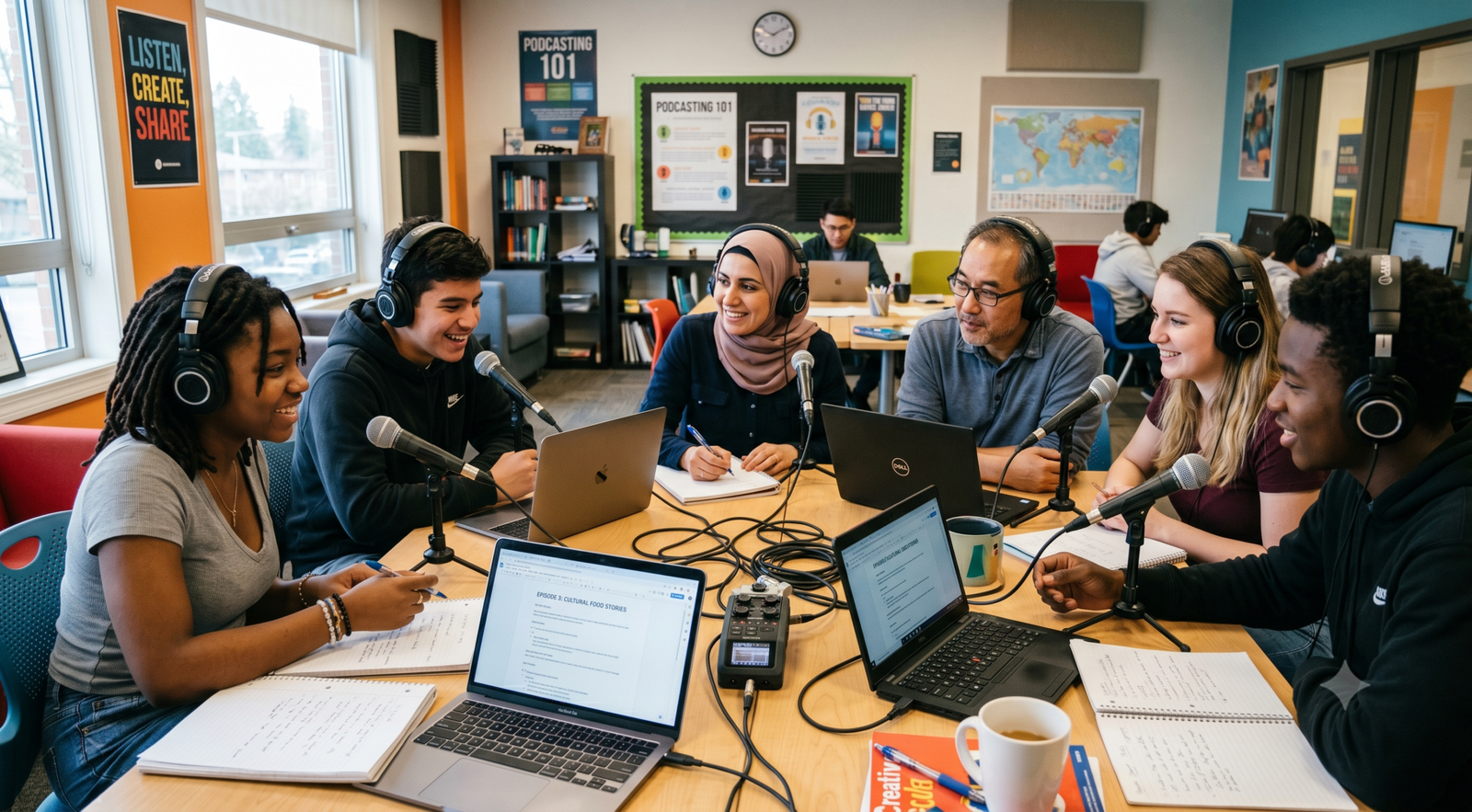
Creating an English Podcast is one of the most engaging ways to help learners use English in a meaningful and authentic context. This project encourages students to communicate ideas clearly, collaborate with classmates, think critically about their chosen topic, and use English for a genuine real-world purpose.
Unlike traditional speaking activities, podcasting gives learners the opportunity to plan, record, edit, and share content with an audience. Throughout the project, students develop confidence in speaking, improve listening skills, and practise the language needed for interviews, discussions, storytelling, and presentations.
Because podcasts are now a major part of modern media, this project also helps learners connect classroom English with contemporary communication practices. To understand how modern media works, access Wikipedia.
Learning Objectives
By completing this project, students will:
- Develop speaking fluency through authentic communication.
- Improve listening comprehension through podcast analysis.
- Build confidence in public speaking and recording.
- Practise research and information-gathering skills.
- Organise ideas effectively for a target audience.
- Use appropriate vocabulary and expressions for discussion.
- Collaborate successfully with peers to create a final product.
Skills Developed
| Skill | How It Is Practised |
|---|---|
| Speaking | Recording episodes, conducting interviews, discussing ideas and presenting information. |
| Listening | Listening to model podcasts, analysing pronunciation, understanding classmates’ recordings. |
| Reading | Researching information, reading articles, gathering facts and checking sources. |
| Writing | Creating podcast scripts, interview questions, show notes and episode outlines. |
Before beginning the project, students can explore authentic listening activities and podcast examples. This is an ideal place to link to your Listening Activities category.
Teachers may wish to review speaking strategies and fluency-building techniques before students record their episodes. This section provides a natural opportunity to link to the Speaking Activities category.
Students often need to read articles and research materials before creating content. Here you can link to your Reading Activities category.
Podcast scripts, episode outlines and interview questions require strong writing skills. This is an excellent location for an internal link to the Writing Activities category.
Recommended Level
| Category | Recommendation |
|---|---|
| CEFR Level | B1–C1 |
| Age Range | 13+ years |
| Group Size | Individual, pairs or groups of 3–5 students |
| Delivery Mode | Face-to-face or online classes |
Materials Needed
Essential Materials
- Smartphones, tablets or computers
- Internet access
- Headphones
- Microphones (optional)
- Note-taking materials
- Podcast planning worksheet
- Audio recording app
- Presentation equipment (if available)
Recommended Digital Tools
- Audacity
- GarageBand
- Anchor/Spotify for Podcasters
- Google Docs
- Canva
Project Overview
In this project, students create their own English-language podcast episode based on a topic of interest. They research information, plan their content, write key notes or scripts, record the episode, and present it to classmates.
Possible podcast topics include:
- Travel experiences
- Current events
- Environmental issues
- Sports
- Technology
- Book reviews
- Film reviews
- Study tips
- Local culture
- Personal interests
The final product can be a short 5–10 minute podcast episode.
Step-by-Step Instructions
Stage 1 – Preparation
Introduce students to the concept of podcasts.
Play short examples from different genres such as interviews, discussions, storytelling podcasts and educational programmes.
Discuss:
- Who is the audience?
- What makes a podcast interesting?
- How do presenters engage listeners?
Encourage students to identify effective communication techniques.
Stage 2 – Research
Students choose a topic and gather information from reliable sources.
They should:
- Read articles
- Watch videos
- Listen to related podcasts
- Take organised notes
Encourage learners to verify information and consider multiple perspectives.
This stage helps develop critical thinking and research skills.
Stage 3 – Planning
Students organise their ideas into a clear structure.
Suggested podcast structure:
| Section | Content |
|---|---|
| Introduction | Welcome and topic introduction |
| Main Segment | Discussion or presentation |
| Interview | Optional guest questions |
| Conclusion | Summary and closing remarks |
Students should create:
- A title
- Episode outline
- Key talking points
- Questions for interviews
Stage 4 – Creation
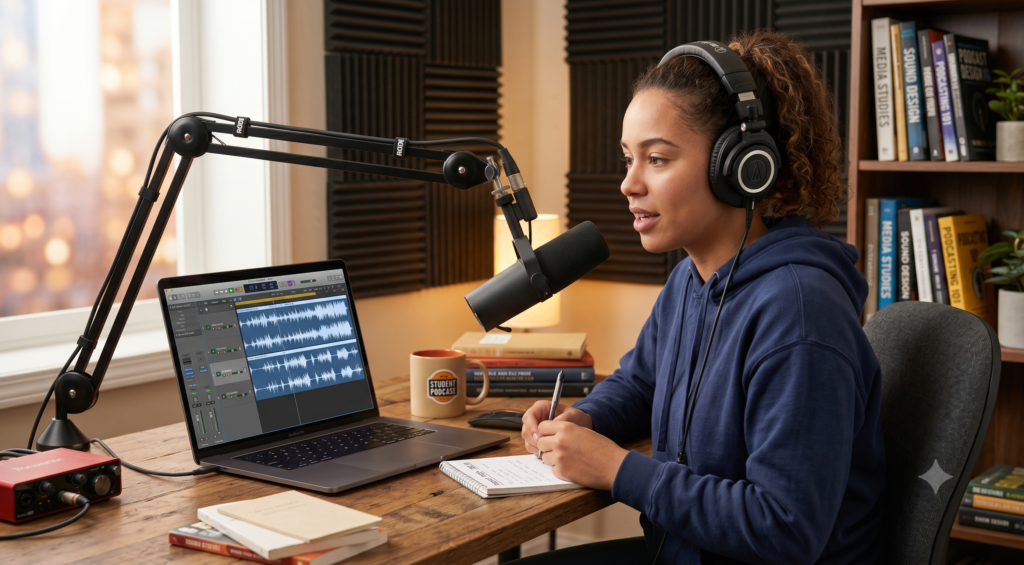
Students record their podcast.
Encourage them to focus on:
- Clear pronunciation
- Natural intonation
- Appropriate pace
- Audience engagement
Remind students that a podcast should sound conversational rather than simply reading a script.
Language Development Opportunity
While preparing their episodes, students may need to use linking words and connectors to connect ideas, introduce contrasting points, give reasons, add information, and guide listeners through their arguments. Reviewing these language structures before recording can help students make their podcasts more coherent and natural. For further practice, explore this grammar resource on linking words and connectors at MyESLFriends.
Stage 5 – Presentation
Students share their podcast with the class.
Possible presentation formats:
- Classroom listening session
- Podcast showcase event
- Online classroom platform
- Peer review activity
Classmates listen actively and provide constructive feedback.
Stage 6 – Reflection
After presenting, students reflect on:
- What went well
- Challenges they faced
- New vocabulary learned
- Speaking improvements
- Listening improvements
Reflection can be completed individually or in groups.
Video
- Planning an episode
- Writing notes
- Recording techniques
- Microphone tips
- Editing basics
- Publishing a podcast
This video provides practical support before students begin recording.
Language Focus
Useful Vocabulary
| Word | Meaning |
|---|---|
| Audience | The people who listen |
| Episode | One podcast recording |
| Host | The presenter |
| Guest | A person invited to speak |
| Script | Written speaking notes |
| Recording | Captured audio |
| Interview | A structured conversation |
| Broadcast | To share audio publicly |
Key Expressions
- Welcome to our podcast.
- Today we’re discussing…
- Let’s move on to our next topic.
- That’s an interesting point.
- What do you think about…?
- Thank you for joining us.
- Thanks for listening.
Communication Phrases
Asking Questions
- Could you tell us more about that?
- What inspired you to…?
- How would you describe…?
Giving Opinions
- In my opinion…
- I strongly believe…
- From my perspective…
Agreeing
- I completely agree.
- That’s a good point.
- I think you’re right.
Disagreeing Politely
- I understand your point, however…
- That’s an interesting view, but…
- I see it differently because…
Assessment Ideas
Assess students using the following criteria:
- Language accuracy
- Pronunciation
- Fluency
- Creativity
- Organisation
- Content quality
- Teamwork
- Research skills
- Presentation skills
- Audience engagement
Sample Rubric
| Criteria | Excellent | Good | Developing |
|---|---|---|---|
| Fluency | Consistently natural | Mostly smooth | Frequent hesitation |
| Accuracy | Very few errors | Some errors | Many errors |
| Organisation | Very clear structure | Mostly organised | Limited organisation |
| Creativity | Highly engaging | Interesting | Basic |
Extension Activities
1. Podcast Series
Students create multiple episodes throughout the term.
2. Interview Project
Invite teachers, parents or community members as guests.
3. International Podcast Exchange
Collaborate with learners from another school or country.
4. Podcast Reviews
Students listen to classmates’ podcasts and write reviews.
5. Video Podcast Version
Transform the audio podcast into a video podcast presentation.
Teacher Tips
- Model a short podcast before starting.
- Keep episode lengths manageable.
- Allow rehearsal time before recording.
- Focus on communication rather than perfection.
- Use peer feedback throughout the process.
- Provide language support sheets.
- Encourage creativity and topic choice.
Online Teaching Tip
Use breakout rooms for planning and recording stages.
Common Challenges and Solutions
| Challenge | Solution |
|---|---|
| Students are nervous about recording | Begin with short speaking tasks |
| Limited technology access | Use smartphones for recording |
| Over-reliance on scripts | Encourage note cards instead |
| Unequal participation | Assign clear group roles |
| Poor audio quality | Record in quiet locations |
| Lack of ideas | Provide topic suggestions |
Conclusion
The English Podcast Project combines speaking, listening, reading and writing in a highly authentic learning experience. By creating content for a real audience, students gain confidence, improve fluency and develop valuable communication skills that extend far beyond the classroom.
Whether delivered in a traditional classroom, a language school or an online learning environment, podcast creation provides meaningful opportunities for collaboration, critical thinking and real-world English use. It is a flexible project that can be adapted to different ages, proficiency levels and interests while keeping learners actively engaged in the language-learning process.
Free PDF Resource
To make classroom implementation even easier, we’ve created a printable English Podcast Project worksheet. The PDF includes planning templates, research notes, vocabulary sections, presentation support, and a self-assessment checklist to guide students through every stage of the project.
Download the free PDF and start creating podcasts with your learners today.
🎓 Join Our Free English Teaching Community
Would you like more ready-to-use classroom resources?
Join our free WhatsApp community to receive:
- ✅ Answer Keys
- ✅ Printable classroom materials
- ✅ New listening and dictation lessons
- ✅ Teaching ideas for B2–C2 learners
- ✅ Updates from MyEnglandBlog
👉 Join our free WhatsApp Community here: https://chat.whatsapp.com/Kfpriy6R30qDRntLEDsqH5?
FAQs
1. How long should the podcast be?
A length of 5–10 minutes is ideal for most learners.
2. Can students work individually in a Podcast Project?
Yes. The project works well individually, in pairs or in small groups.
3. Do students need professional equipment to make a Podcast Project?
No. Most smartphones provide adequate recording quality.
4. Can a Podcast Project be used online?
Absolutely. Students can collaborate and share recordings through online platforms.
This printable resource is designed to support both face-to-face and online lessons, making project management simple while encouraging meaningful communication in English.
ENGLISH PODCAST PROJECT
Student Name: __________________________
Class: __________________________
Date: __________________________
Project Instructions
Create an English-language podcast episode on a topic of your choice.
Your podcast should:
- Be informative and engaging
- Include clear organisation
- Use appropriate vocabulary
- Demonstrate good pronunciation
- Show evidence of research
Task Checklist
□ Choose a topic
□ Conduct research
□ Take notes
□ Plan the episode structure
□ Prepare questions (if interviewing)
□ Practise speaking
□ Record the episode
□ Review and edit
□ Present the podcast
□ Complete reflection
Research Notes
Topic:
Useful Sources:
Important Information:
Vocabulary Notes
| New Word | Meaning | Example Sentence |
Project Planning
Podcast Title:
Introduction:
Main Ideas:
Conclusion:
Presentation Notes
Important Speaking Points:
Self-Assessment Checklist
| Statement | Yes | Not Yet |
| I researched my topic carefully | □ | □ |
| I used appropriate vocabulary | □ | □ |
| I spoke clearly and confidently | □ | □ |
| I organised my ideas effectively | □ | □ |
| I worked well with others | □ | □ |
| I listened respectfully to feedback | □ | □ |
| I completed all project tasks | □ | □ |
myenglandblog.com